
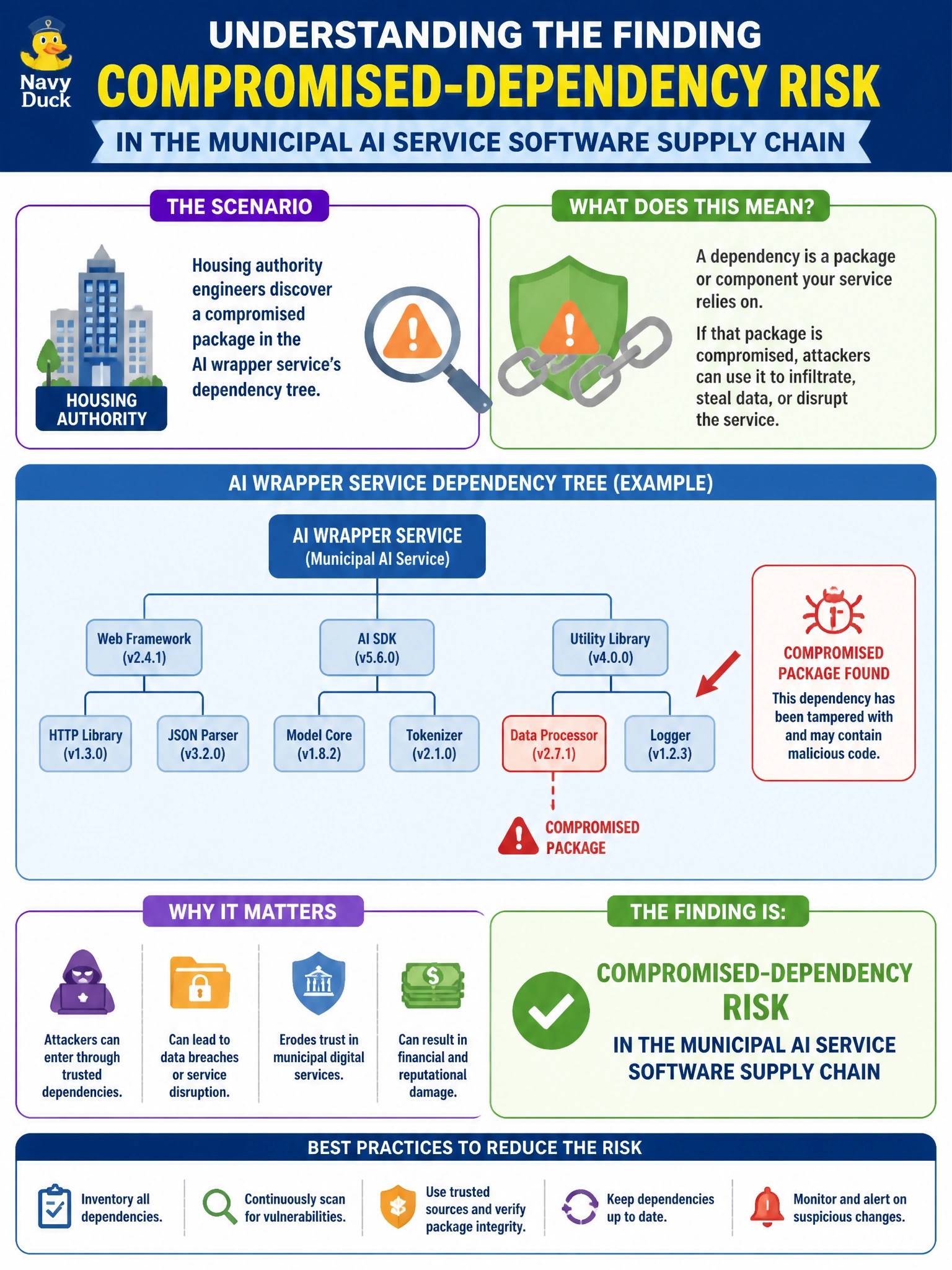
Housing authority engineers discover a compromised package in the AI wrapper service's dependency tree. What supply-chain finding is that?
Select an answer to reveal the explanation.
Short Explanation
A poisoned package in the wrapper tree is classic supply-chain compromise—trust broke upstream. Audit deps; a stale SBOM inventory for dependency version records won't help.
Full Explanation
A compromised package in the housing authority AI wrapper’s dependency tree is a classic software supply-chain finding: malicious or tampered code enters the municipal service without any change to first-party application source. Offensive and assurance reviews treat tainted transitive dependencies as high-severity because build systems will faithfully package and deploy the payload into production wrappers that handle housing cases, PII, or eligibility logic. Correct remediation language centers on pin-and-verify controls, lockfiles, reproducible builds, vulnerability scanning of the dependency graph, and rebuild from known-good artifacts after removing the compromised package.
Stale SBOM inventory for municipal AI service wrapper dependency version records describes outdated record-keeping, not the discovery of an actual compromised package. Incomplete build provenance attestation for municipal AI service release pipeline artifacts describes a provenance-attestation gap, not the finding itself. A vulnerable container base image used in municipal AI service deployment environment describes a deployment-layer exposure, but none of these three identifies the compromised package that engineers already found in the dependency tree — they describe process weaknesses that could let one slip through, not the compromise itself.
Exam caveat: compromise may appear only in a transitive dependency version bump or in a typosquatted package that resolved during an unpinned install—relying on a stale SBOM inventory for dependency version records is incomplete. Operational check: generate an SBOM for the wrapper image, diff lockfile hashes against a known-good build, quarantine the tainted package, rebuild from verified sources, and redeploy only after CI fails on unsigned or unscanned dependency changes.