
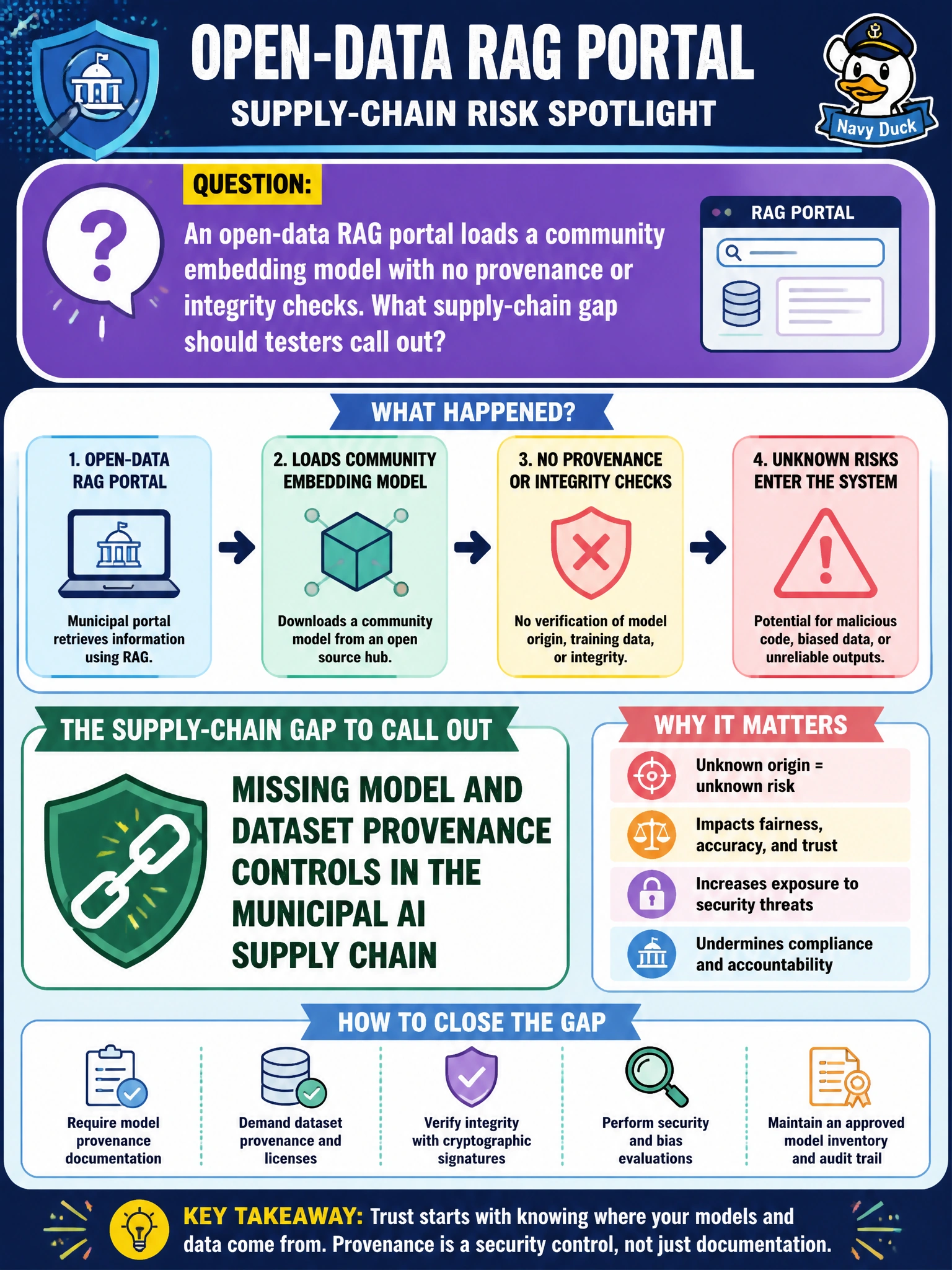
An open-data RAG portal loads a community embedding model with no provenance or integrity checks. What supply-chain gap should testers call out?
Select an answer to reveal the explanation.
Short Explanation
Grabbing a mystery embedding model is like stocking the kitchen from an unmarked box. Provenance first; logging alone isn't enough.
Full Explanation
Loading a community embedding model into an open-data RAG portal without provenance or integrity checks leaves the municipal AI supply chain unverified. Embedding models and their training or fine-tuning datasets can be tampered with to bias retrieval, inject poisoned vectors, or introduce licensing violations that later block public release. Assessments correctly call out missing model and dataset provenance: signed artifacts, known publishers, checksum verification, and documented lineage before any civic RAG index is built. Without those controls, the portal cannot assure residents or auditors that retrieval grounding came from trustworthy components.
Logging model loads without hash verification describes an incomplete control, not the full absence of provenance checks the testers found. Free-text provenance notes instead of structured metadata describe a documentation-quality problem, not a substitute for missing checks entirely. Using inference-time confidence as a proxy for training-data integrity is a flawed technical shortcut unrelated to verifying lineage before load. None of these three names the actual gap: no provenance or integrity checks were performed at all.
Exam caveat: popularity on a public hub is not provenance—mirrors and forks can diverge silently from the advertised card, and licensing gaps can appear even when hashes match if documentation is incomplete. Operational check: record publisher, version, license, and hash for the embedding artifact in the city’s model registry; verify signature or checksum at pull time; refuse unsigned community models in the open-data pipeline; and re-index only after the approved artifact passes integrity gates.