
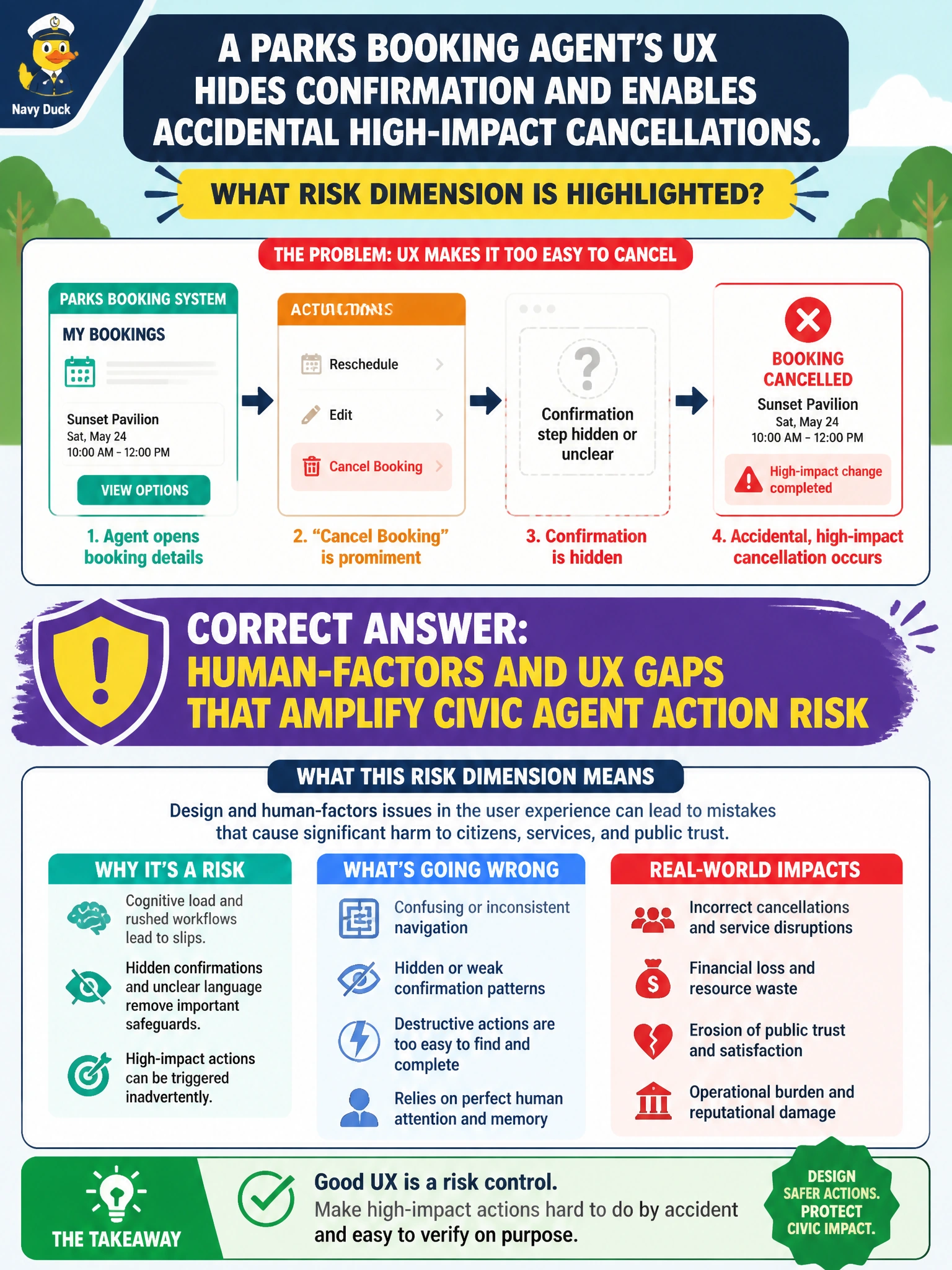
A parks booking agent's UX hides confirmation and enables accidental high-impact cancellations. What risk dimension is highlighted?
Select an answer to reveal the explanation.
Short Explanation
Hidden confirmations are like a trapdoor under the cancel button—you’re looking at UX that amplifies agent risk. Fix the human factors, not model hallucinations of park rules in booking summaries.
Full Explanation
A parks booking agent's UX that hides confirmation and enables accidental high-impact cancellations highlights human-factors and UX gaps that amplify civic agent action risk. Powerful tools behind a chat or admin surface become accidental weapons when confirmations are absent, buried, or worded so staff and residents cannot foresee irreversible outcomes such as mass reservation cancellations. Offensive and assurance reviews should treat misleading UX as part of the agent risk surface because it raises the likelihood of integrity failures without any sophisticated attack technique. Model hallucination of park rules when generating booking summaries, testing only expected inputs, or prompt tampering that redirects booking agent tool invocations do not reduce accidental cancellation risk and are unrelated to action-safety design. Exam distractors emphasize model hallucinations of park rules while the correct dimension is human factors amplifying agent actions. Caveat: adding friction to every micro-read creates abandonment and shadow processes; apply stronger confirmation patterns to high-impact, irreversible, or multi-party actions such as bulk cancellations or fee forfeitures. Operational check: walk the cancellation path with a usability probe, confirm a clear preview of affected bookings appears before commit, and verify the privileged API cannot fire without an explicit, logged confirmation step.