
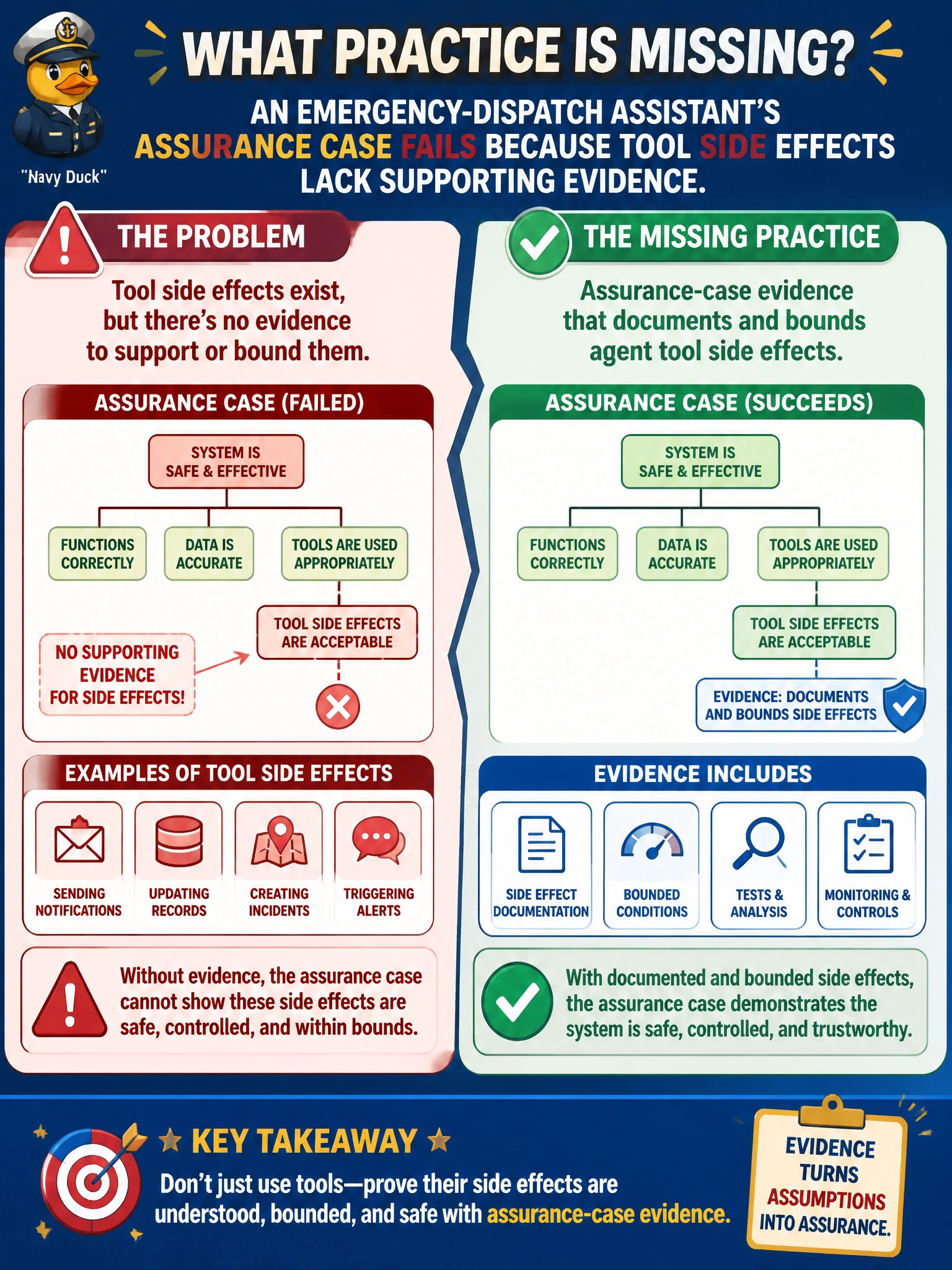
An emergency-dispatch assistant's assurance case fails because tool side effects lack supporting evidence. What practice is missing?
Select an answer to reveal the explanation.
Short Explanation
If you can't show evidence for what a tool might kick off, the assurance case falls over. Bound those side effects on paper—a comms drill or a latency benchmark won't help.
Full Explanation
When an emergency-dispatch assistant's assurance case fails because tool side effects lack supporting evidence, the missing practice is assurance-case evidence that documents and bounds agent tool side effects. Assurance cases for civic agents must show what each tool can change in the real world—notifications, unit recommendations, computer-aided dispatch updates, or status writes—and how those effects are bounded, monitored, and rolled back when wrong. Without that evidence, reviewers cannot claim residual risk is acceptable for life-safety-adjacent assistants even if model benchmarks and demo transcripts look strong. The failure mode is incomplete assurance artifacts, not décor or morale purchases around the emergency operations center. A communication-only tabletop exercise, keeping design details secret from competitors, or benchmarking response latency do not substitute for side-effect evidence packages tied to each tool. Exam questions distinguish decorative EOC culture from assurance artifacts; pick documented bounds on tool side effects. Caveat: evidence must stay current as tools gain new parameters or backends; stale diagrams that omit a newly added write API invalidate the case until refreshed and re-reviewed. Operational check: for each dispatch-adjacent tool, require a dated evidence item listing side effects, maximum blast radius, monitoring signals, and a failed-call experiment proving the bound holds under misuse prompts.