
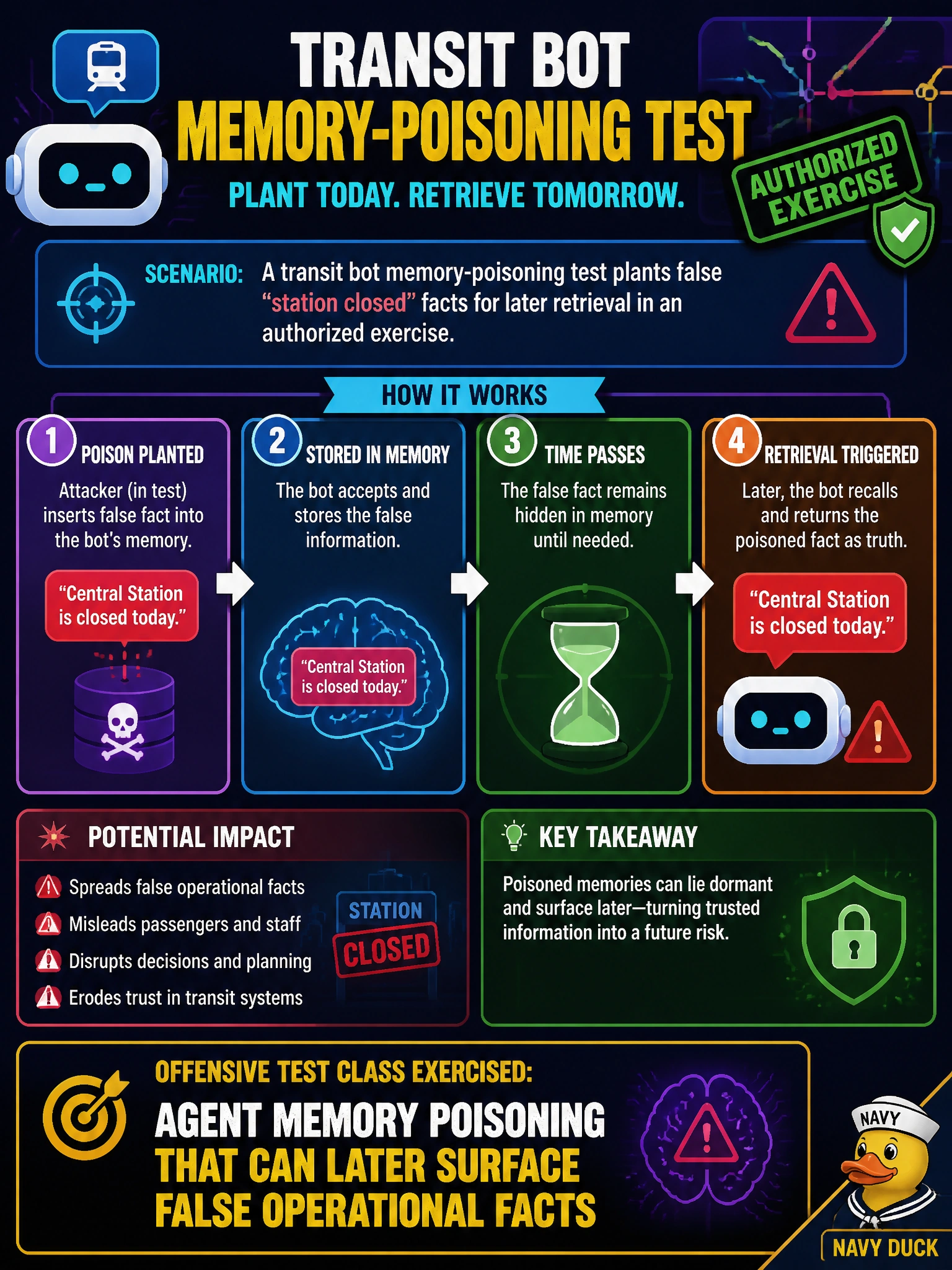
A transit bot memory-poisoning test plants false 'station closed' facts for later retrieval in an authorized exercise. What offensive test class is being exercised?
Select an answer to reveal the explanation.
Short Explanation
Plant a fake 'station closed' in memory and see if it comes back later—that's memory poisoning as a test class. You're proving the bot can be taught a lie, then hardening recall—not installing a keyword backdoor that hands out free fares.
Full Explanation
An authorized transit bot memory-poisoning test that plants false 'station closed' facts for later retrieval exercises the offensive test class of agent memory poisoning that can later surface false operational facts. The technique class proves whether adversaries can write lasting lies into memory that subsequent turns present as operational truth, harming rider trust and transit decisions. Correct framing is memory integrity T&E followed by hardening of write policies and recall verification. Agent prompt injection that rewrites live trip instructions in this session targets the live conversation rather than durable memory writes that let a false closure fact be recalled later. Agent tool abuse that forces unscheduled service alerts through dispatch APIs abuses external alerting channels instead of planting false memory entries the bot can later present as truth. Agent backdoor that triggers hidden free-fare commands on a keyword installs a concealed command trigger, which is unrelated to teaching the bot to recall a fabricated station closure. Exam caveat: authorized exercises plant and detect false facts under controlled conditions; reports describe the class and impact without providing a playbook for disrupting live transit communications. Operational check: restrict who or what can write to long-term memory, require corroboration from authoritative transit feeds before recalling closure facts, expire unverified memory entries, alert on conflicts with official status APIs, and retest poisoning attempts after controls.