
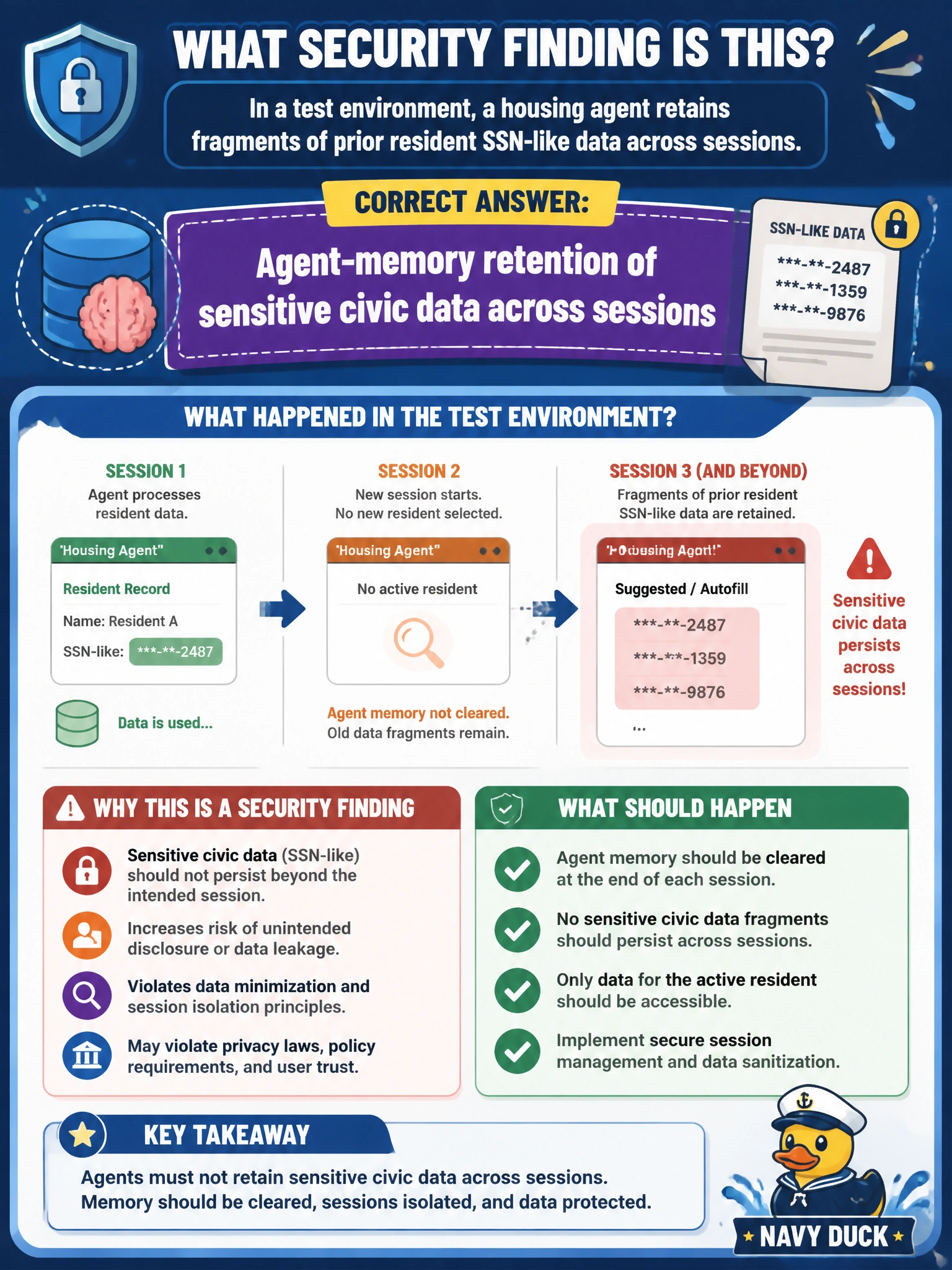
In a test environment, a housing agent retains fragments of prior resident SSN-like data across sessions. What security finding is that?
Select an answer to reveal the explanation.
Short Explanation
If yesterday's sensitive digits show up in today's chat memory, the agent is hanging onto the wrong leftovers. That's cross-session sensitive-data retention—clear it and lock memory down.
Full Explanation
In a test environment, a housing agent that retains fragments of prior resident SSN-like data across sessions presents an agent-memory retention finding for sensitive civic data. Memory features without strong isolation, TTL, and redaction can leak identifiers into later conversations with different users or contexts, creating privacy and compliance exposure in housing and benefits workflows. Correct classification drives memory hygiene controls appropriate to high-sensitivity resident data handled by municipal agents. Ephemeral buffering of anonymized eligibility notes within a session is a transient, single-session control, not cross-session retention of sensitive identifiers. Audit logging of redacted inquiry metadata for compliance review is an accountability record, not agent memory carrying prior resident fragments between conversations. Rate limiting of repeated eligibility checks from a test account is a throttling control, not sensitive data leakage across agent sessions. Exam caveat: even test-environment SSN-like fixtures demonstrate the retention class; production would amplify privacy impact under real resident identifiers and records rules. Operational check: enforce per-session or per-tenant memory isolation, redact government identifiers before persistence, set short TTLs for agent memory, purge between test cases, disable cross-user recall by default, and verify a new session cannot surface prior resident-sensitive fragments when probing the housing agent under authorization.