
A city SOC builds a framework that scores LLM output-handling failures by resident-service impact. What capability does that represent?
Select an answer to reveal the explanation.
Short Explanation
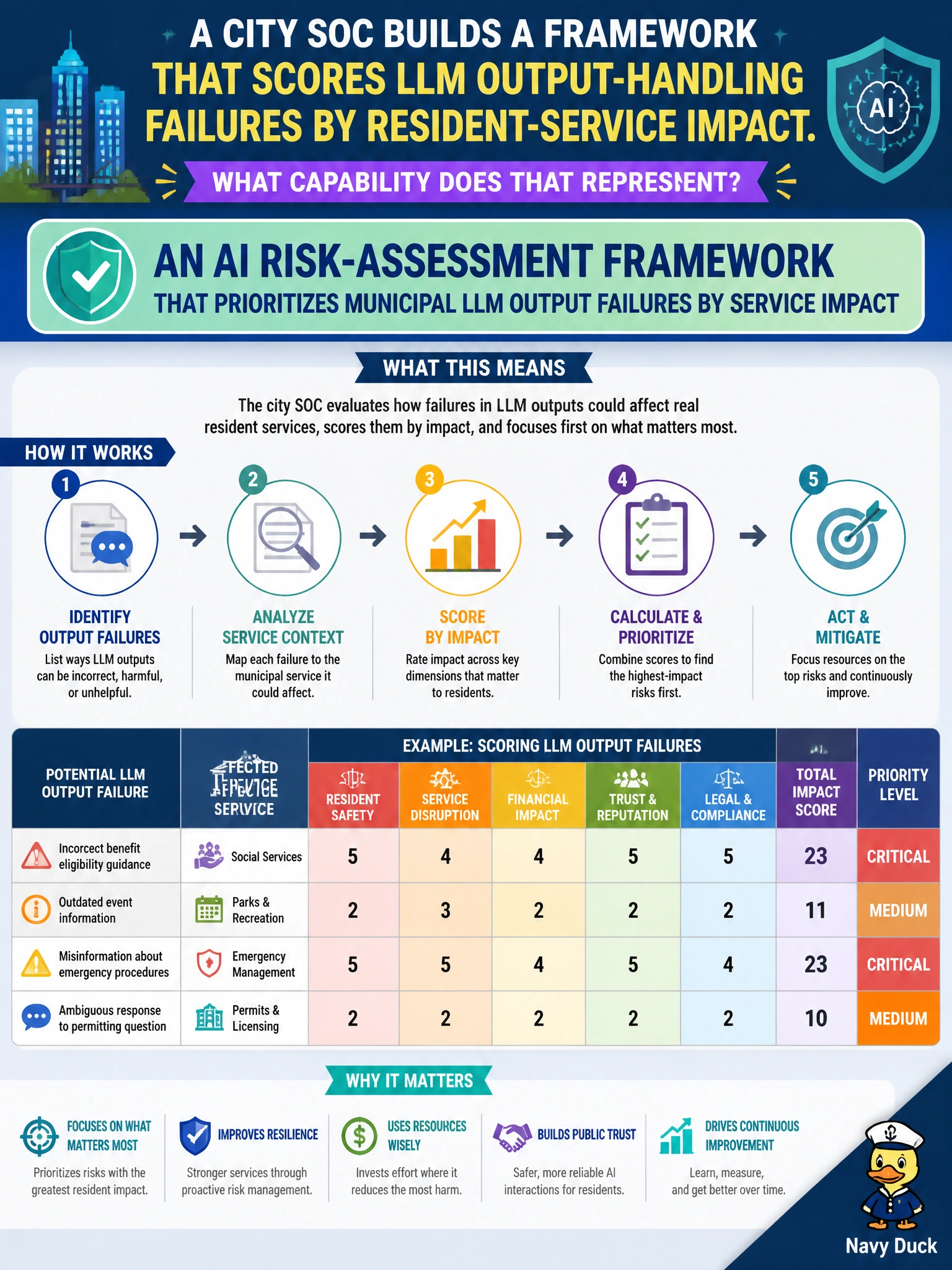
Scoring 'how bad is this bad output for residents?' is an AI risk-assessment framework with civic priorities baked in. A logging repository and a red-team exercise don't score resident impact or harden the 311 stack. A content-filtering block is just prevention, not the impact-scoring framework you need.
Full Explanation
A city SOC framework that scores LLM output-handling failures by resident-service impact represents an AI risk-assessment capability that prioritizes municipal LLM failures according to how they affect city services. Technical bugs become ranked work when scored against resident harm, service downtime, misinformation reach, and recovery cost, so limited SOC capacity goes to the failures that matter most for civic operations. Correct capability design aligns SOC and CISO prioritization with civic outcomes rather than treating all model mistakes as equal. A content-filtering control that blocks disallowed municipal LLM outputs before automated resident delivery is a preventive control, not an AI risk-assessment framework that scores output-handling failures by resident-service impact. A logging repository that retains municipal LLM prompts and outputs for compliance review merely stores records; it does not score failures by service impact or direct limited SOC capacity to the highest-impact resident harms. A red-team exercise that probes municipal LLM prompts for jailbreak techniques before planned deployment finds vulnerabilities but does not prioritize LLM output failures according to resident-service impact. Exam caveat: frameworks should use transparent scoring criteria tied to named municipal services; opaque 'AI mystery' scores without service linkage fail the same exam objective. Operational check: define impact rubrics for 311, transit, health, and permitting bots, score recent output-handling findings against those rubrics, review rankings with service owners each cycle, and verify remediation queues follow the framework rather than only engineering preference or ticket age.