
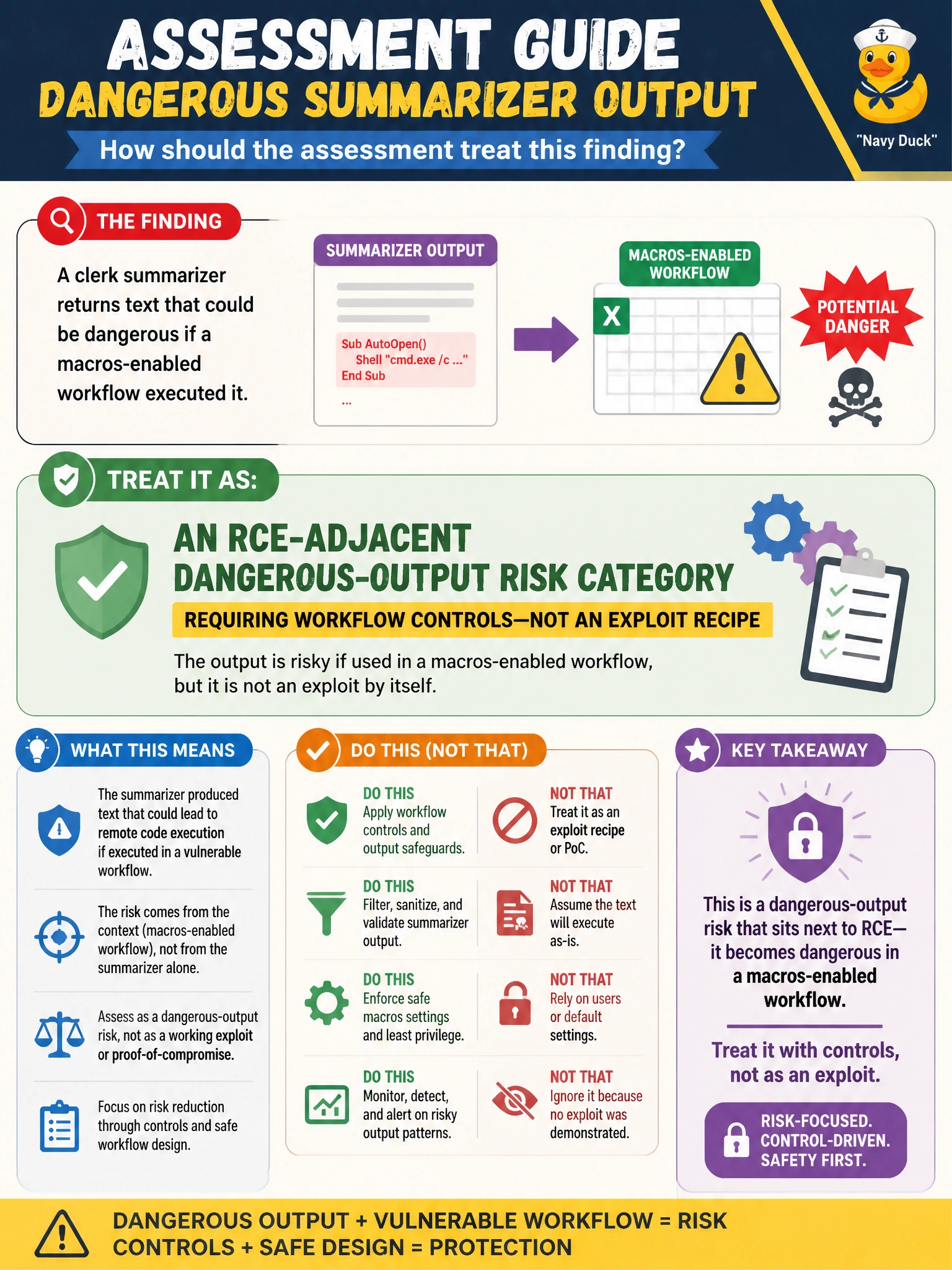
A clerk summarizer returns text that could be dangerous if a macros-enabled workflow executed it. How should the assessment treat that finding?
Select an answer to reveal the explanation.
Short Explanation
Dangerous-looking model text next to a macros workflow is an RCE-adjacent risk category—fix the plumbing, don't hand out a how-to. Civic defense means controls, not recipes.
Full Explanation
When a clerk summarizer returns text that could be dangerous if a macros-enabled workflow executed it, COASP-aligned assessment treats the issue as an RCE-adjacent dangerous-output risk category requiring workflow controls—not as an exploit recipe to share. The point is to harden the path between generative text and executable civic workflows (macros, scripts, automation) so model output cannot become unintended code execution. Correct handling emphasizes containment and process design over publishing dangerous snippets. Classifying it as a prompt-injection input-handling gap requiring hardened system instructions and strict upstream filtering mistakes the vector; the risk is dangerous summarizer output reaching an executable macros workflow, not malicious input bypassing system instructions. Treating it as a content-accuracy quality issue requiring scheduled retraining on historical clerk correspondence archives overlooks the execution hazard; the output is active content near a macros-enabled pipeline, not merely inaccurate text. Addressing it as a user-awareness training need requiring updated guidance on reviewing summarizer outputs carefully is insufficient; the finding calls for workflow controls that block automatic execution, not only reviewer caution. Exam caveat: 'RCE-adjacent' describes category and consequence potential when outputs meet executable pipelines; it is not a claim that every summarizer string is a working remote exploit. Operational check: disable automatic execution of model output in macros-enabled clerk tools, sandbox or strip active content, require explicit human promotion before any scripted action, scan summarizer outputs for high-risk patterns, and document residual risk until those controls are verified.