
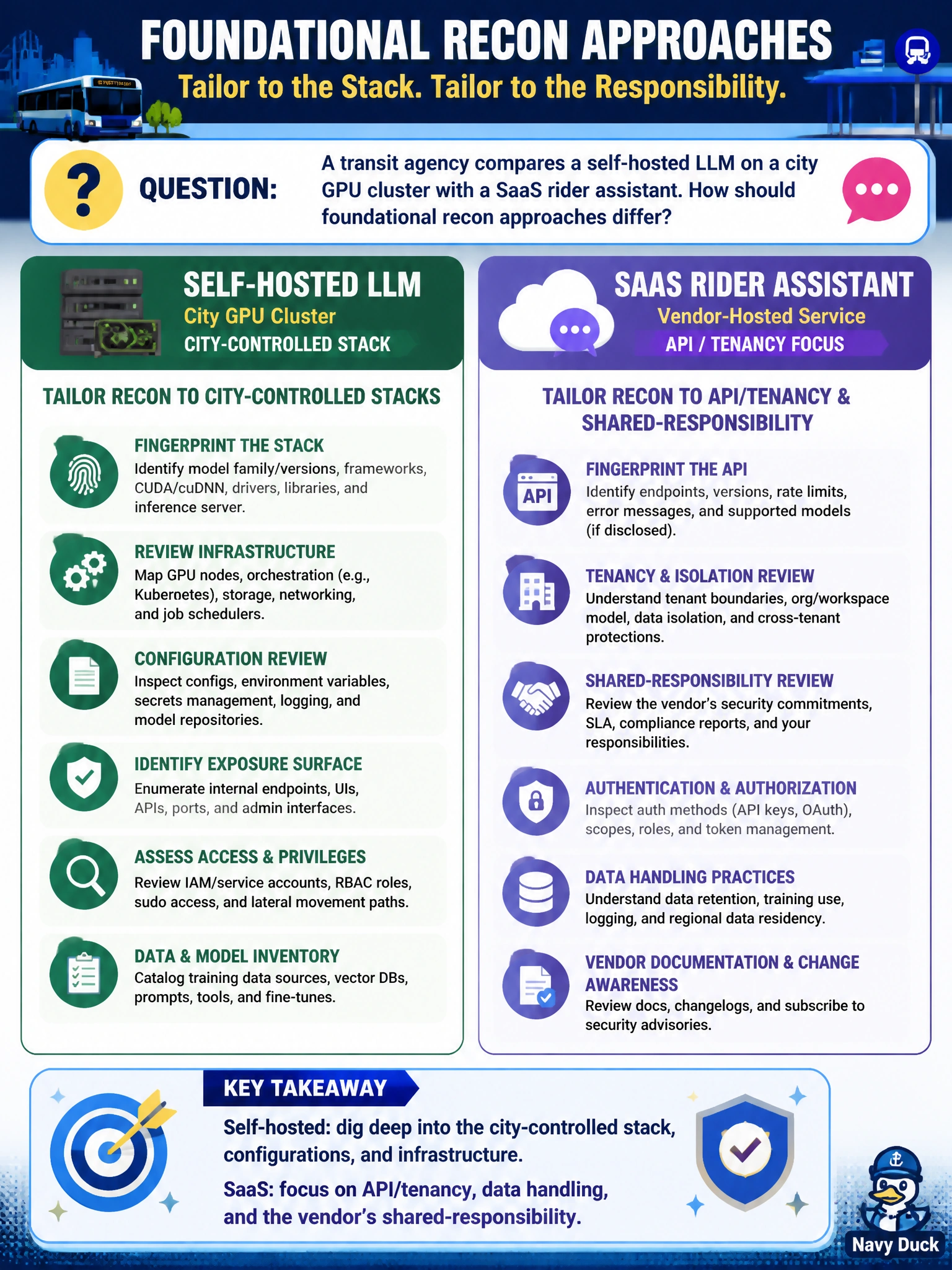
A transit agency compares a self-hosted LLM on a city GPU cluster with a SaaS rider assistant. How should foundational recon approaches differ?
Select an answer to reveal the explanation.
Short Explanation
Self-hosted means you can inspect the city’s own GPU kitchen; SaaS means you study the menu, APIs, and lease terms. Same hunger for attack-surface truth—different cupboards you’re allowed to open.
Full Explanation
Foundational recon for a transit LLM differs by deployment. Self-hosted on a city GPU cluster exposes infrastructure, configs, and local model serving for authorized review. SaaS rider assistants emphasize API behavior, tenancy isolation, vendor logging, and contractual shared responsibility. Offensive AI planning selects fingerprinting and configuration techniques that match those boundaries and rules of engagement. Ignoring model or tool behavior in either case leaves critical surfaces unmapped.
Prioritizing vendor IAM policy and data tenancy review for self-hosted while pushing GPU host hardening onto SaaS reverses ownership boundaries—the city controls its own GPU stack, while SaaS recon belongs at the API/tenancy layer under the vendor’s shared responsibility. Applying matching model registry and tool integration checklists to both deployments based only on shared feature sets ignores the required deployment split—self-hosted recon must target city-controlled GPU stacks and configs, while SaaS recon targets API behavior, tenancy, and vendor terms under different rules of engagement. Treating internal DNS and network fingerprinting as merely secondary context does not address the actual dichotomy the question asks about—tailoring technique to self-hosted infrastructure review versus SaaS API/tenancy review—so it misses the required recon distinction even though DNS data has some baseline value.
Exam caveat: tailor recon to self-hosted stack versus SaaS API/tenancy; swapping vendor IAM/tenancy for self-hosted and GPU host hardening for SaaS is wrong, as is DNS-only tunnel vision. Operational check: for self-hosted, review city GPU serving configs under charter; for SaaS, review API docs, tenancy, logging, and contract assessment clauses; include model/tool behavior probes in both within RoE.