
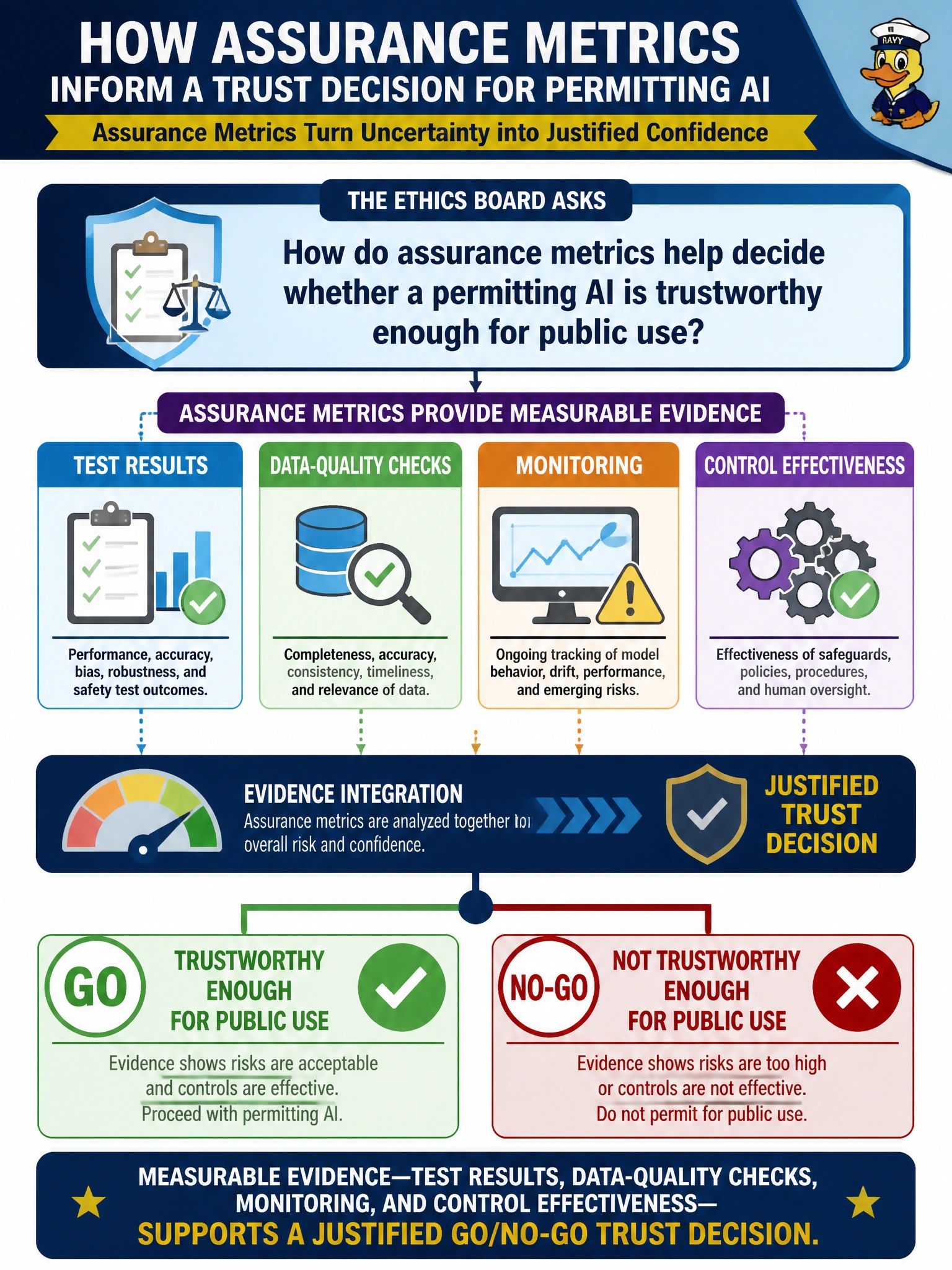
An ethics board asks how assurance metrics help decide whether a permitting AI is trustworthy enough for public use. What is the best foundational answer?
Select an answer to reveal the explanation.
Short Explanation
Trust isn’t a vibe—it’s a scoreboard of tests, data checks, and monitoring that say the permitting AI behaves well enough for residents. You should ask for that evidence, not just transparency artifacts like model cards and datasheets that don't prove the system is trustworthy.
Full Explanation
Assurance metrics help an ethics board decide whether a permitting AI is trustworthy enough for public use by supplying measurable evidence: authorized test results, data-quality checks, monitoring effectiveness, and control performance. Those measures support a justified go/no-go trust decision tied to mission risk rather than vanity statistics. Foundations of offensive AI security connect red-team findings and operational signals to civic trustworthiness claims before residents rely on the system.
Pointing to development indicators such as training accuracy, inference latency, and release velocity does not substitute for assurance evidence, because performance metrics alone do not establish safety or control effectiveness for a permitting decision. Treating transparency artifacts such as model cards, datasheets, and architecture diagrams as formal verification confuses documentation with the measurable evidence needed to justify public trustworthiness. Relying on aggregated user satisfaction scores, adoption rates, and stakeholder feedback as justification for continued public operation mistakes popularity for assurance evidence and leaves permitting risk unmeasured.
Exam caveat: trust decisions need measurable assurance evidence—not development indicators, transparency artifacts, or satisfaction and adoption metrics. Operational check: present the board with red-team summaries, curation quality metrics, bias/safety evals, and monitoring SLOs; record residual risk and oversight; require explicit go/no-go before public permitting use.