
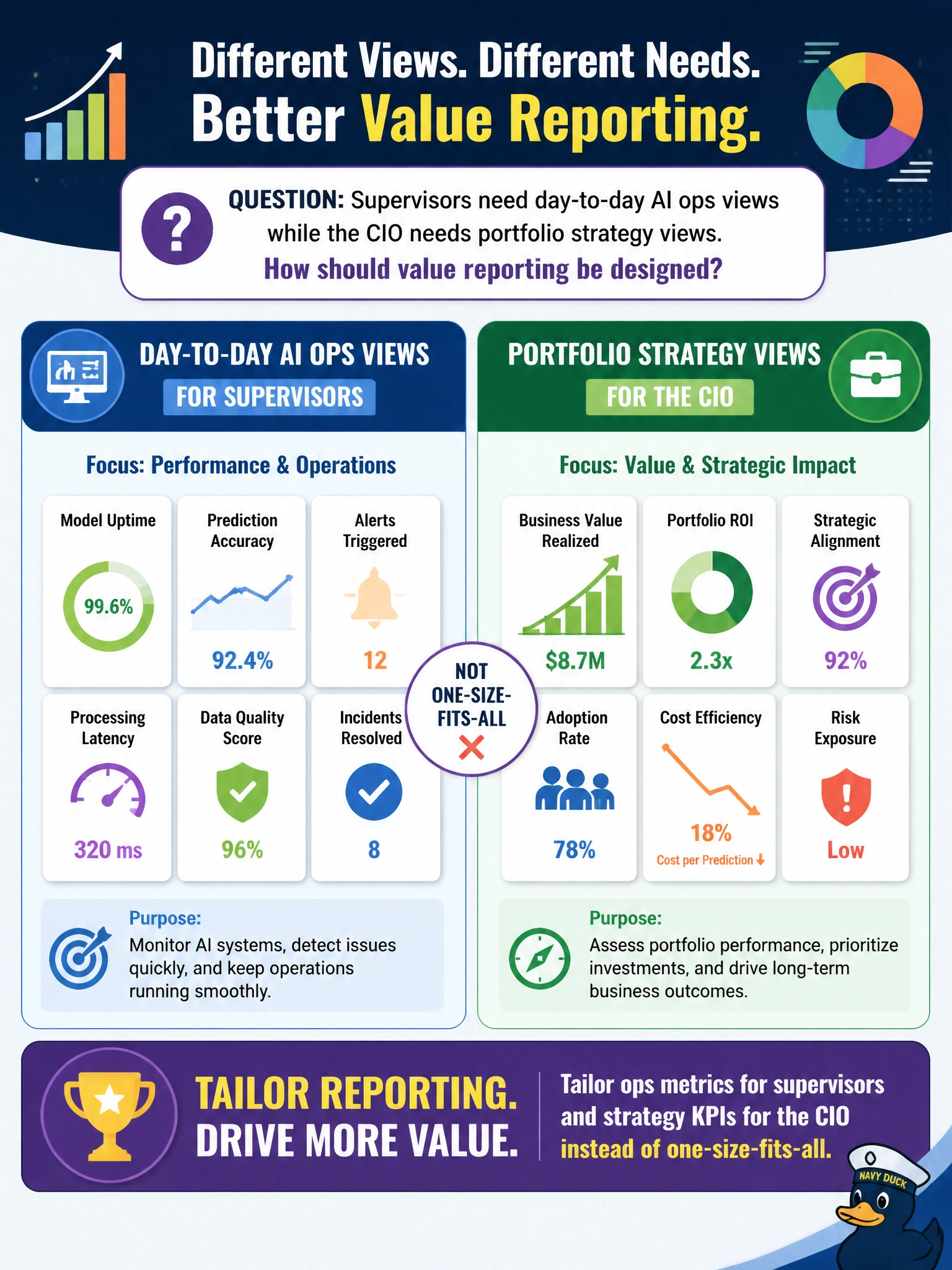
Supervisors need day-to-day AI ops views while the CIO needs portfolio strategy views. How should value reporting be designed?
Select an answer to reveal the explanation.
Short Explanation
Same airport, different instruments—tower wants runway status; the CEO wants the network map. Build supervisor ops views and CIO strategy views separately so each can fly their altitude.
Full Explanation
Value reporting for municipal AI should be tailored: supervisors need day-to-day AI ops views while the CIO needs portfolio strategy views, not one identical pack for every altitude. Frontline supervisors manage queues, quality samples, escalations, and staffing impacts; the CIO steers investment, risk posture, and alignment to the published city AI strategy. Designing both views from shared underlying data preserves consistency without forcing the wrong grain on either audience. Shipping one identical dashboard to every audience to reduce report sprawl fails because aggregation that satisfies executives hides the operational signals supervisors need, and ticket-level detail overwhelms strategy review. Giving supervisors only annual strategy slides and the CIO only ticket queues fails by inverting information needs—neither role can govern at its decision cadence. Stopping operational dashboards once an executive strategy pack exists fails because strategy without live ops visibility cannot detect adoption collapse, quality drift, or fairness problems between council cycles. Exam caveat: "standardize reporting" distractors sound efficient but ignore stakeholder-fit as a core program-management principle. Operational check: define two civic reporting products from one metric warehouse—supervisor ops tiles (throughput, quality sample status, open exceptions) and CIO strategy KPIs (portfolio value, risk exceptions, roadmap health)—and refresh each on its own cadence.