
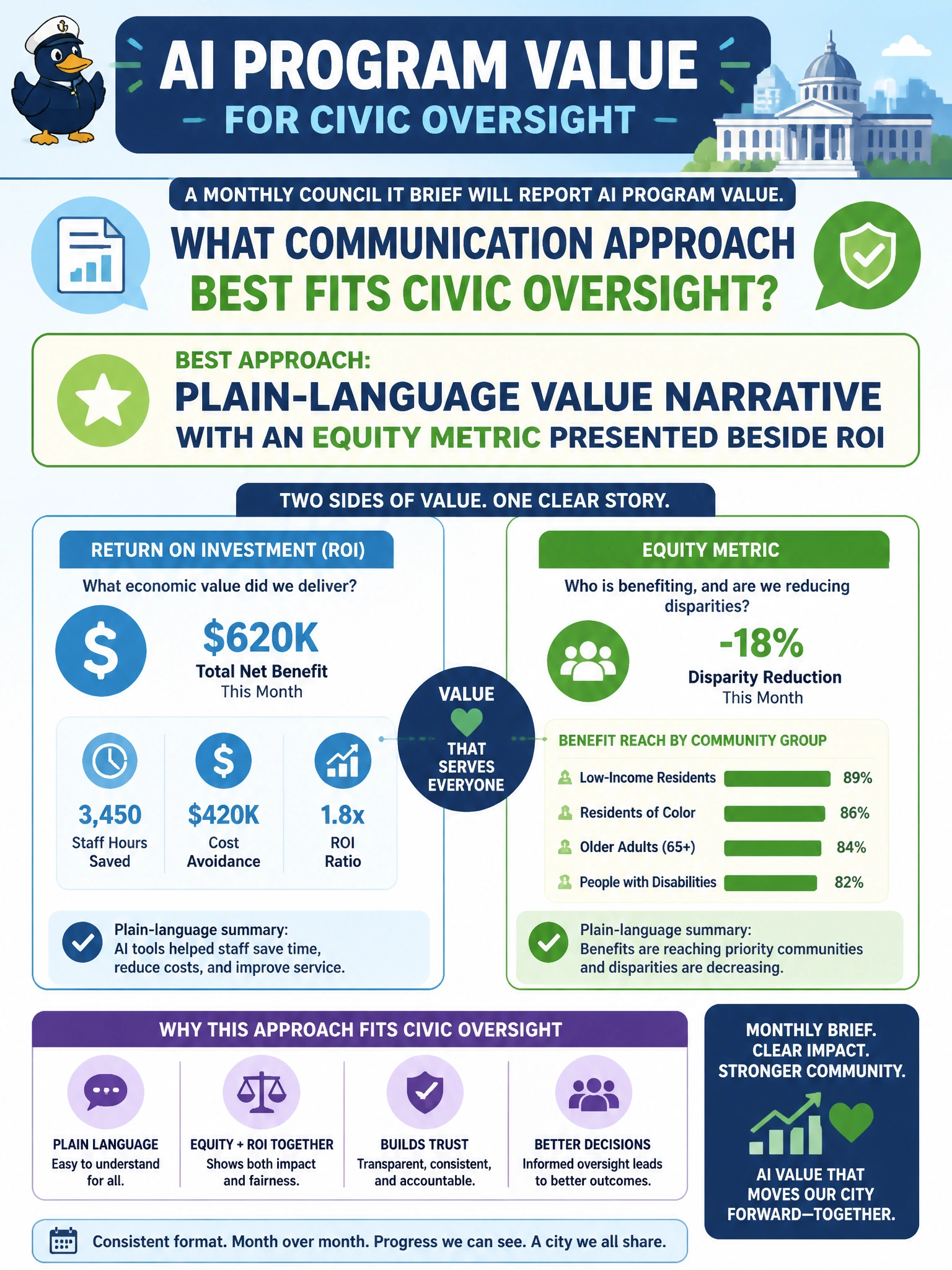
A monthly council IT brief will report AI program value. What communication approach best fits civic oversight?
Select an answer to reveal the explanation.
Short Explanation
Council packets aren’t engineer lab notes. Speak plain, show the money story, and put an equity metric right next to ROI so oversight sees who benefits—not just what got cheaper.
Full Explanation
For a monthly council IT brief on AI program value, the strongest civic oversight approach is a plain-language value narrative with an equity metric presented beside ROI. Council members govern public money and resident outcomes; they need to see whether efficiency gains coincide with fair service access across neighborhoods, languages, and channel preferences. Pairing ROI with equity keeps the value story honest for municipal accountability rather than optimizing only for cost. Dense model-accuracy tables without resident-impact context fail because technical classifier scores do not translate into oversight decisions about permits, 311, or benefits access. Vendor marketing slides with no local metrics or equity indicators fail because third-party claims are not evidence of this city's performance and omit who benefits or is left behind. Internal jargon-heavy dashboards copied verbatim into the council packet fail because unreadability creates false confidence and blocks questioning. Exam caveat: items often reward "more data" when the real requirement is audience-appropriate transparency that includes equity alongside financial return. Operational check: draft the council brief in plain language; include one equity KPI next to ROI (for example completion rates by geography or language); cite local baselines; and keep a glossary appendix rather than dumping raw model tables into the packet.