
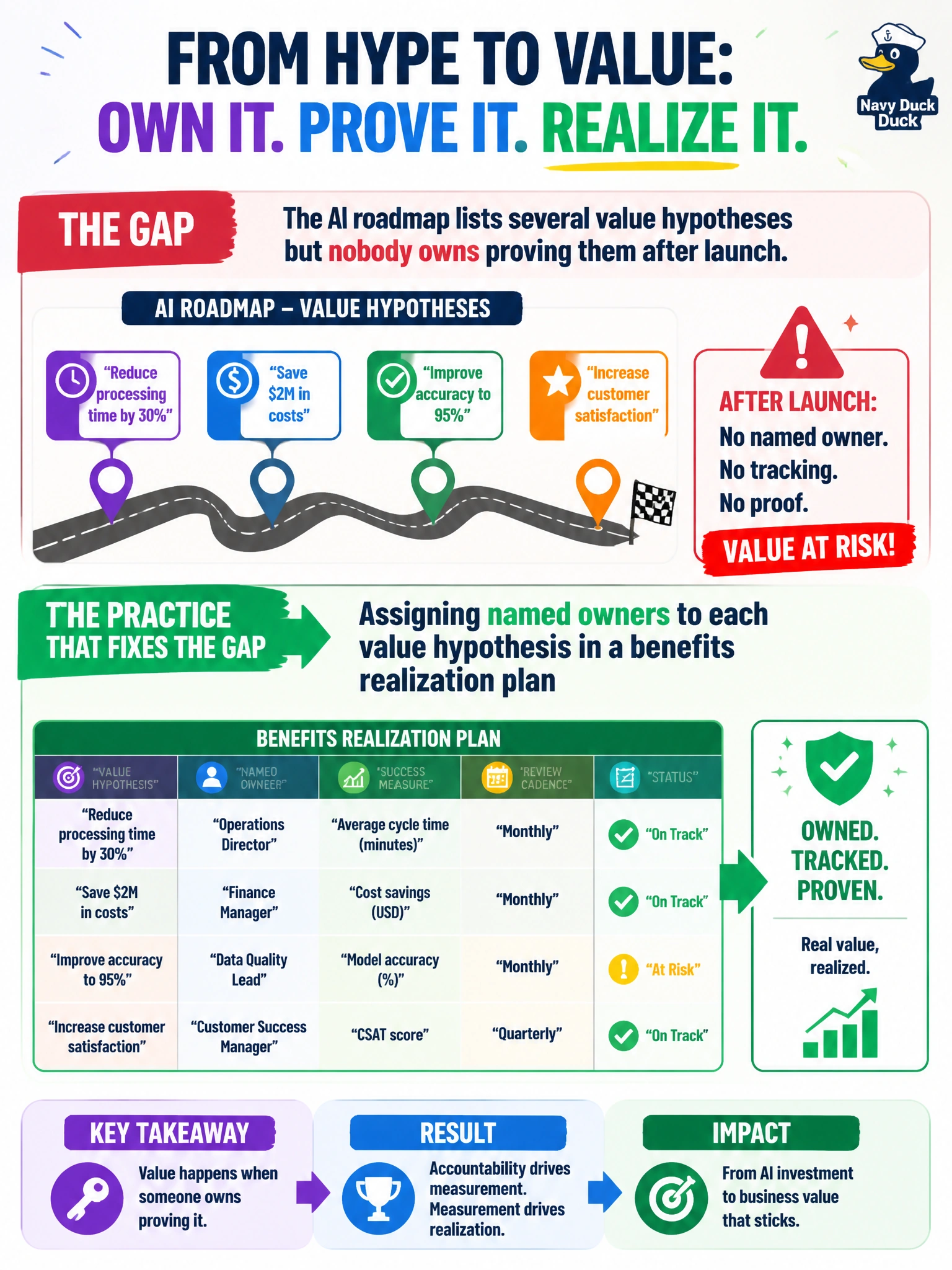
The AI roadmap lists several value hypotheses but nobody owns proving them after launch. What practice fixes that gap?
Select an answer to reveal the explanation.
Short Explanation
A value hypothesis without an owner is a wish on a whiteboard. Put a name next to each benefit so someone actually hunts down the evidence after launch.
Full Explanation
Benefits realization assigns accountable owners to each value hypothesis so post-launch measurement actually happens. When an AI roadmap lists several value hypotheses but nobody owns proving them after launch, naming owners in a benefits realization plan fixes the gap: delivery focus otherwise ends at go-live while outcomes evaporate unmeasured and unowned. Leaving hypotheses unowned so no bureau feels accountable almost guarantees neglected evidence and orphaned KPIs that never appear in steering packs. Assuming vendors will independently prove city mission outcomes misassigns accountability—vendors may prove uptime or model scores, not municipal mission results for residents and clerks. Tracking only delivery milestones and never benefits after go-live confuses output with outcome and celebrates shipping over impact. Exam caveat: ownership of benefits after launch is the discipline tested, distinct from vendor delivery tracking or milestone burndown. Operational check: attach a named city owner, metric, baseline, and review date to each hypothesis; include benefits reviews in steering agendas; escalate unowned items before launch approval; and retire or revise hypotheses that cannot be evidenced with municipal data.