
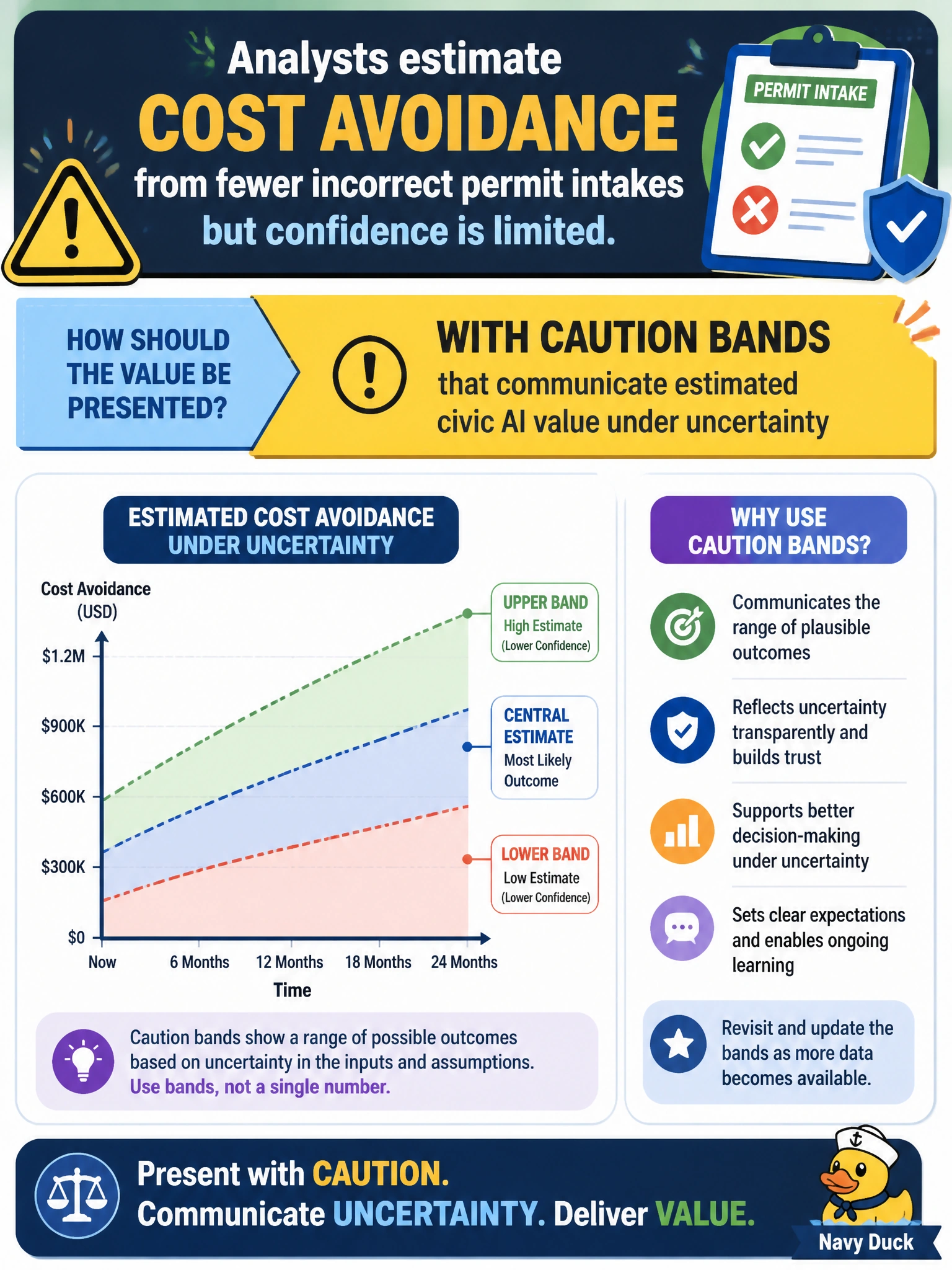
Analysts estimate cost avoidance from fewer incorrect permit intakes but confidence is limited. How should the value be presented?
Select an answer to reveal the explanation.
Short Explanation
Fuzzy savings still matter—just don’t paint them like laser measurements. Show the estimate with caution bands so council sees the range, not a fake pinpoint.
Full Explanation
Municipal value estimates often include uncertainty from attribution gaps, partial data, and counterfactuals about what would have happened without the AI. When analysts estimate cost avoidance from fewer incorrect permit intakes but confidence is limited, presenting caution bands communicates estimated civic AI value under uncertainty while still informing budget and keep-or-improve decisions. False precision—a single exact dollar figure with no disclosed uncertainty—overstates knowledge and erodes trust when figures inevitably move after better data arrive. Unlimited upside projections to maximize budget enthusiasm are advocacy, not analysis, and set leaders up for disappointment when bands collapse toward the low end. Omitting the estimate entirely whenever uncertainty exists throws away decision-useful information; ranges and sensitivity analysis are the professional municipal response. Exam caveat: choose transparent uncertainty communication over fake pinpoint accuracy or silence when civic AI value is estimated. Operational check: publish low, expected, and high bands; list key assumptions and data gaps; run sensitivity on attribution shares; label figures as estimates; and update bands as better operational data arrives rather than defending an illusory single point to council.