
Leaders want to announce that AI improved average permit intake time. What measurement prerequisite is required?
Select an answer to reveal the explanation.
Short Explanation
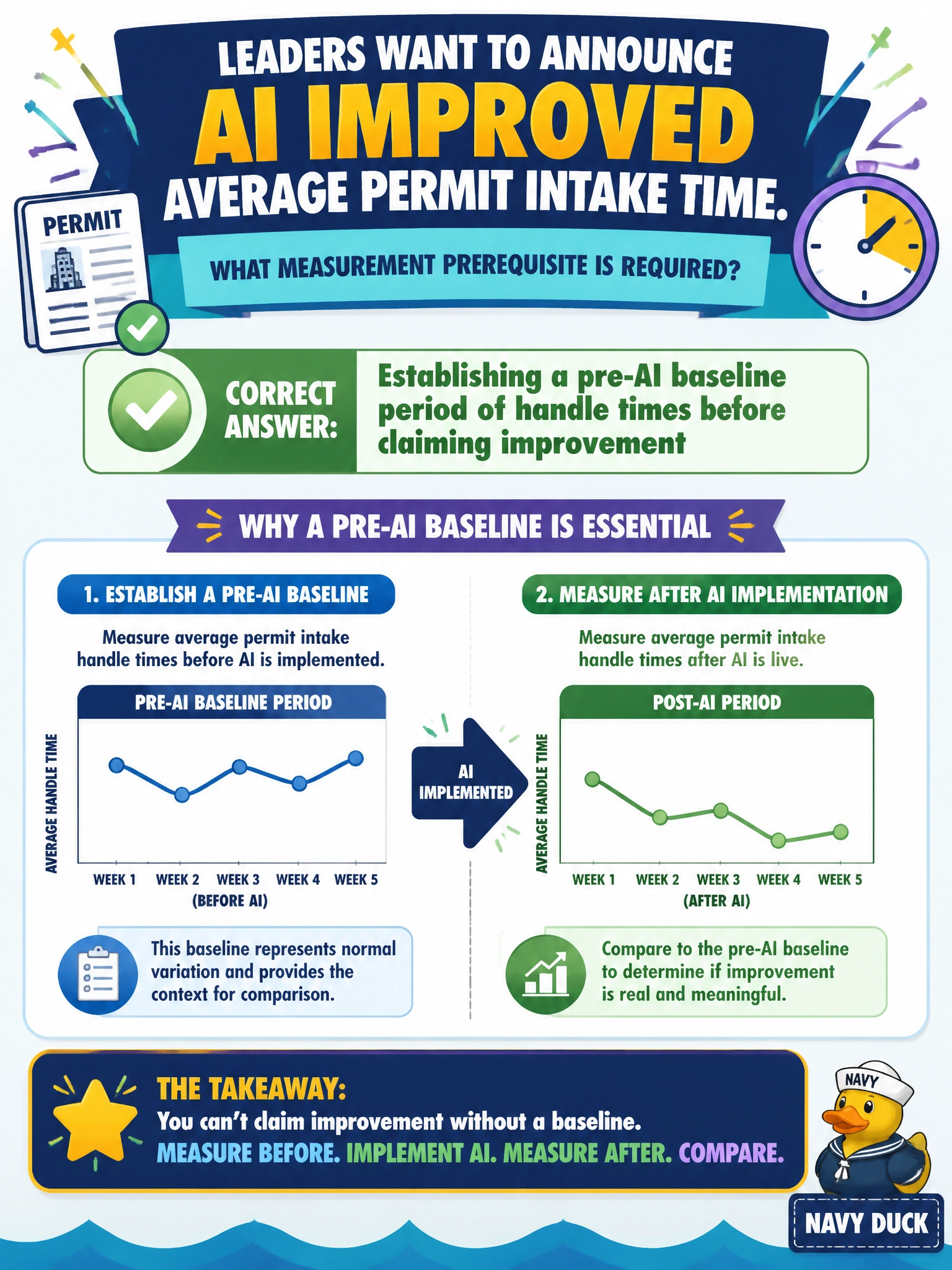
Without a before picture, “improvement” is just a hopeful caption. Capture pre-AI handle times first, then compare—otherwise you’re guessing with a megaphone.
Full Explanation
Credible civic AI value claims require a documented pre-intervention baseline for the metric in question. Before leaders announce that AI improved average permit intake time, the program must establish a pre-AI baseline period of handle times under comparable conditions, with the method written down so later reviewers can reproduce the comparison. Without that before picture, “improvement” is unverifiable and invites challenge that weakens oversight trust with council and the public. Announcing first and collecting numbers afterward if challenged reverses evidence order and risks retracting public claims after political capital is spent. Using another city’s blog post as the local baseline ignores context differences in staffing, systems, ordinances, and case mix that make cross-city anecdotes weak substitutes. Skipping baselines because generative AI always improves every metric is faith-based management, not measurement, and fails when intake mix or staffing changes drive the apparent gain. Exam caveat: baselines are prerequisites for improvement claims on the exam; external anecdotes cannot substitute for local baseline data. Operational check: lock a baseline window and method before go-live, control for seasonality and staffing changes where possible, store raw extracts, compute confidence intervals on the delta, and approve external announcements only after baseline-versus-post comparisons pass internal review.