
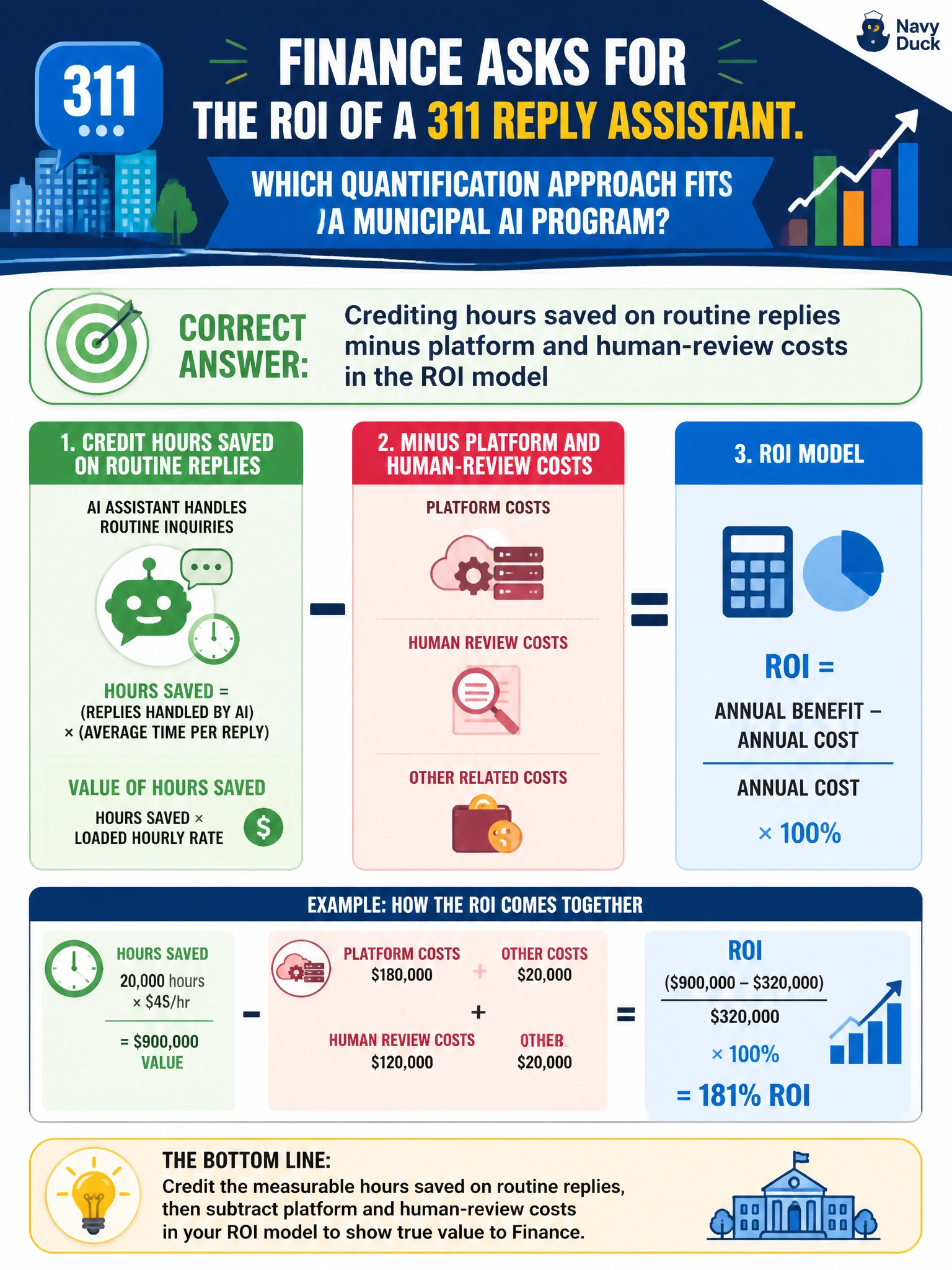
Finance asks for the ROI of a 311 reply assistant. Which quantification approach fits a municipal AI program?
Select an answer to reveal the explanation.
Short Explanation
ROI isn’t “hours saved, please ignore the bill.” Subtract platform and review costs from the time you clawed back, or the spreadsheet is a fairy tale.
Full Explanation
Municipal AI ROI should net operational benefits such as hours saved on routine 311 replies against platform costs and human-review costs. Crediting hours saved minus those costs fits public-sector value discipline: gross savings without costs overstate value and mislead budget decisions about continuing or expanding the assistant. Local baselines and observed review effort beat unverified vendor marketing maxima that assume ideal conditions. Reporting only gross hours saved while ignoring platform and review costs produces a fairy-tale spreadsheet that collapses under finance scrutiny. Using the vendor’s maximum marketing ROI claim without local baselines abandons fiduciary measurement and civic accountability. Treating ROI as impossible so value tracking is abandoned leaves leaders without decision support and invites purely political prioritization. Exam caveat: pick net quantification with local costs, not gross-only or vendor brochure figures. Operational check: define hour-saved methodology with a pre-period baseline, capture license and platform invoices plus average human-review minutes per interaction, compute net ROI ranges with documented assumptions, and refresh the model as review rates change after hypercare ends.