
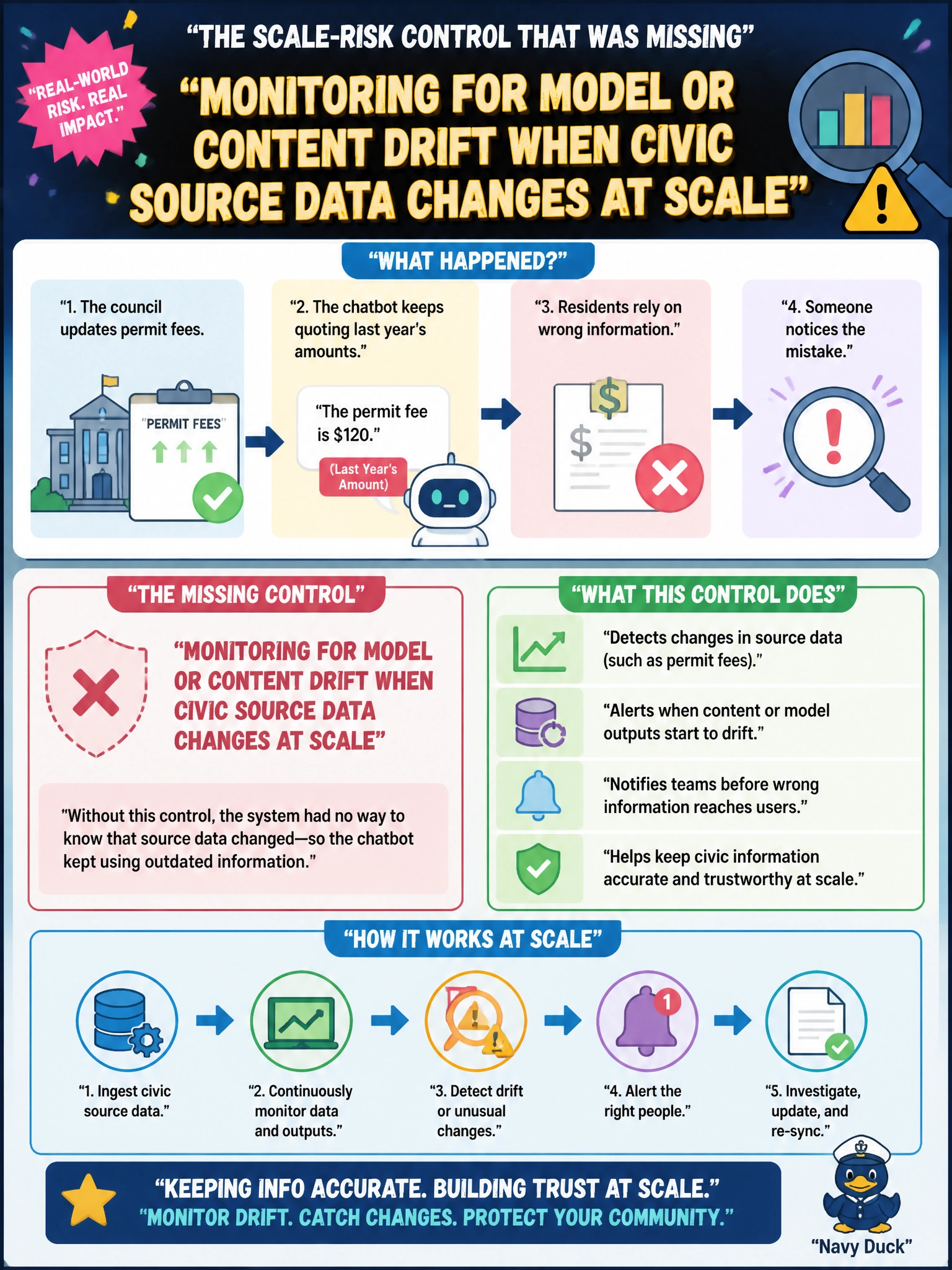
After the council updates permit fees, the chatbot keeps quoting last year’s amounts until someone notices. What scale-risk control was missing?
Select an answer to reveal the explanation.
Short Explanation
Fee schedules change; dusty answers don’t age like wine. At scale you need drift monitoring so a council update doesn’t leave the bot stuck in last year’s price list.
Full Explanation
At civic scale, authoritative source changes—such as council-updated permit fees—invalidate prior grounding and fine-tuned or retrieved answers unless the program monitors for content and model drift. When the chatbot keeps quoting last year’s amounts until someone notices, the missing control is continuous monitoring for drift after source data changes, plus processes to refresh corpora, embeddings, or retrieval indexes and to re-sample answer quality. One-time pilot accuracy samples do not detect later degradation; production municipal AI needs ongoing checks tied to policy change events. Freezing fee schedules forever so AI answers never need updates is not a viable civic control—policy must change while systems adapt. Relying on residents to crowdsource fee corrections on social media outsources quality assurance to the public and guarantees inequitable discovery of errors. Turning off all monitoring once the pilot sample looked fine mistakes a snapshot for a lifecycle control. Exam caveat: items often lure candidates toward “set and forget” after a successful pilot; CAIPM thinking treats post-change drift detection as a core scale-risk control. Operational check: subscribe to fee/policy change feeds, trigger re-ingestion and evaluation suites on change, alert when sampled answers disagree with the current schedule, maintain a human override banner during known update windows, and assign an owner for content freshness SLAs across resident-facing assistants.