
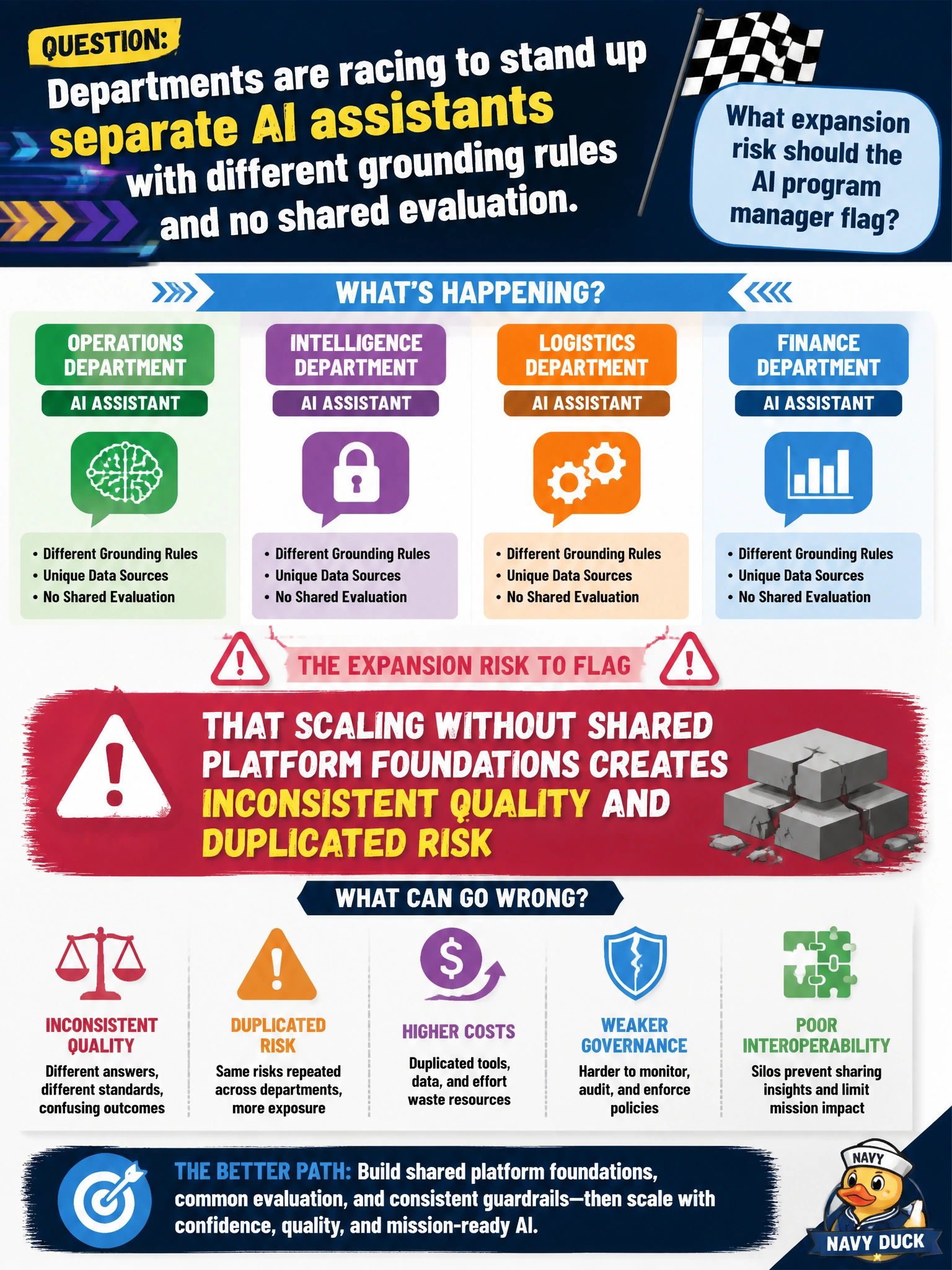
Departments are racing to stand up separate AI assistants with different grounding rules and no shared evaluation. What expansion risk should the AI program manager flag?
Select an answer to reveal the explanation.
Short Explanation
When every department builds its own assistant, the city gets a patchwork quilt of answers—some warm, some full of holes. Shared foundations keep quality and risk controls from splintering as you scale.
Full Explanation
When departments race to stand up separate AI assistants with different grounding rules and no shared evaluation, the primary expansion risk is scaling without shared platform foundations: inconsistent answer quality, duplicated security and privacy gaps, fragmented vendor contracts, and no common way to compare or govern risk. A municipal AI program manager should flag that sprawl because residents experience “the city,” not bureau silos, and one unsafe assistant can damage trust citywide. Shared platforms, evaluation harnesses, logging, access control patterns, and governance templates reduce repeated design debt while still allowing local use cases. Claiming shared platforms always slow innovation and should be banned is an anti-pattern that treats coordination as the enemy rather than unmanaged variance. Asserting that separate tools guarantee identical resident experiences automatically is false; divergent grounding and prompts almost guarantee inconsistent guidance. Believing scaling is safest when every bureau invents its own governance from scratch maximizes compliance blind spots and audit pain. Exam caveat: distractors often cast central foundations as bureaucracy; the exam concept is that expansion without shared evaluation and controls multiplies quality and risk failures. Operational check: establish a thin shared platform and mandatory evaluation gates, require grounding and logging standards for any new assistant, inventory shadow AI tools, and pause bureau-level launches that cannot meet shared security, privacy, and quality baselines before they reach residents.