
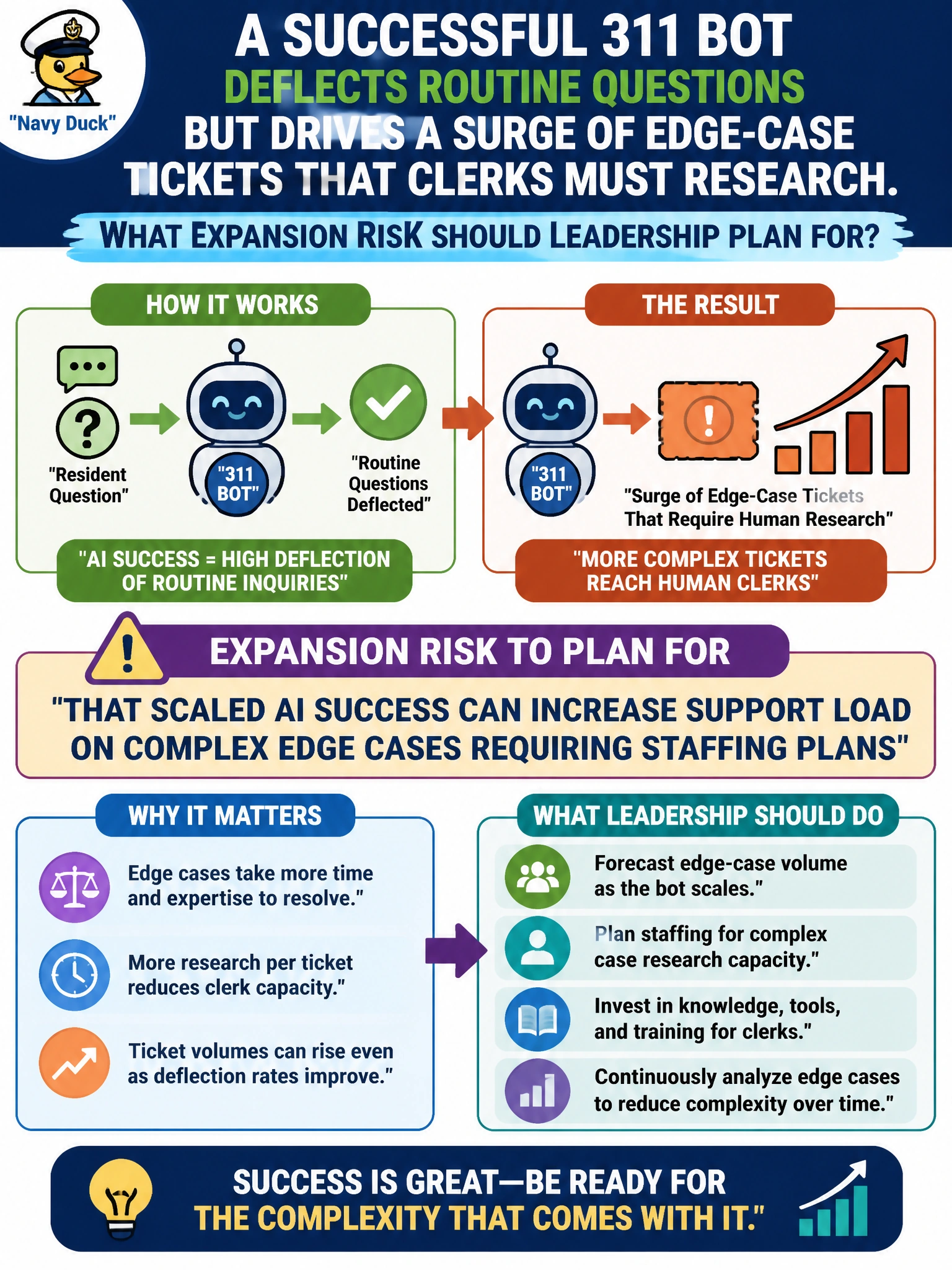
A successful 311 bot deflects routine questions but drives a surge of edge-case tickets that clerks must research. What expansion risk should leadership plan for?
Select an answer to reveal the explanation.
Short Explanation
Ironic but true: a helpful bot can create a new pile—the weird cases people never bothered asking before. Plan staffing for that edge-case surge or “success” just moves the work sideways.
Full Explanation
Scaled AI success can reshape demand: a 311 bot that deflects routine questions often increases the relative volume of complex edge-case tickets that still require clerk research. Leadership must plan staffing and skill mix for that support-load shift rather than assuming deflection only reduces work. Popular assistants also surface latent demand—residents ask harder questions they previously abandoned—so “success” can raise specialized workload even as routine contacts fall. Believing successful deflection always eliminates human support capacity ignores residual and induced complexity and underfunds the hardest work. Auto-closing edge-case tickets without review to protect deflection metrics optimizes a vanity KPI at the expense of resident outcomes and legal risk. Claiming support-volume risks only apply to failed pilots, never popular assistants, reverses the operational reality that high adoption amplifies both value and leftover hard cases. Exam caveat: exam stems highlight the irony of success-driven load; pick the risk framing that couples AI deflection with human capacity planning for complex remainders. Operational check: forecast contact mix before and after launch, track deflection vs. escalation categories, staff research-capable clerks for edge queues, set escalation quality SLAs, and resist closing complex tickets solely to defend deflection dashboards.