
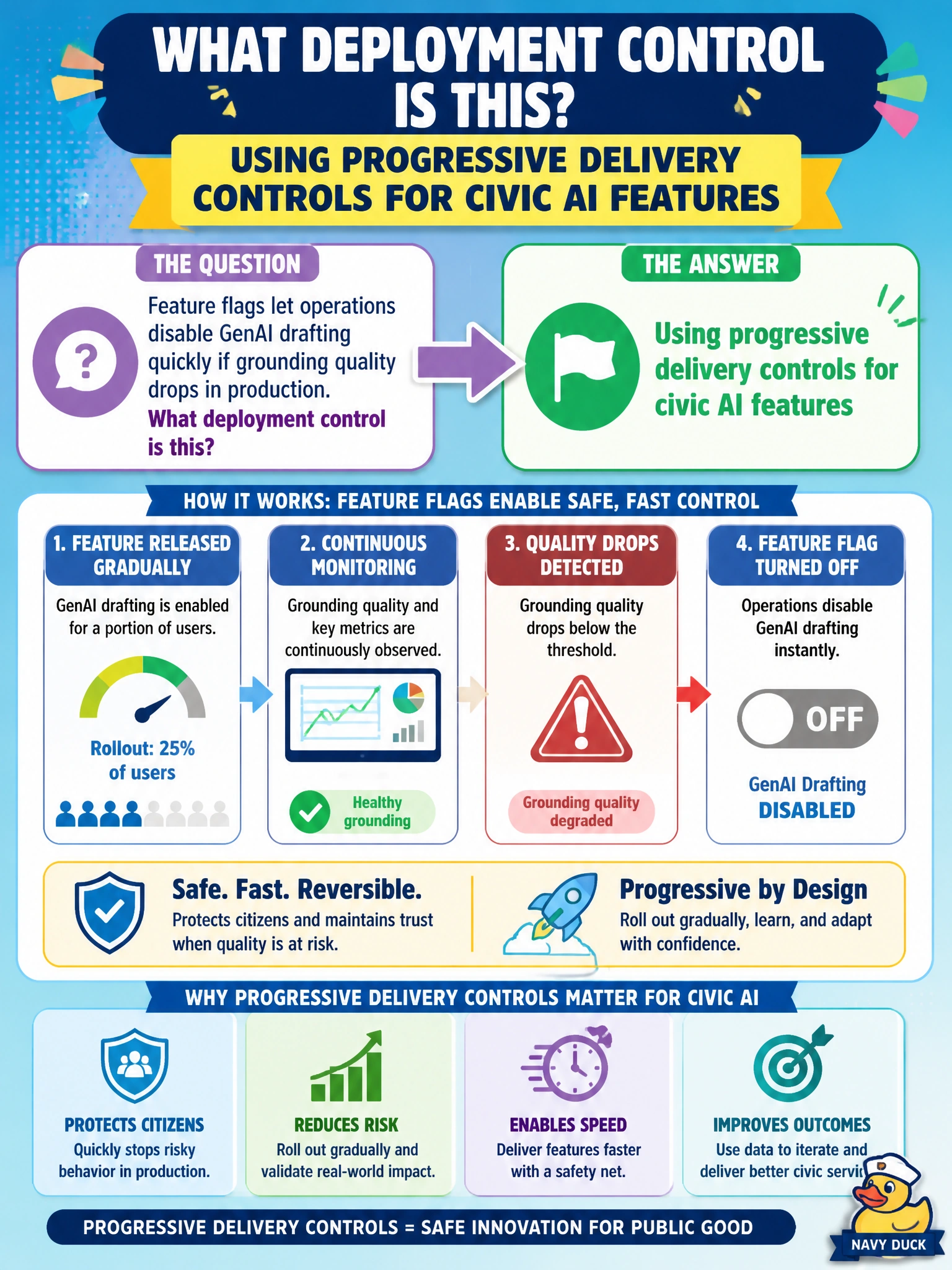
Feature flags let operations disable GenAI drafting quickly if grounding quality drops in production. What deployment control is this?
Select an answer to reveal the explanation.
Short Explanation
If grounding goes wobbly, flip the feature flag—do not wait for an annual release or a council vote to turn the draft button off. Progressive delivery is a seatbelt, not bureaucracy.
Full Explanation
Using progressive delivery controls for civic AI features is the correct deployment control when feature flags let operations disable GenAI drafting quickly if grounding quality drops in production. That works because GenAI quality can degrade from content drift, retrieval failures, or model changes without a full application outage; waiting for annual releases or political votes leaves residents exposed. Feature flags (and related progressive delivery tools) give operations a fast, reversible kill switch so grounding failures can be contained while root cause is fixed.
Hard-coding GenAI on with no way to disable without a full redeploy fails by concept: slow disable paths turn quality incidents into prolonged resident-facing failures. Waiting for the next annual release to turn off a failing feature fails by concept—release calendars are not incident response. Requiring council votes for every temporary feature disable fails by concept: governance of strategy belongs in policy forums; emergency operational disables need delegated authority and speed.
Exam caveat: flags need monitoring triggers, owners, and post-disable communications—not silent toggles without accountability. Keep GenAI drafting / municipal operations framing. Operational check: implement feature flags for GenAI drafting; define grounding-quality monitors and thresholds; authorize operations to disable; test the flag; document who is notified; and require a fix-and-reenable review before turning the feature back on.