
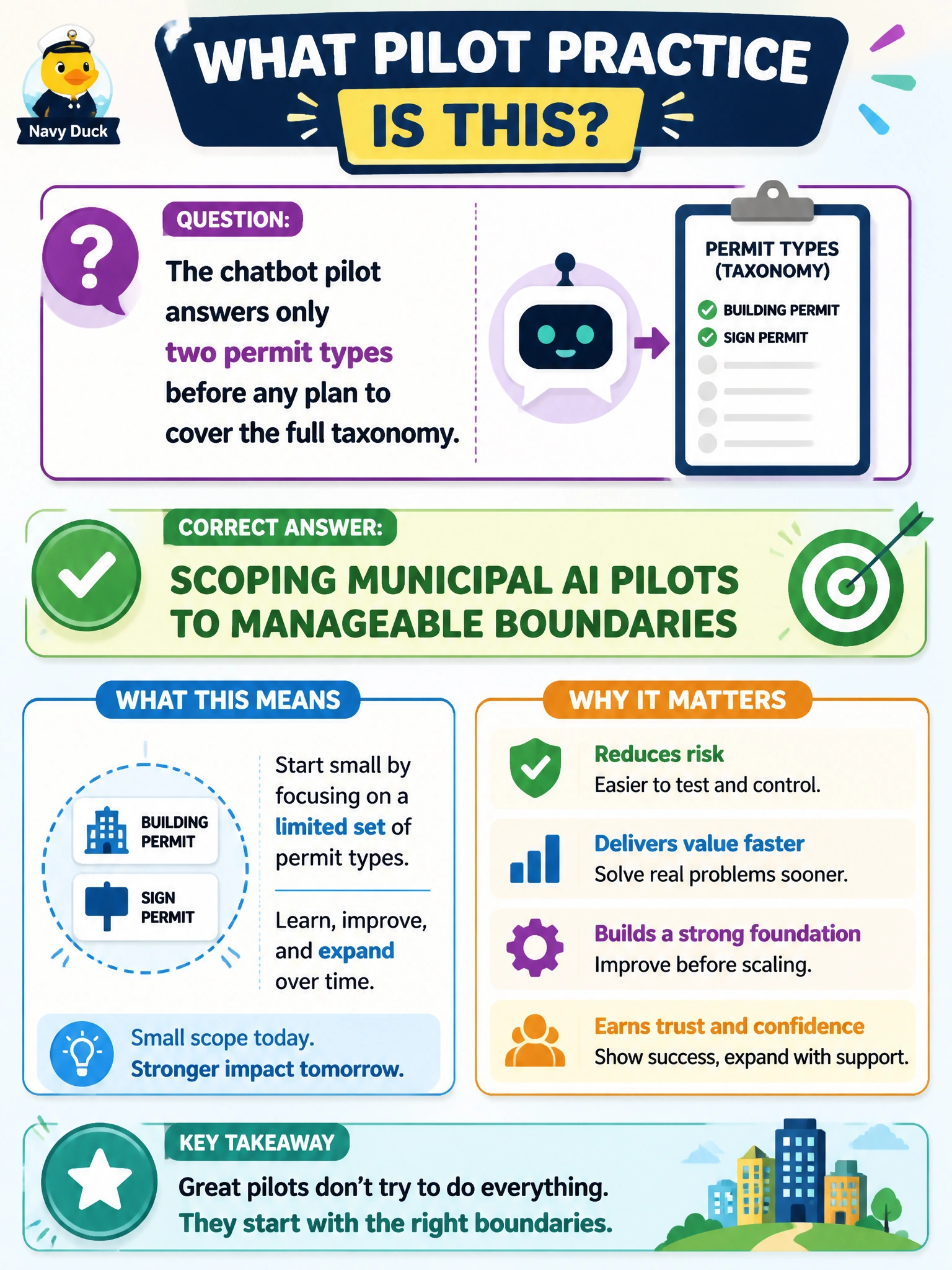
The chatbot pilot answers only two permit types before any plan to cover the full taxonomy. What pilot practice is this?
Select an answer to reveal the explanation.
Short Explanation
You can learn more from a manageable two-permit pilot than from trying to cover every permit type on day one. Keep the scope steady so you can measure what works before expanding.
Full Explanation
Scoping municipal AI pilots to manageable boundaries is the right practice when the chatbot answers only two permit types before any plan to cover the full taxonomy. A narrow scope makes outcomes measurable, keeps support load survivable, and helps you see content and quality gaps. Starting with two permit types creates a controlled learning environment; launching every permit type on day one for coverage optics turns the pilot into an uncontrolled production rollout, with too many variables to tell what worked. Refusing any scope limit because narrowing feels like failure also misses the point: disciplined scope helps a pilot produce evidence and does not mean giving up ambition. Changing scope weekly with no baseline for comparison makes results incomparable and success claims difficult to verify. Exam caveat: a narrow pilot still needs representative resident paths and an explicit expansion plan tied to gates; it should not become permanent under-coverage marketed as “done.” Practical check: select two high-volume permit types, freeze the scope for the pilot window, measure accuracy and deflection within that boundary, and expand only when written criteria are met and the next types’ content is ready.