
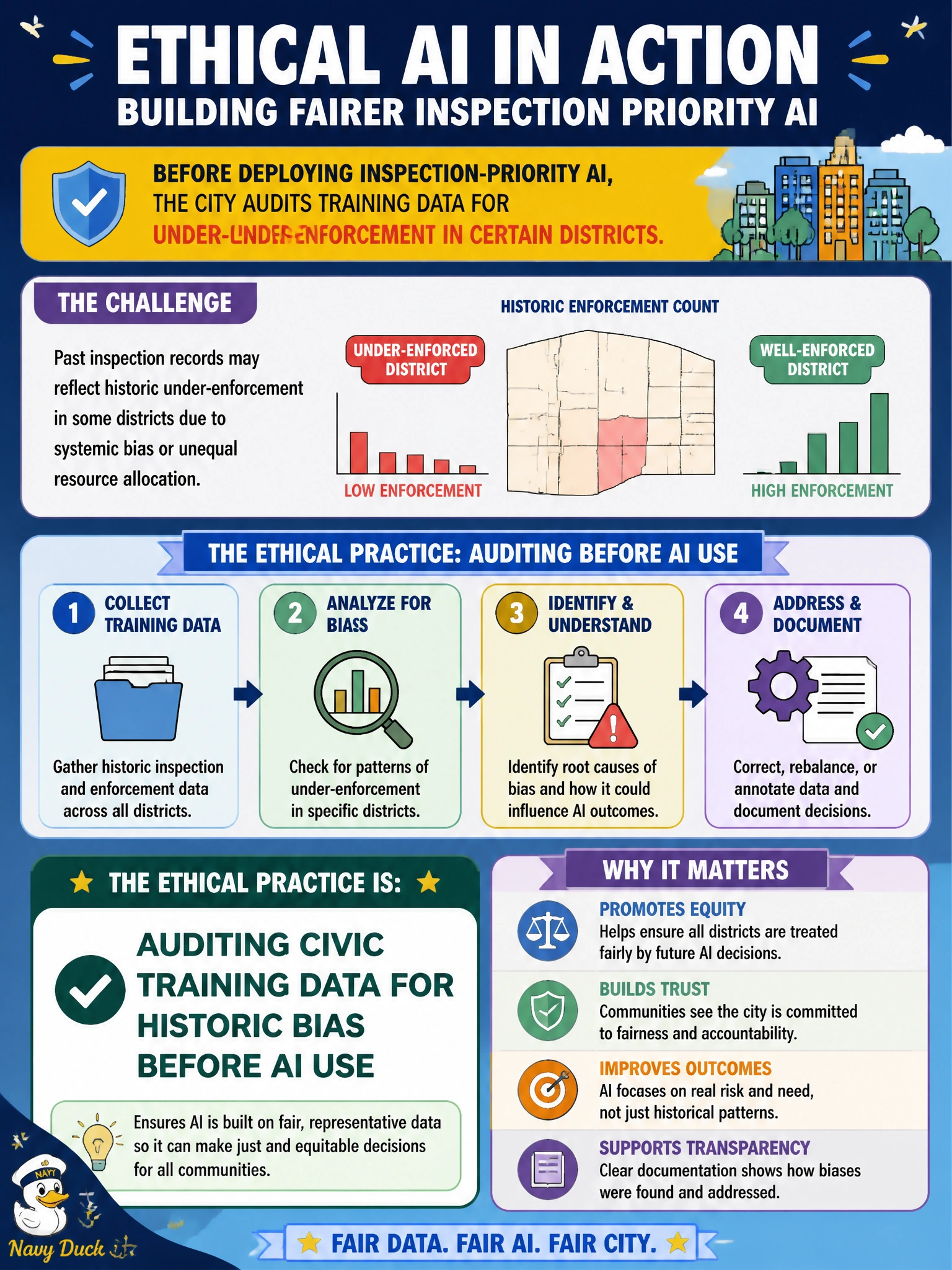
Before deploying inspection-priority AI, the city audits training data for historic under-enforcement in certain districts. What ethical practice is this?
Select an answer to reveal the explanation.
Short Explanation
If inspectors skipped a neighborhood for years, the model will 'learn' that neighborhood does not need attention. Audit the history first—official does not mean fair.
Full Explanation
Auditing civic training data for historic bias before AI use is the correct ethical practice when, before deploying inspection-priority AI, the city audits training data for historic under-enforcement in certain districts. That works because predictive or priority models trained on past tickets will reproduce under-attention where enforcement historically lagged—official volumes are not proof of fair need. Auditing for geographic and demographic skew before deployment lets the city adjust features, sampling, or human review rules so the model does not entrench neglect as 'learned' priority.
Assuming historic ticket volumes are fair because they are official fails by concept: administrative data encode past practice and capacity, not ground truth of conditions or equity. Training only on the most heavily ticketed ZIP to maximize 'precision' fails by concept—it hard-codes over-policing of already-targeted areas and ignores under-served districts. Deleting demographic fields so bias cannot be measured later fails by concept: removing measurement fields does not remove bias; it only blinds monitoring and remediation.
Exam caveat: a pre-deploy audit is incomplete without a remediation plan and ongoing disparate-impact monitoring after go-live. Keep inspection-priority / district enforcement framing. Operational check: profile training labels by district and relevant protected attributes where lawful; flag under-enforcement patterns; document mitigations (reweighting, features, human overrides); and set post-deploy metrics that detect concentration of AI-driven inspections in historically over- or under-targeted areas.