
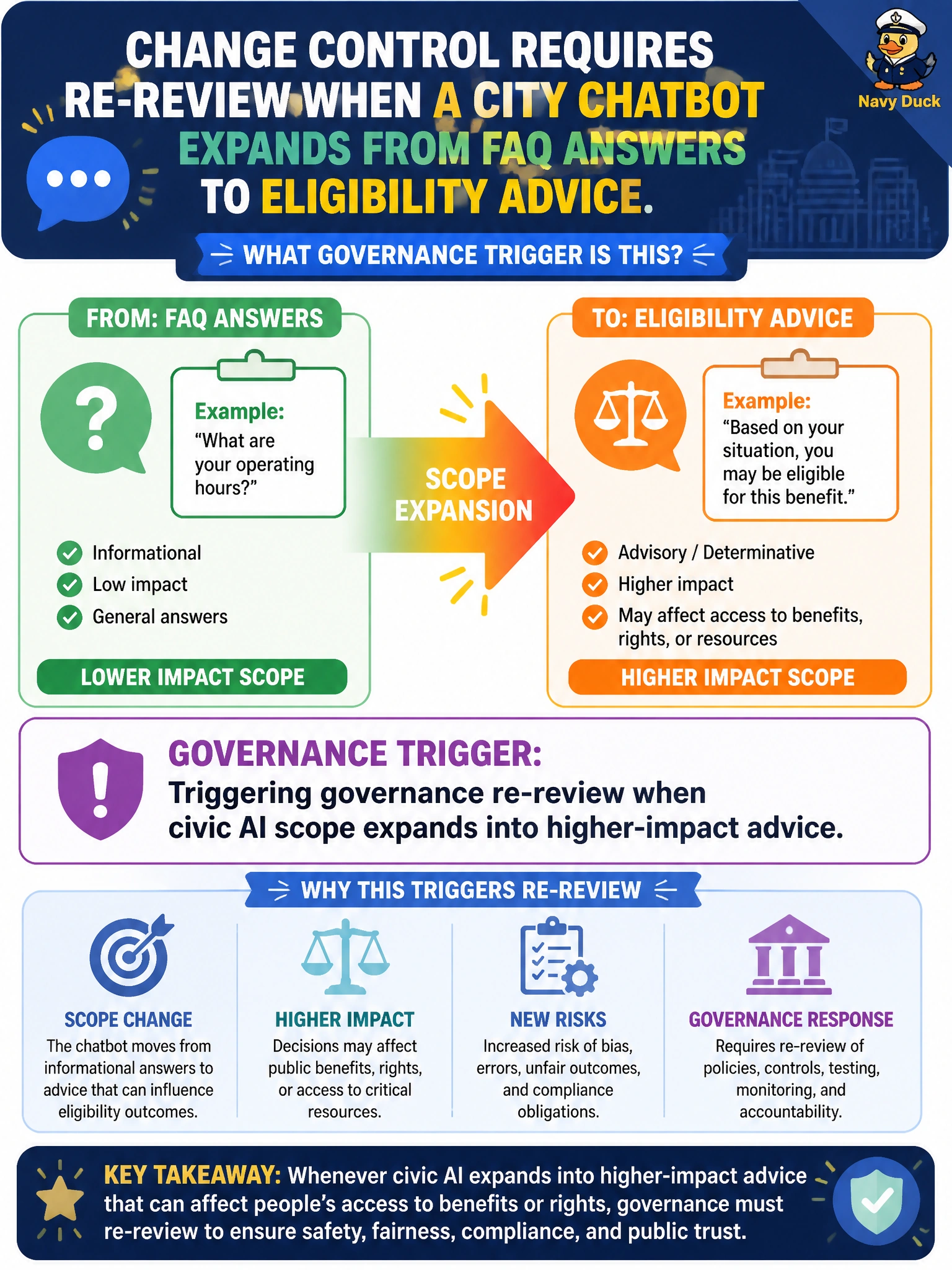
Change control requires re-review when a city chatbot expands from FAQ answers to eligibility advice. What governance trigger is this?
Select an answer to reveal the explanation.
Short Explanation
FAQ bots that start advising on eligibility just leveled up in risk. Scope creep needs a fresh governance look—last year’s approval doesn’t automatically cover this year’s advice engine.
Full Explanation
Triggering governance re-review when civic AI scope expands into higher-impact advice is the correct change-control trigger when a chatbot grows from FAQ answers to eligibility advice. Risk is not fixed at initial approval; advising on eligibility can affect resident benefits, fairness, and appeals in ways that listing office hours does not. Change control that forces re-review on scope expansion keeps controls, testing, and human-review rules aligned with the new impact. The trigger works because prior FAQ approval does not automatically authorize higher-stakes advisory behavior.
Assuming FAQ approval covers any future advice the bot might give fails by concept: approval is scoped to assessed use, not an unlimited future feature license. Expanding scope quietly during a holiday weekend to avoid scrutiny fails by concept and integrity—circumventing governance is itself a control failure. Treating eligibility advice as identical risk to listing office hours fails by concept: informational hours and eligibility determinations differ sharply in resident impact and error cost.
Exam caveat: re-review is required on material scope expansion; trivial copy edits to FAQs may not need a full board, but eligibility advice is material. Keep city chatbot change-control framing. Operational check: define scope-change triggers (e.g., moving into eligibility, enforcement, or rights decisions); require governance re-review before enabling those intents; update testing and human-review rules; and prohibit silent holiday expansions of high-impact advice.