
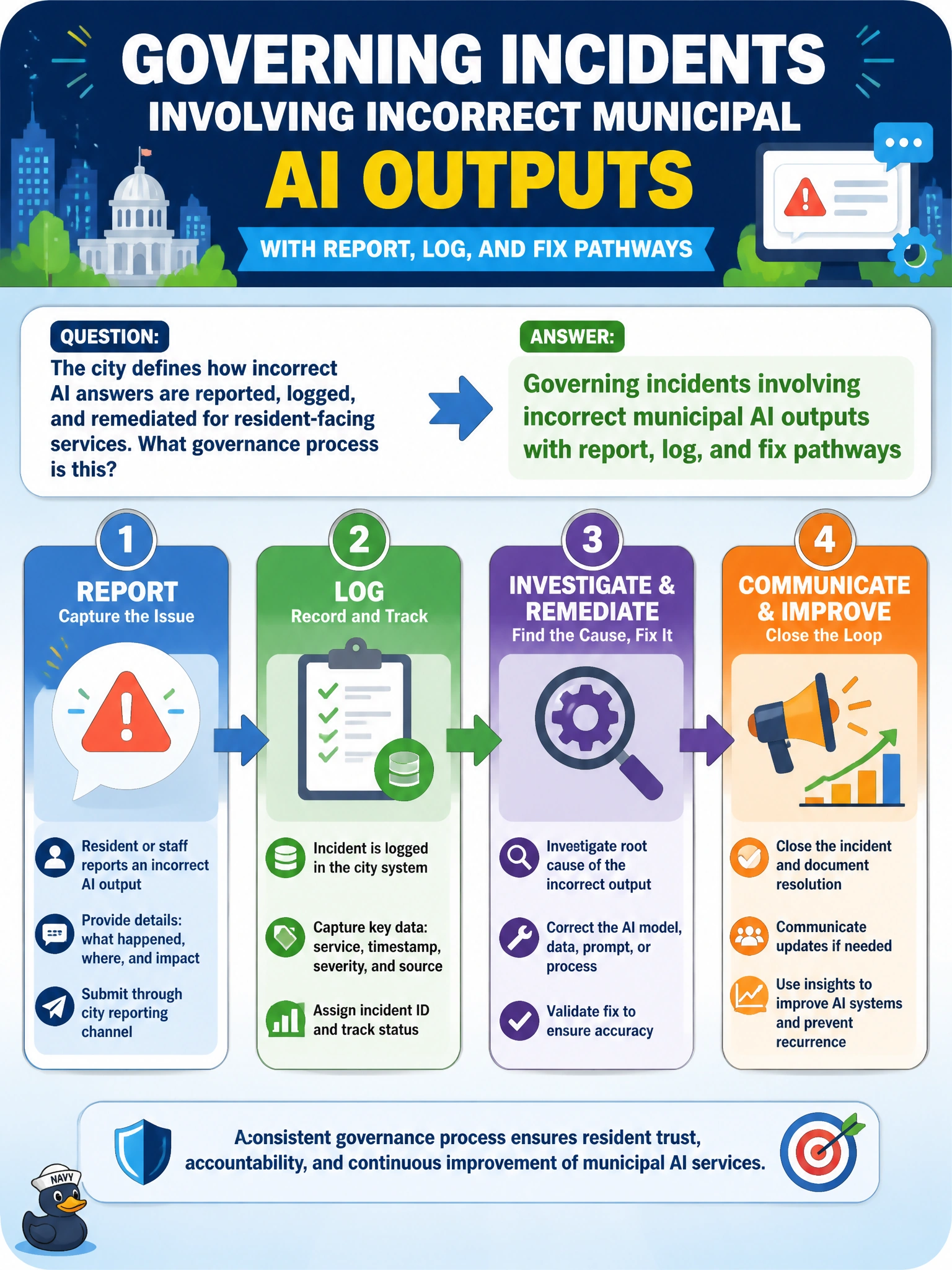
The city defines how incorrect AI answers are reported, logged, and remediated for resident-facing services. What governance process is this?
Select an answer to reveal the explanation.
Short Explanation
Wrong answers are incidents, not awkward jokes. Give staff a path to report, log, and fix bad AI outputs—sweeping them under the rug just teaches the city to repeat the mistake.
Full Explanation
Governing incidents involving incorrect municipal AI outputs with report, log, and fix pathways is the correct governance process when the city defines how wrong answers are handled for resident-facing services. Incorrect outputs are operational incidents: they can mislead residents, create fairness issues, and erode trust if ignored. Clear report-log-remediate pathways let staff escalate bad answers, create an auditable trail, and drive prompt, retrieval, or content fixes. The process works because municipal AI quality management requires incident handling, not wishful silence.
Telling staff to ignore wrong answers unless the media calls fails by concept: media attention is a late and arbitrary signal; residents may already be harmed. Deleting error reports so dashboards stay green fails by concept and integrity—suppressing reports hides systemic defects and blocks learning. Blaming residents for misunderstanding whenever the bot is wrong fails by concept: deflection avoids root-cause analysis of prompts, content, or model behavior that produced the error.
Exam caveat: incident governance for wrong answers should be proportionate and linked to remediation owners; not every typo needs a full SEV-1, but pathways must exist. Keep resident-facing municipal service framing. Operational check: publish how to report incorrect AI answers; log incidents with severity and owner; require remediation (content, retrieval, prompt, or guardrail changes); verify fixes; and review trends so repeated errors become backlog items rather than one-off shrugs.