
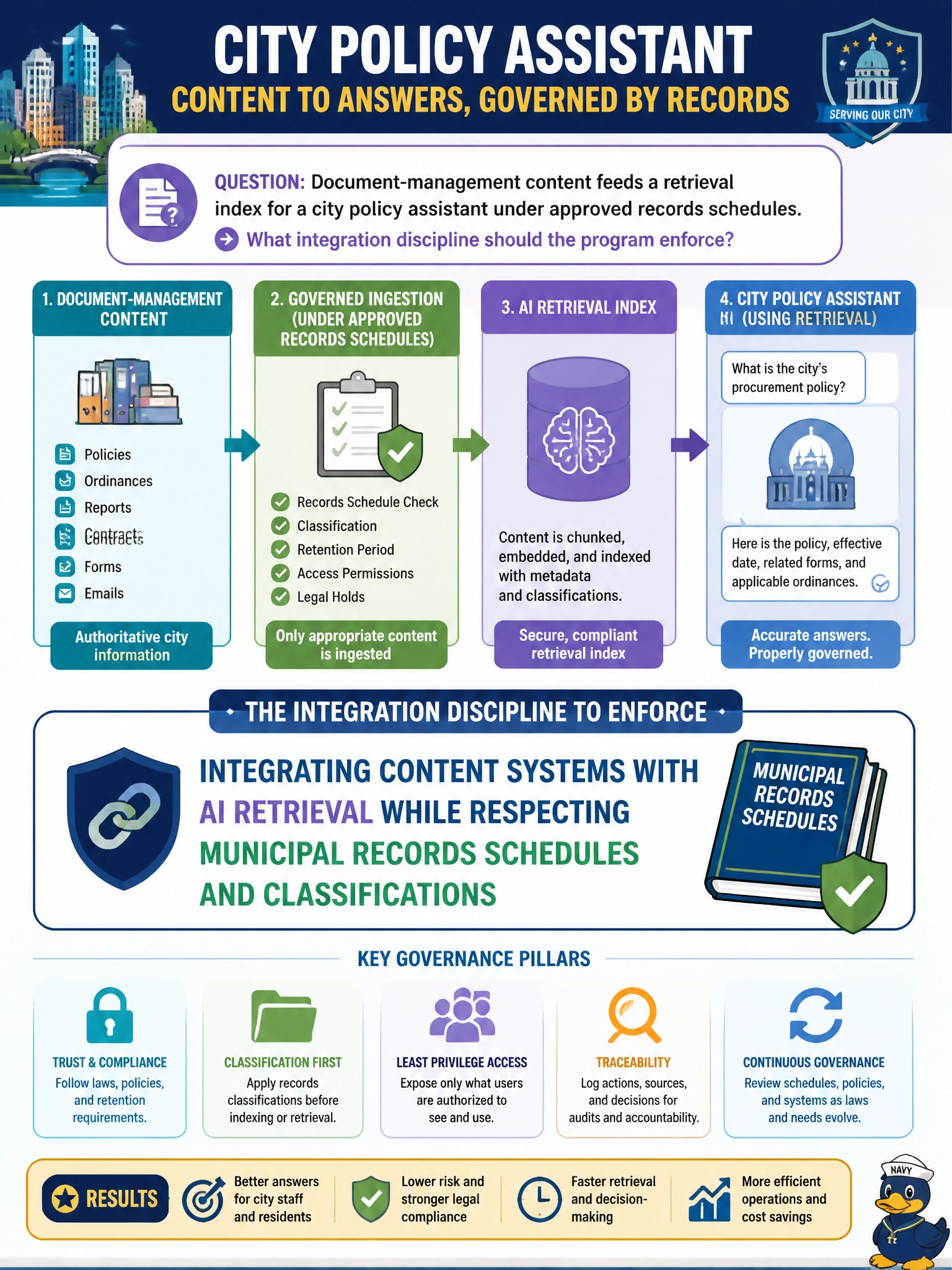
Document-management content feeds a retrieval index for a city policy assistant under approved records schedules. What integration discipline should the program enforce?
Select an answer to reveal the explanation.
Short Explanation
RAG isn’t a junk drawer. Feed the index under records schedules and classifications so the assistant learns what the city is allowed to keep—and not the stuff it must shred or protect.
Full Explanation
Integrating content systems with AI retrieval while respecting municipal records schedules and classifications is the correct discipline when document-management content feeds a retrieval index for a city policy assistant. RAG corpora inherit retention, disposition, and sensitivity rules from the source records program; indexing everything forever or mixing confidential classes into a broad corpus creates retention violations and disclosure risk. Approved schedules and classification checks determine what may be embedded, how long it stays searchable, and who may retrieve it. The practice works because municipal AI retrieval is an extension of records management, not a bypass of it.
Indexing every draft forever with no retention or disposition rules fails by concept: drafts and superseded policy may be retained or disposed under schedules that a permanent RAG index would violate. Copying confidential attorney files into a public RAG corpus by default fails by concept—classification boundaries must prevent privileged or restricted material from entering broader retrieval sets. Letting staff upload anything into the index without classification checks fails by concept: unmanaged uploads recreate shadow repositories outside records and security controls.
Exam caveat: respecting schedules does not mean the assistant can never use documents—it means inclusion, retention, and access follow municipal records and classification rules. Keep city policy-assistant / document-management framing. Operational check: inventory source libraries and classifications; apply retention/disposition to indexed content; block confidential classes from unauthorized corpora; and review the retrieval index on a schedule aligned with records governance.