
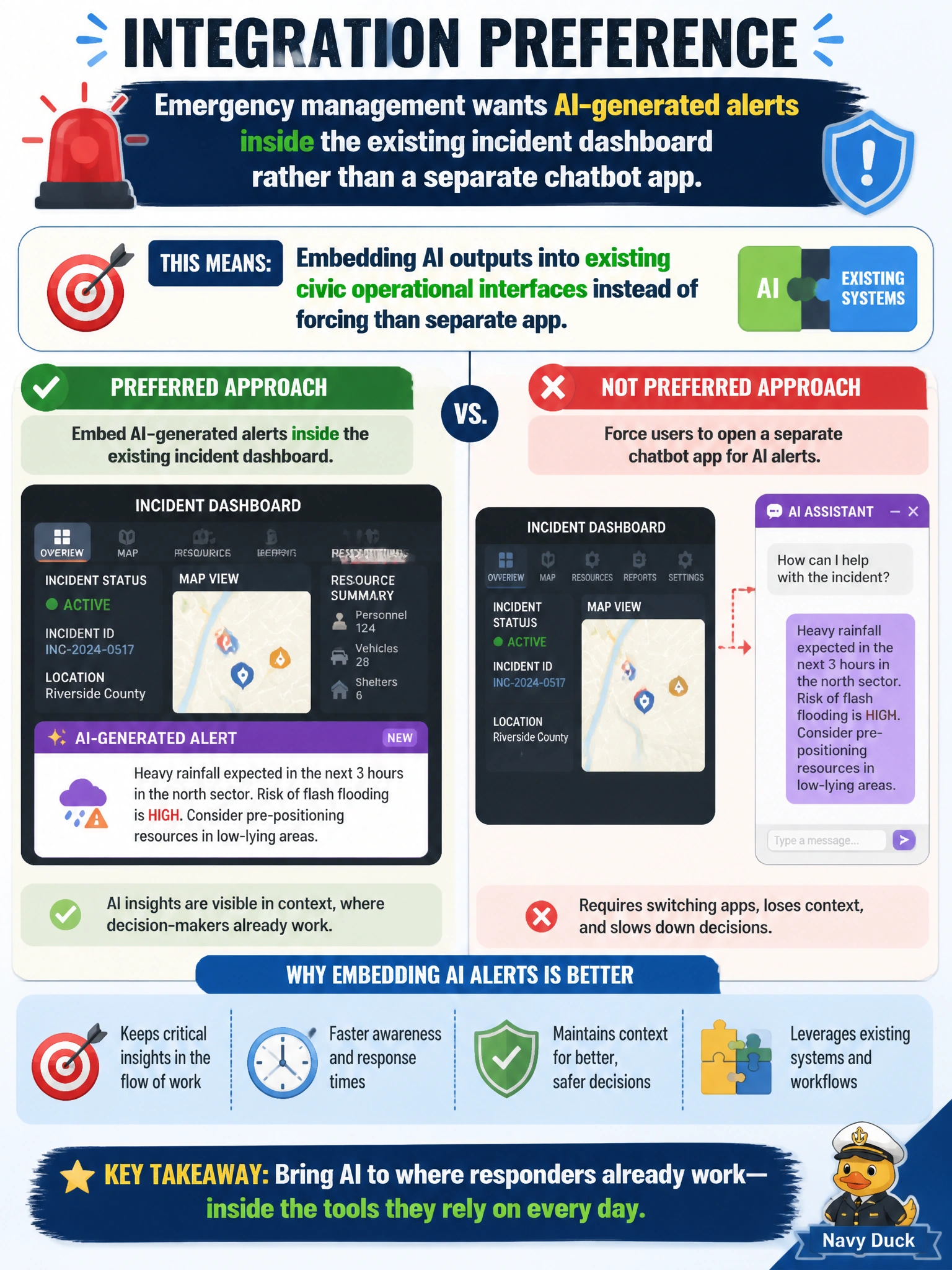
Emergency management wants AI-generated alerts inside the existing incident dashboard rather than a separate chatbot app. What integration preference is this?
Select an answer to reveal the explanation.
Short Explanation
You want alerts to appear where responders already work, not send them searching across tools. Embedding AI outputs in the incident dashboard keeps support inside the operational workflow.
Full Explanation
Embedding AI outputs into existing civic operational interfaces instead of forcing a separate app is the right integration preference when emergency management wants alerts inside the incident dashboard. During incidents, operators already work in established dashboards; requiring them to switch to a standalone vendor portal adds friction, context loss, and error risk. Putting alerts where work already happens supports adoption and keeps AI assistance within the operational picture. Requiring responders to switch from the incident dashboard to a standalone vendor portal fails by concept because context switching during emergencies can slow response and increase the chance of missing information. Printing AI alerts on paper and walking them to the ops floor fails because manual paper relays are slow, lossy, and poorly suited to modern incident tempo. Disabling the incident dashboard so staff rely only on chat history fails because the dashboard is the operational system of engagement; AI should augment it, not replace it with unstructured chat. Exam caveat: embedding does not require rebuilding the dashboard; it means delivering AI outputs into the operators’ primary interface through approved integration patterns. Practical check: consider API or widget embedding in the existing incident UI, test alert placement with operators, compare time-to-acknowledge with a separate chatbot, and reject designs that force portal switching during active incidents.