
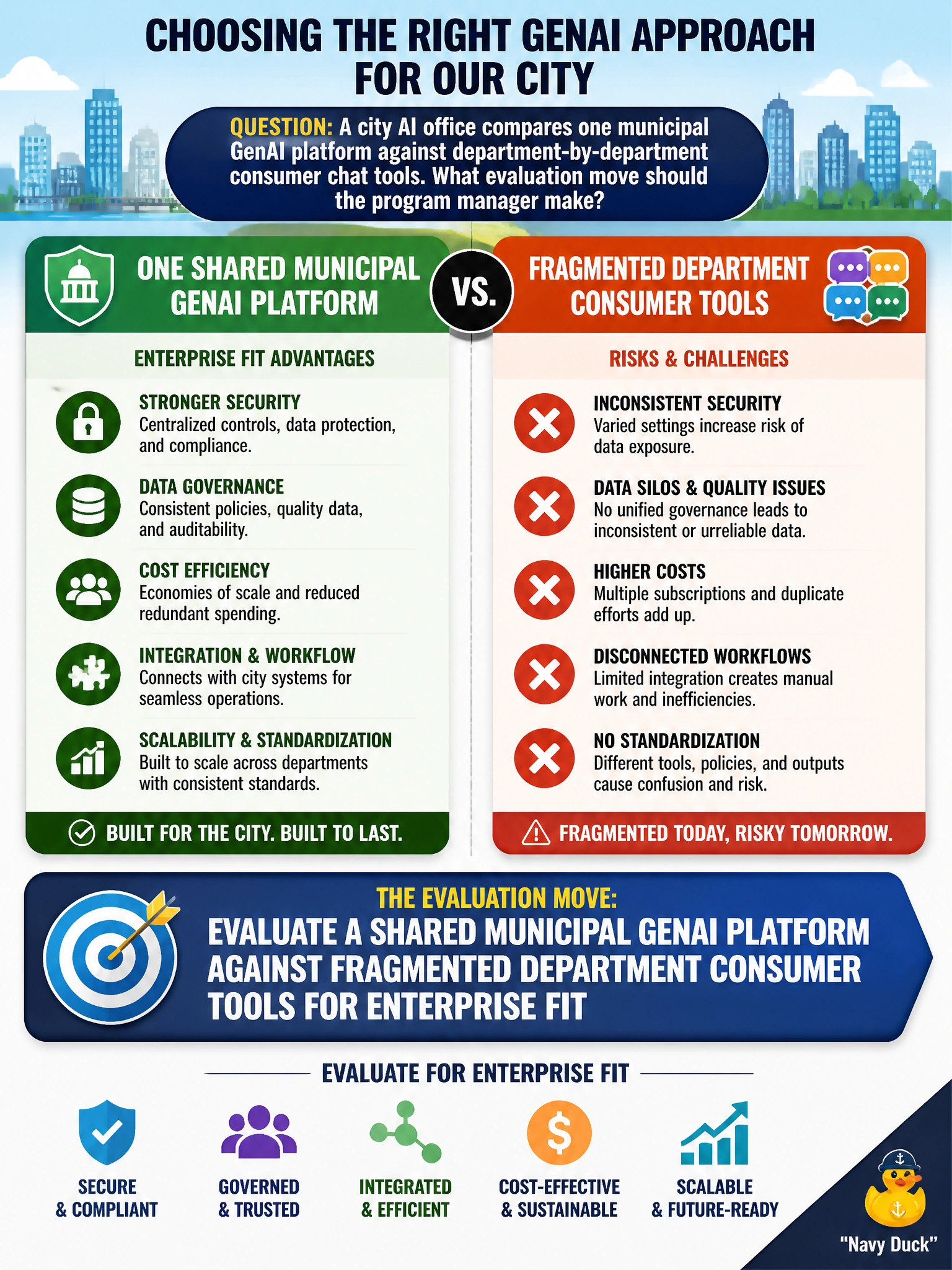
A city AI office compares one municipal GenAI platform against department-by-department consumer chat tools. What evaluation move should the program manager make?
Select an answer to reveal the explanation.
Short Explanation
Scattered consumer chat apps feel easy—until every department is a snowflake. Compare one municipal GenAI platform against that patchwork so the city buys once for shared controls, not twenty times for chaos.
Full Explanation
Comparing one municipal GenAI platform against department-by-department consumer chat tools is the right evaluation move because enterprise fit—not tool abundance—determines whether a city can govern, secure, support, and measure AI consistently. A shared municipal platform consolidates identity, logging, retention, vendor management, and prompt/knowledge controls so the AI office can apply one policy set across departments instead of chasing snowflake consumer apps. That comparison surfaces tradeoffs in cost, control, residency, accessibility, and operational support before sprawl becomes irreversible. Program managers should score platforms against civic requirements and against the real failure mode of fragmented consumer tools that each department adopts independently.
Approving every consumer chat tool so departments can pick whatever they prefer fails by concept: unconstrained choice multiplies attack surface, creates uneven data handling, and makes audit and offboarding impractical. Banning all GenAI until each department trains its own foundation model from scratch fails by concept and scale—municipal offices rarely need or can afford custom foundation models for routine GenAI use, and the ban delays safer governed alternatives. Skipping platform evaluation and letting marketing pick tools based on demo polish alone fails by concept because demo theater ignores retention, residency, accessibility, security, and supportability that public-sector platforms must meet.
Exam caveat: the question tests platform evaluation for municipal fit versus consumer sprawl, not a mandate to pick a specific vendor brand. Keep the civic framing of city AI offices comparing shared platforms to department consumer tools. Operational check: define evaluation criteria (SSO, logging, retention, residency, accessibility, support SLAs), run a structured comparison of one municipal GenAI option versus current consumer-tool fragmentation, document residual risks of either path, and only then recommend a governed platform approach for departments.