
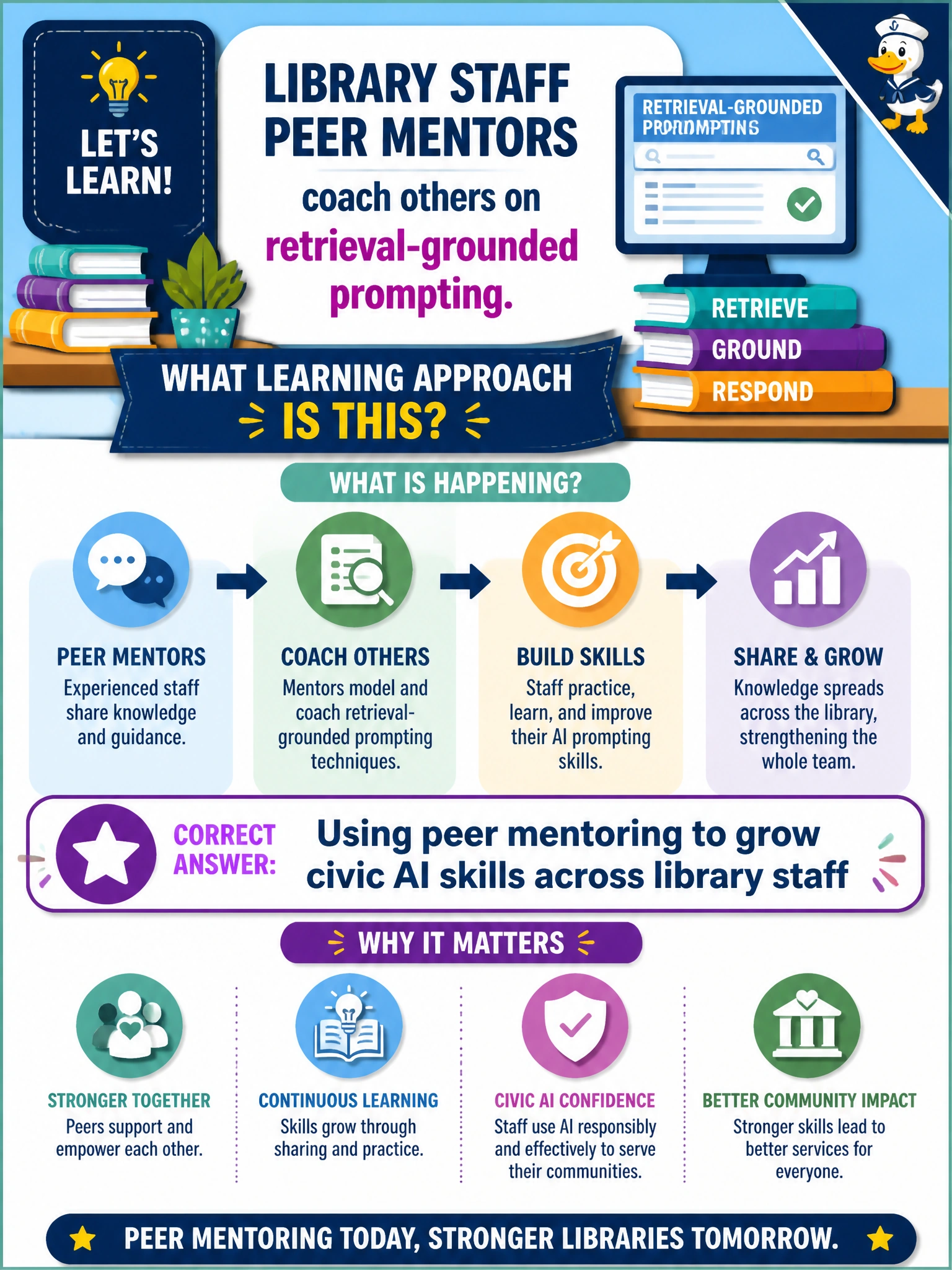
Library staff peer mentors coach others on retrieval-grounded prompting. What learning approach is this?
Select an answer to reveal the explanation.
Short Explanation
Peer mentors are the friendly librarians who show you the grounded-prompt shortcut. Skills travel desk-to-desk faster than unread PDFs.
Full Explanation
Peer mentoring scales skills where central training cannot sit at every desk. Library staff peer mentors coaching others on retrieval-grounded prompting is a peer-mentoring learning approach that grows civic AI skills across library staff. It works because grounded prompting—citing approved knowledge sources, refusing fabrication, escalating when retrieval misses—is a craft best transferred through demonstration and feedback. Librarians already share reference practices peer-to-peer; extending that culture to AI keeps skills local, current, and trusted.
Forbidding peer coaching so only external consultants may teach prompting fails by concept: consultants leave, and peer capacity is what sustains municipal skill. Assuming mentoring happens automatically without designated peer coaches fails because informal hope is not a program—roles, time, and expectations must be explicit. Limiting all AI skill growth to unread policy PDFs with no coaching fails transfer; PDFs do not build Ability.
Exam caveat: peer mentoring complements—not replaces—policy and formal literacy. Operational check: designate mentors, give them time allocation and a grounded-prompting checklist, observe coaching sessions, and track mentee error rates on citation and refusal behaviors.