
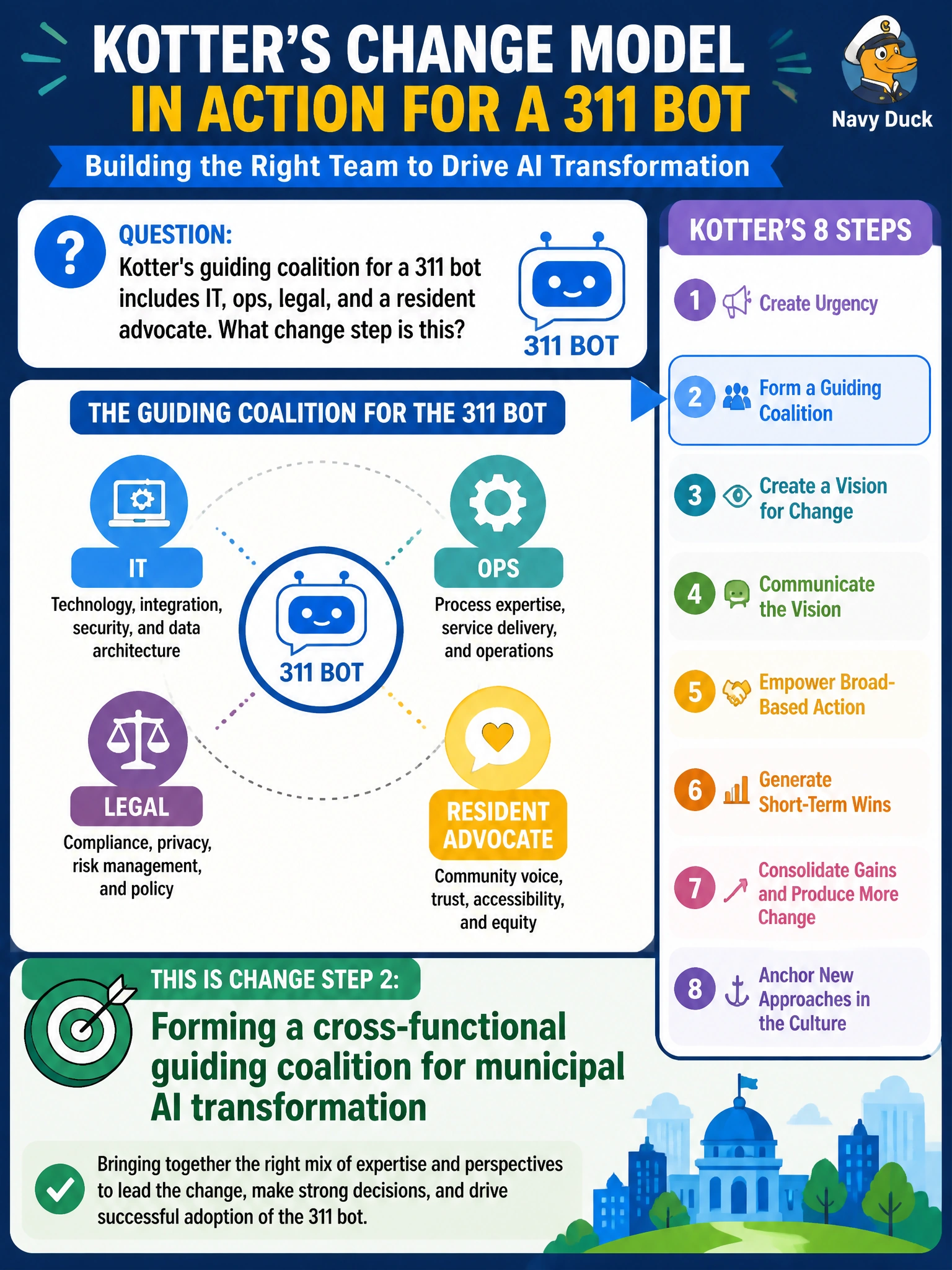
Kotter's guiding coalition for a 311 bot includes IT, ops, legal, and a resident advocate. What change step is this?
Select an answer to reveal the explanation.
Short Explanation
IT, ops, legal, and a resident advocate around one table—that’s a real guiding coalition, not a one-person pep rally.
Full Explanation
Kotter’s guiding coalition step requires a credible cross-functional power center—not a lone coordinator. Staffing the 311 bot coalition with IT, operations, legal, and a resident advocate forms that coalition for municipal AI transformation: technical feasibility, service operations, legal/privacy constraints, and resident voice sit together to steer urgency, vision, and barriers. That composition works because 311 bots touch public communications, incorrect advice risk, accessibility, and equity; excluding any of those perspectives recreates blind spots that later become political failures.
Staffing the coalition with only one vendor salesperson fails by concept: vendors lack municipal authority and multi-stakeholder legitimacy. Skipping a guiding coalition and relying on a lone project coordinator fails Kotter’s power and bandwidth requirements for transformation. Excluding legal and resident voices from the 311 bot coalition fails the civic risk profile—legal and resident harm modes are central, not optional.
Exam caveat: 'lean team' distractors often omit legal or resident advocates; for municipal AI, those seats belong in the coalition. Operational check: publish coalition membership and decision rights, meet on a fixed cadence, and verify legal and resident-advocate inputs appear in bot content, escalation, and notice decisions before scale.