
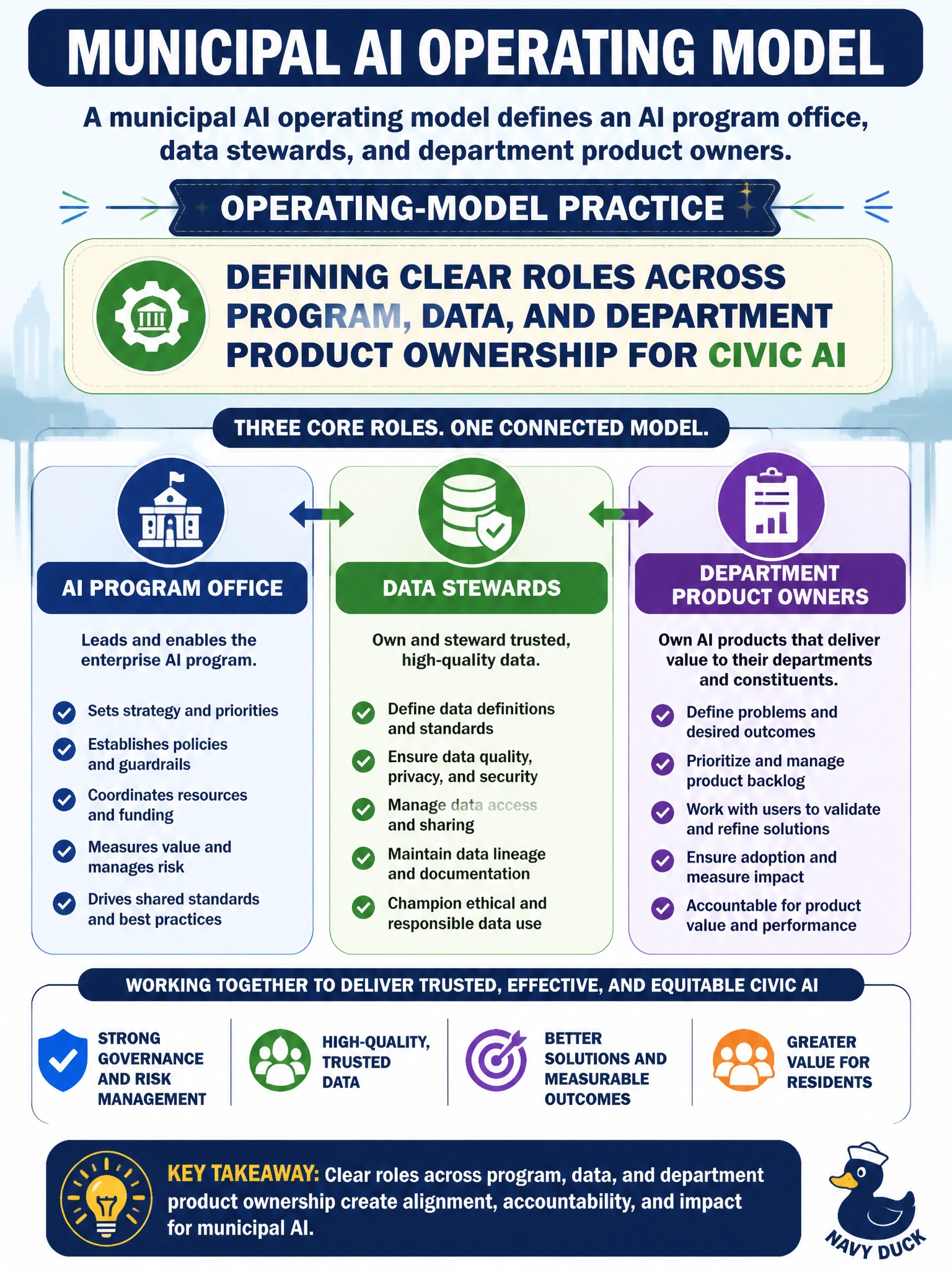
A municipal AI operating model defines an AI program office, data stewards, and department product owners. What operating-model practice is this?
Select an answer to reveal the explanation.
Short Explanation
Program office, data stewards, product owners—name the seats on the bus. Clear roles beat the ‘I thought you had it’ shuffle every time.
Full Explanation
A municipal AI operating model defines clear roles across program coordination, data stewardship, and department product ownership. An AI program office sets standards, intake, and portfolio rhythm. Data stewards own quality, access, and lineage for datasets models consume. Department product owners own resident or staff outcomes, prioritization inside the domain, and acceptance of the service. Naming those seats reduces gaps where everyone assumes someone else is accountable.
Leaving ownership vague so every team assumes someone else is accountable fails operating-model design and produces orphaned systems. Assigning all AI work only to a single unpaid intern fails capacity, continuity, and appropriate authority. Eliminating data stewardship because models do not need owners fails because models inherit data defects and access risks that require named stewardship.
Exam caveat: role definitions must include decision rights and escalation paths, not only org-chart labels. Operational check: publish an RACI for civic AI covering intake, data access, model change, incident response, and resident communications; verify each department product has a named owner before production approval.