
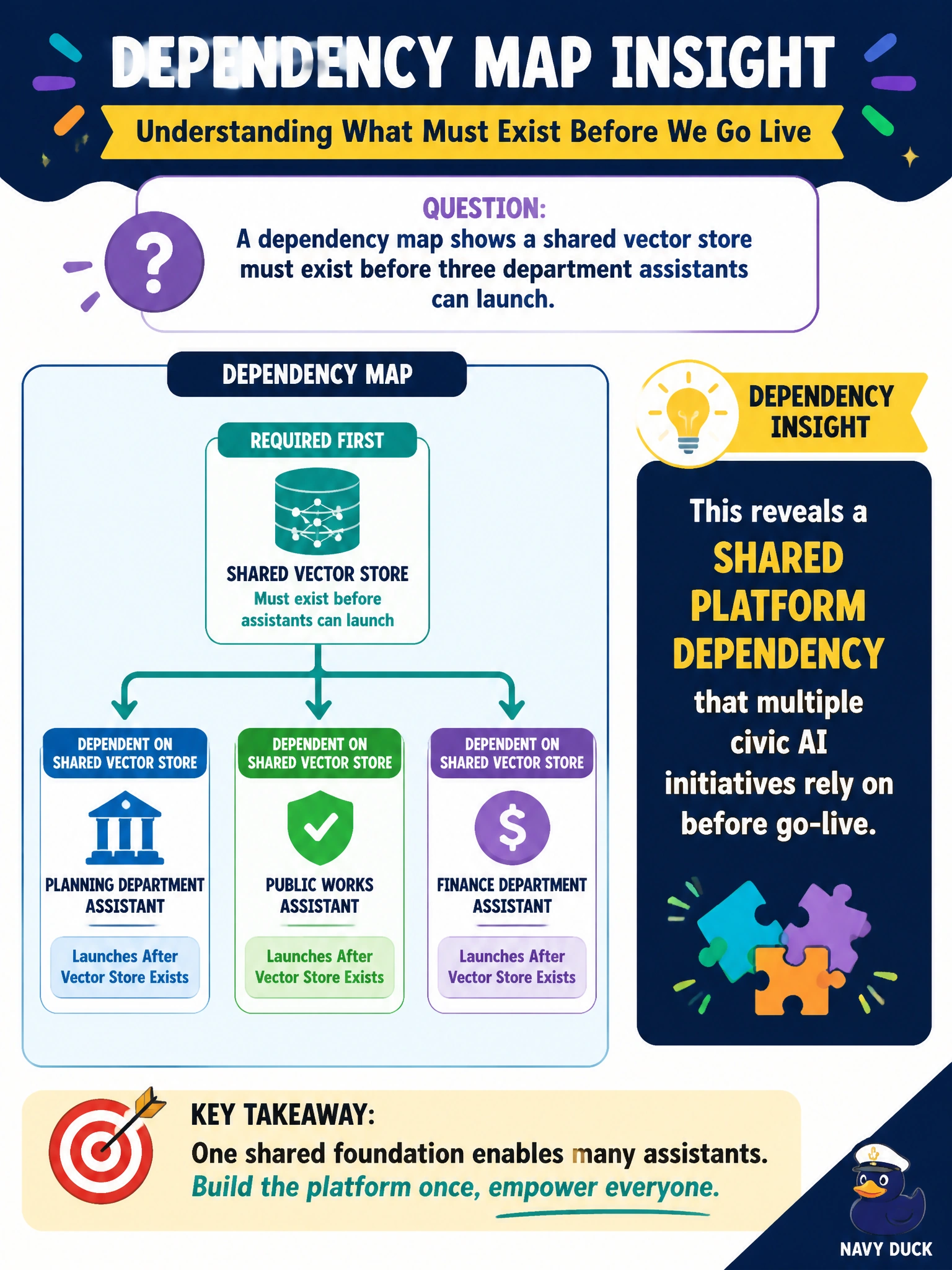
A dependency map shows a shared vector store must exist before three department assistants can launch. What dependency insight does this provide?
Select an answer to reveal the explanation.
Short Explanation
Three assistants, one pantry. If the shared vector store isn’t built, none of those department bots get dinner.
Full Explanation
Dependency maps show shared platform prerequisites that multiple initiatives rely on. If three department assistants need a shared vector store before go-live, the map reveals a common blocker and a common unlock: sequence the vector store (and its governance, access control, and evaluation) so several launches become possible. That insight prevents each department from inventing private retrieval stacks and clarifies platform investment value.
Each department needs an unrelated private stack with no shared platform fails the insight and multiplies cost and inconsistency. Assistants can launch safely with no retrieval infrastructure at all fails for knowledge-grounded municipal assistants that must cite or retrieve authoritative content. Vector stores are irrelevant once chat UIs are branded fails because branding does not substitute for retrieval quality or shared infrastructure readiness.
Exam caveat: a shared vector store still needs data stewardship, tenancy or access boundaries, and evaluation—sharing is not a shortcut past governance. Operational check: maintain a cross-department dependency map for civic AI; fund and staff shared prerequisites explicitly, and do not allow three independent “temporary” stores to become permanent fragmentation.