
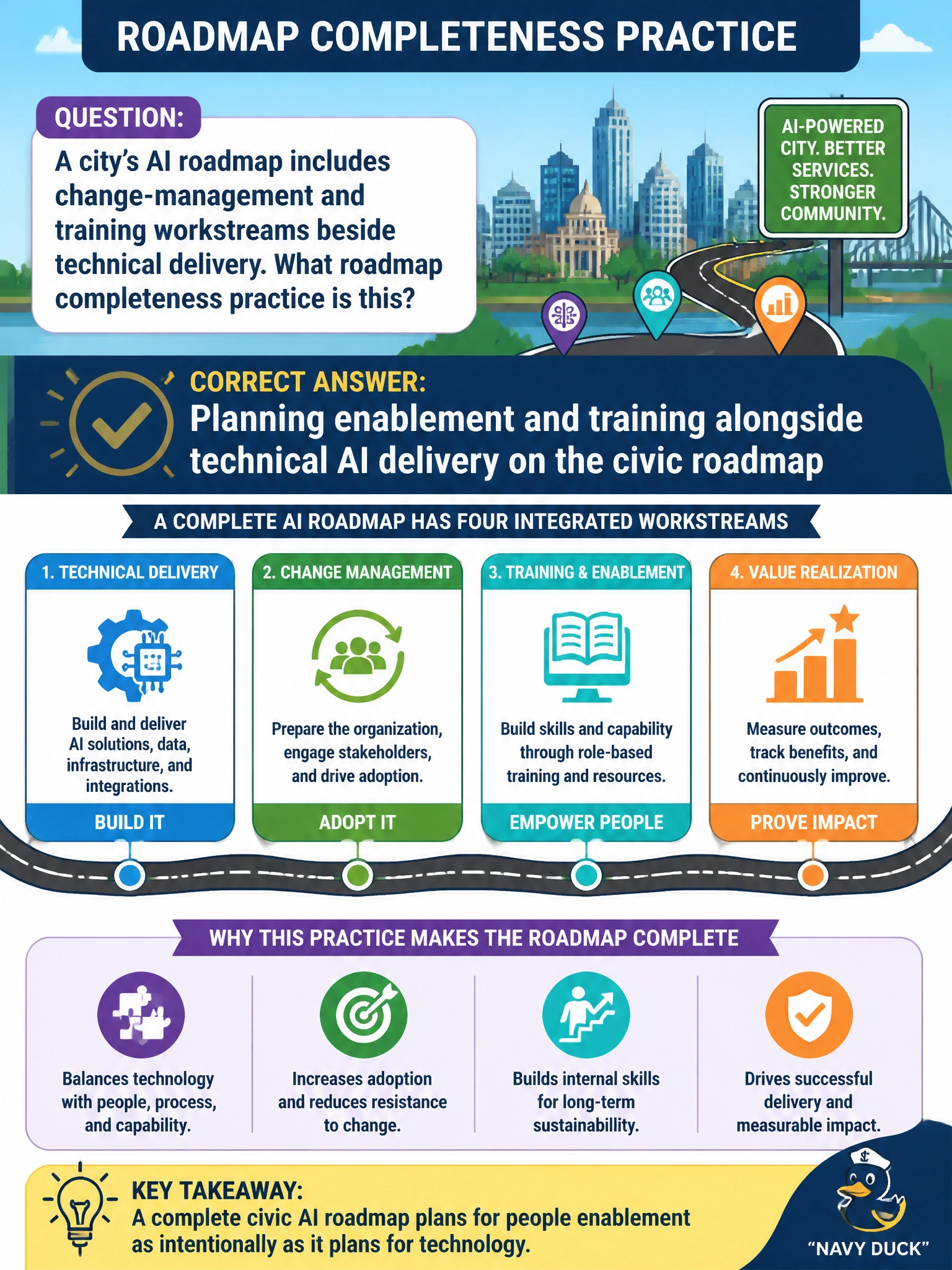
A city’s AI roadmap includes change-management and training workstreams beside technical delivery. What roadmap completeness practice is this?
Select an answer to reveal the explanation.
Short Explanation
Code ships; people still need a map. Put training and change work on the same roadmap as the tech, or adoption stalls in the hallway.
Full Explanation
Complete municipal AI roadmaps plan enablement—change management and training—alongside technical delivery. Staff who take 311 calls, review permits, or dispatch crews need new workflows, escalation rules, and confidence in when to trust or override AI outputs. Putting those workstreams on the roadmap allocates budget and time instead of assuming adoption will happen spontaneously. Technology-only plans consistently underperform in government because the human system is part of the service residents actually experience.
Listing only engineering tasks and assuming staff will adapt without support fails change reality and leaves frontline teams improvising. Deferring all training until after a failed citywide launch fails residents and staff and wastes political capital that is hard to regain. Removing change management because technology alone guarantees adoption fails; technology does not guarantee adoption, correct use, or safe override behavior in civic settings.
Exam caveat: training must include policy and ethics for high-impact uses, not only button-click tutorials on a new interface. Operational check: for each AI go-live on the civic roadmap, require named change and training deliverables, audience lists, completion metrics, and a post-launch reinforcement plan before declaring operational readiness to leadership.