
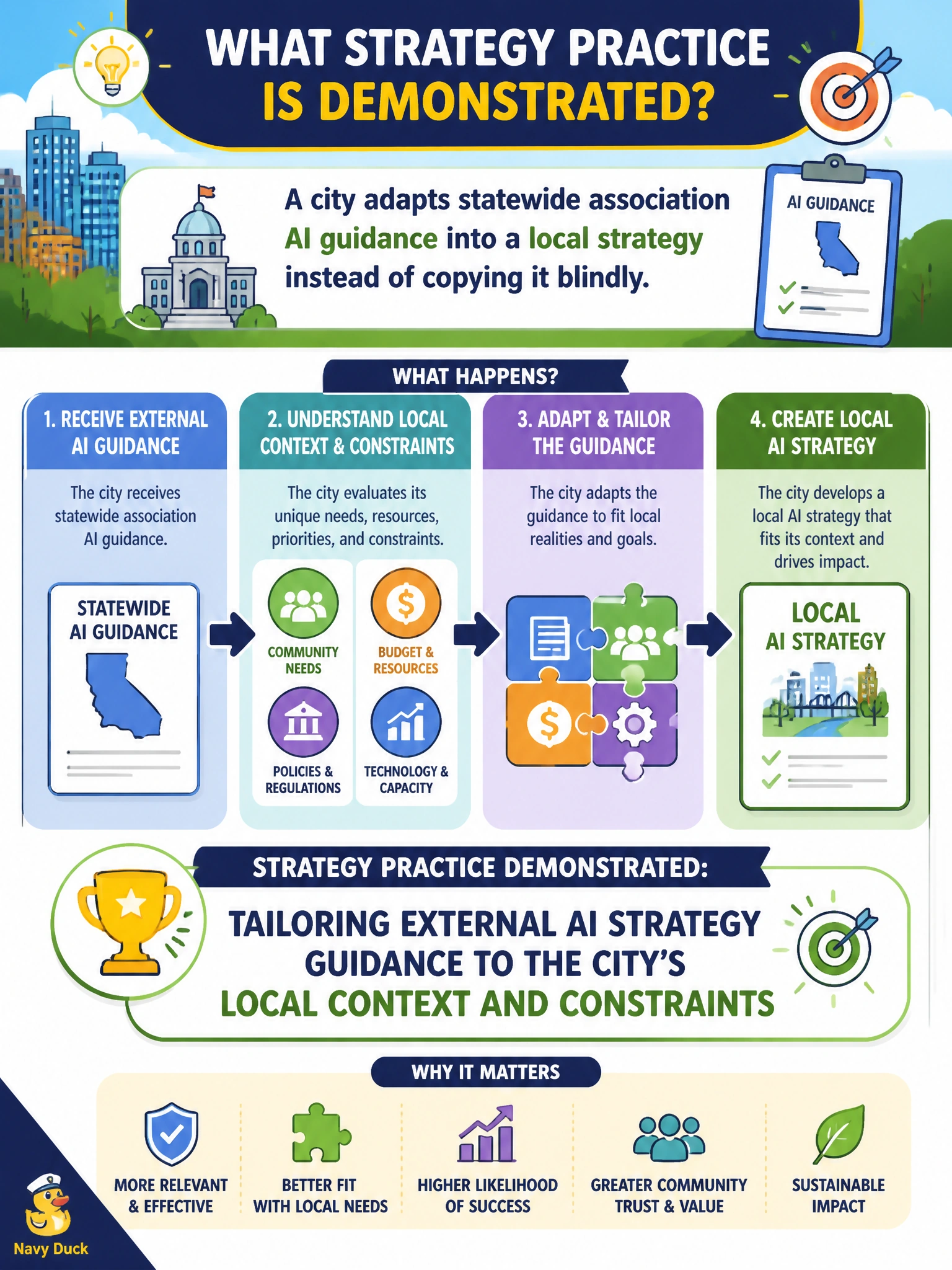
A city adapts statewide association AI guidance into a local strategy instead of copying it blindly. What strategy practice is demonstrated?
Select an answer to reveal the explanation.
Short Explanation
Peer guidance is a recipe card, not a photocopy. Adapt the statewide tips to your city’s kitchen—staffing, systems, and laws included.
Full Explanation
Tailoring external AI strategy guidance to local context is sound municipal practice. Statewide association guidance offers patterns, risk categories, and role models, but each city has different charters, bargaining agreements, legacy systems, staffing, and risk appetite. Adapting guidance means translating principles into local policy, operating model, and roadmap constraints rather than photocopying another jurisdiction’s binder. The result is usable strategy staff can execute.
Ignoring all external guidance and inventing conflicting rules weekly fails by discarding peer learning and creating instability. Pasting another city’s entire strategy without local context fails because mismatched legal and operational assumptions produce shelfware or noncompliant practice. Waiting for a statewide mandate before any local planning is allowed fails subsidiarity: cities can and should plan within existing authorities while watching for higher-level rules.
Exam caveat: adaptation is not a license to weaken non-negotiable legal requirements that do apply locally. Operational check: when adopting association AI guidance, produce a short gap analysis—what applies as-is, what needs local rewrite, what is out of scope—and assign owners for each local policy artifact before declaring the strategy “done.”