
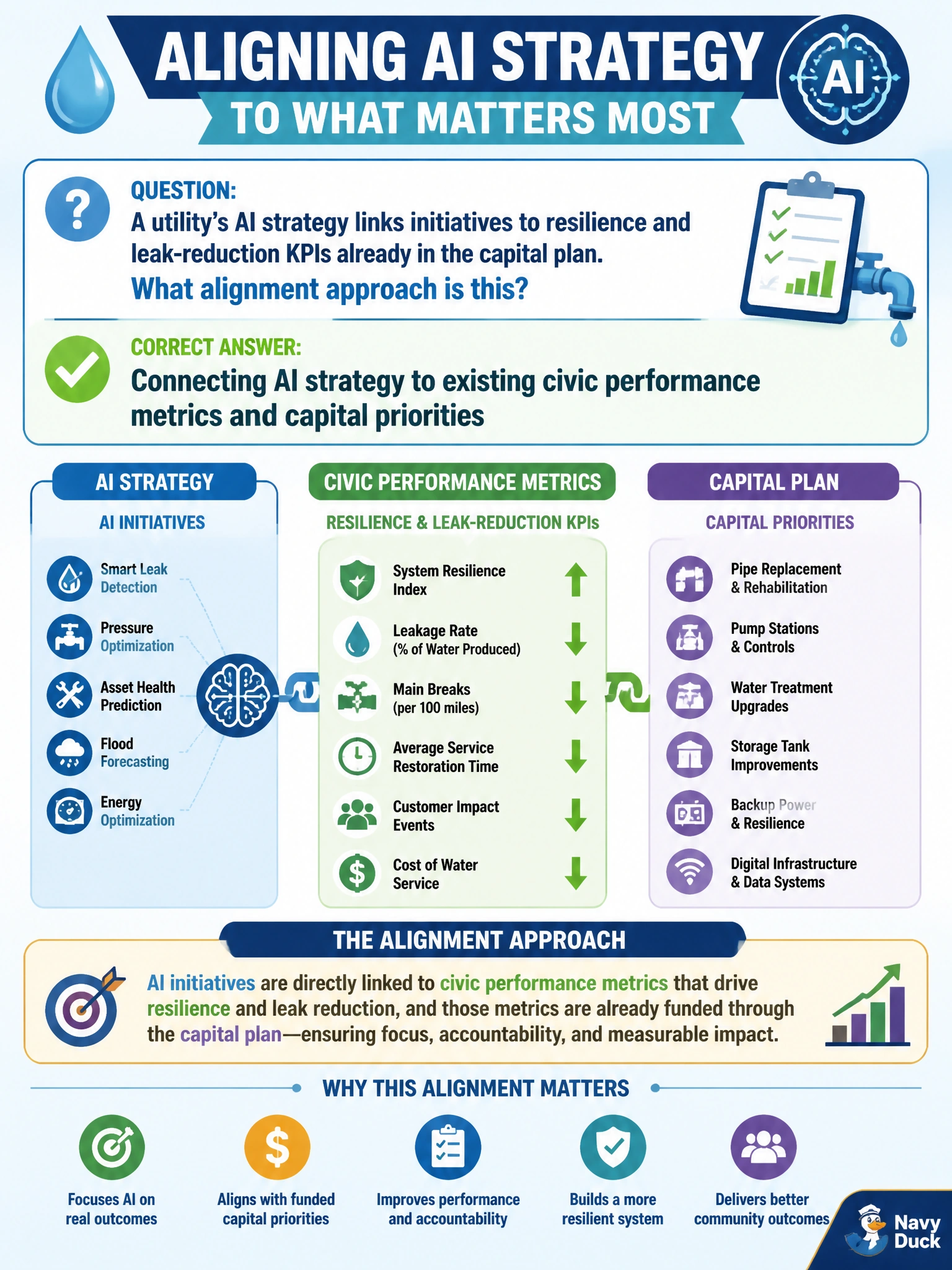
A utility’s AI strategy links initiatives to resilience and leak-reduction KPIs already in the capital plan. What alignment approach is this?
Select an answer to reveal the explanation.
Short Explanation
Don’t invent a new scoreboard when the capital plan already tracks leaks and resilience. Hook AI strategy to the KPIs the city already lives by.
Full Explanation
Connecting AI strategy to existing civic performance metrics and capital-plan priorities anchors AI in accountability systems the city already runs. For a utility, resilience and leak-reduction KPIs are concrete, budgeted outcomes. Linking AI initiatives to those measures clarifies why models for anomaly detection, prioritization of crews, or predictive maintenance deserve funding—and how success will be judged. It also prevents parallel “AI scoreboards” that council cannot reconcile with capital reality.
Inventing unrelated vanity metrics that ignore capital-plan goals fails alignment and confuses oversight. Disconnecting AI work from any published performance measures fails because unmeasured programs drift and cannot defend budget. Replacing all capital KPIs with undefined “AI vibes” fails as governance language and provides no operational target.
Exam caveat: mapping to existing KPIs still requires validating that AI can causally influence those KPIs and that data quality supports measurement. Operational check: for each utility AI initiative, cite the exact capital-plan KPI, baseline, expected contribution, and how confounding factors (weather, staffing) will be handled in reporting to leadership.