
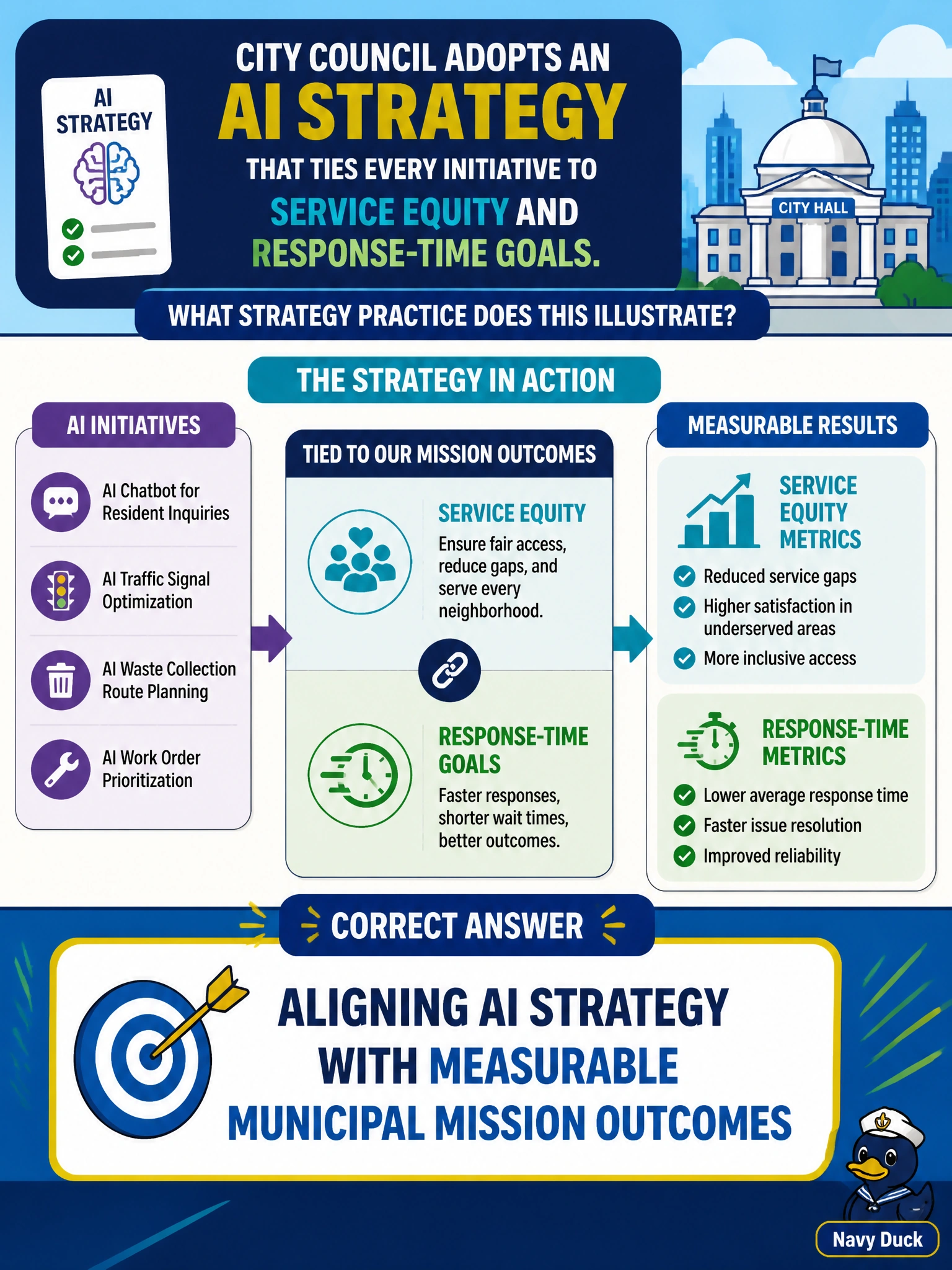
City council adopts an AI strategy that ties every initiative to service equity and response-time goals. What strategy practice does this illustrate?
Select an answer to reveal the explanation.
Short Explanation
If AI can’t help equity or response times, it doesn’t belong in the strategy binder. Tie every initiative to real city outcomes, not vanity fireworks.
Full Explanation
Effective municipal AI strategy ties initiatives to measurable mission outcomes already valued by the city—here, service equity and response-time goals. That practice converts AI from a technology fashion into an instrument of public service performance. When council adopts a strategy requiring every initiative to map to those outcomes, portfolio intake, funding, and retirement decisions gain a shared yardstick. Equity and response-time metrics also surface disparate impacts early, which matters for resident-facing automation.
Treating AI as a standalone vanity program with no service outcomes fails because vanity programs consume budget without accountable civic results. Writing strategy that deliberately ignores equity and response times fails the mission-alignment practice and invites harmful or irrelevant deployments. Funding AI only when it cannot map to any adopted city goal fails by inverting the rule: inability to map to goals should block funding, not enable it.
Exam caveat: outcome alignment must be specific and measurable; vague claims like “improves equity somehow” are not strategy discipline. Operational check: for each AI initiative in the municipal portfolio, list the equity or response-time KPI baselines, the expected movement, measurement method, and reporting cadence to council—park any initiative that cannot complete that mapping.