
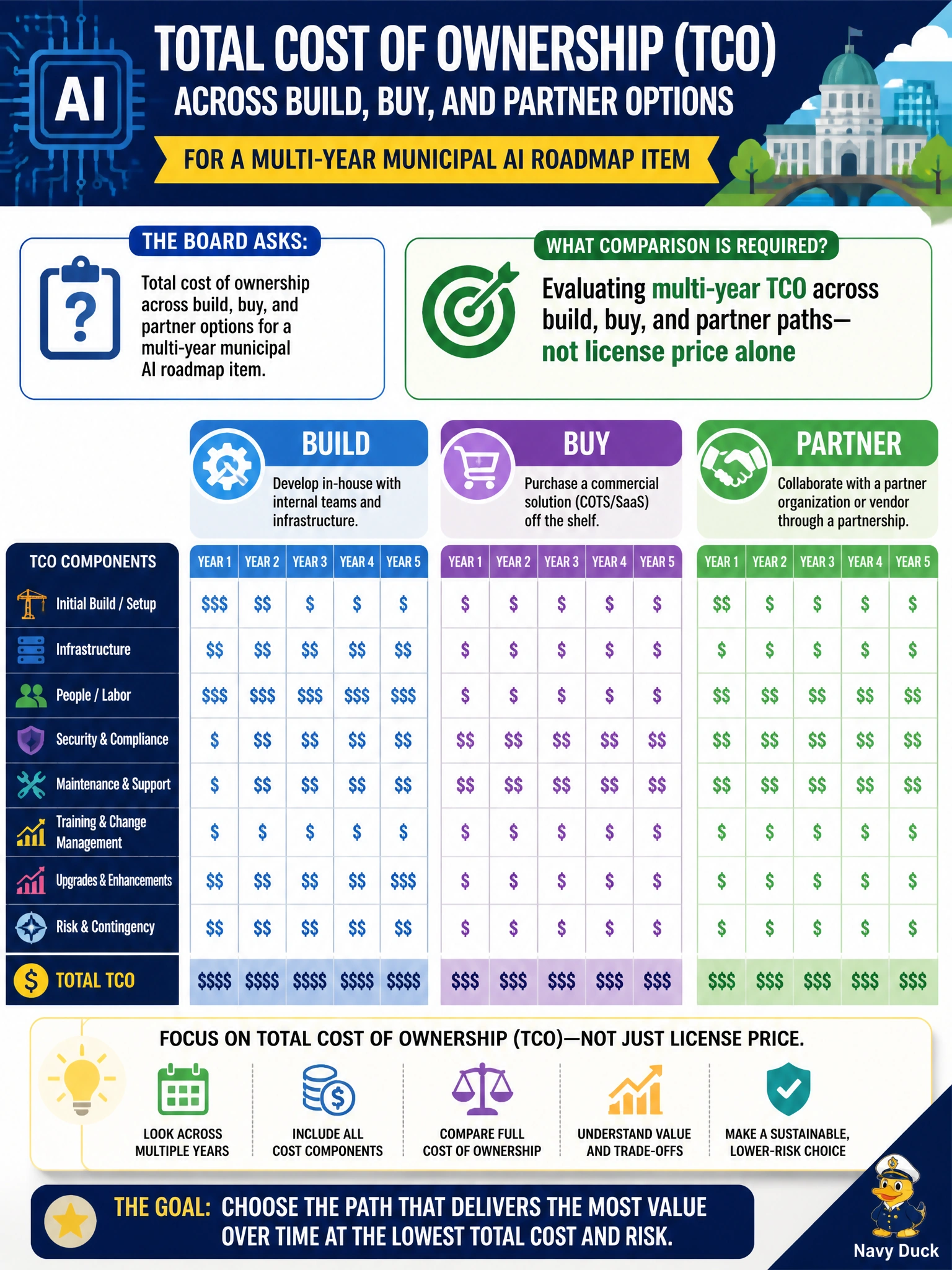
The board asks for total cost of ownership across build, buy, and partner options for a multi-year municipal AI roadmap item. What comparison is required?
Select an answer to reveal the explanation.
Short Explanation
Sticker price is the appetizer; TCO is the whole meal. The board wants build, buy, and partner costs across years, not one shiny invoice.
Full Explanation
Total cost of ownership (TCO) comparison across build, buy, and partner paths is the correct economic frame for multi-year municipal AI roadmap items. TCO includes licenses or development, integration, infrastructure, staffing, change management, training, monitoring, model refresh, vendor management, and decommissioning—not only a first invoice. Boards that insist on TCO force apples-to-apples comparison of custom builds that look “free” on day one, SaaS that looks cheap monthly, and partnerships that shift costs into grants or shared services with hidden sustainment tails.
Comparing only the first month’s SaaS invoice and ignoring staff and sustainment fails because short-horizon sticker price understates civic operating reality. Assuming build has zero cost because city employees already exist fails because employee time is scarce capacity with opportunity cost, and builds incur tooling, testing, and long-term maintenance. Selecting partner solely because grant language sounds innovative fails as a cost comparison: narrative innovation is not TCO analysis.
Exam caveat: lowest TCO is not automatically the right choice when residency, explainability, or sovereignty constraints eliminate an option. Operational check: require a multi-year TCO worksheet for build, buy, and partner alternatives with explicit line items for integration and staff FTE, and present residual risk alongside cost so the municipal board does not optimize price alone.