
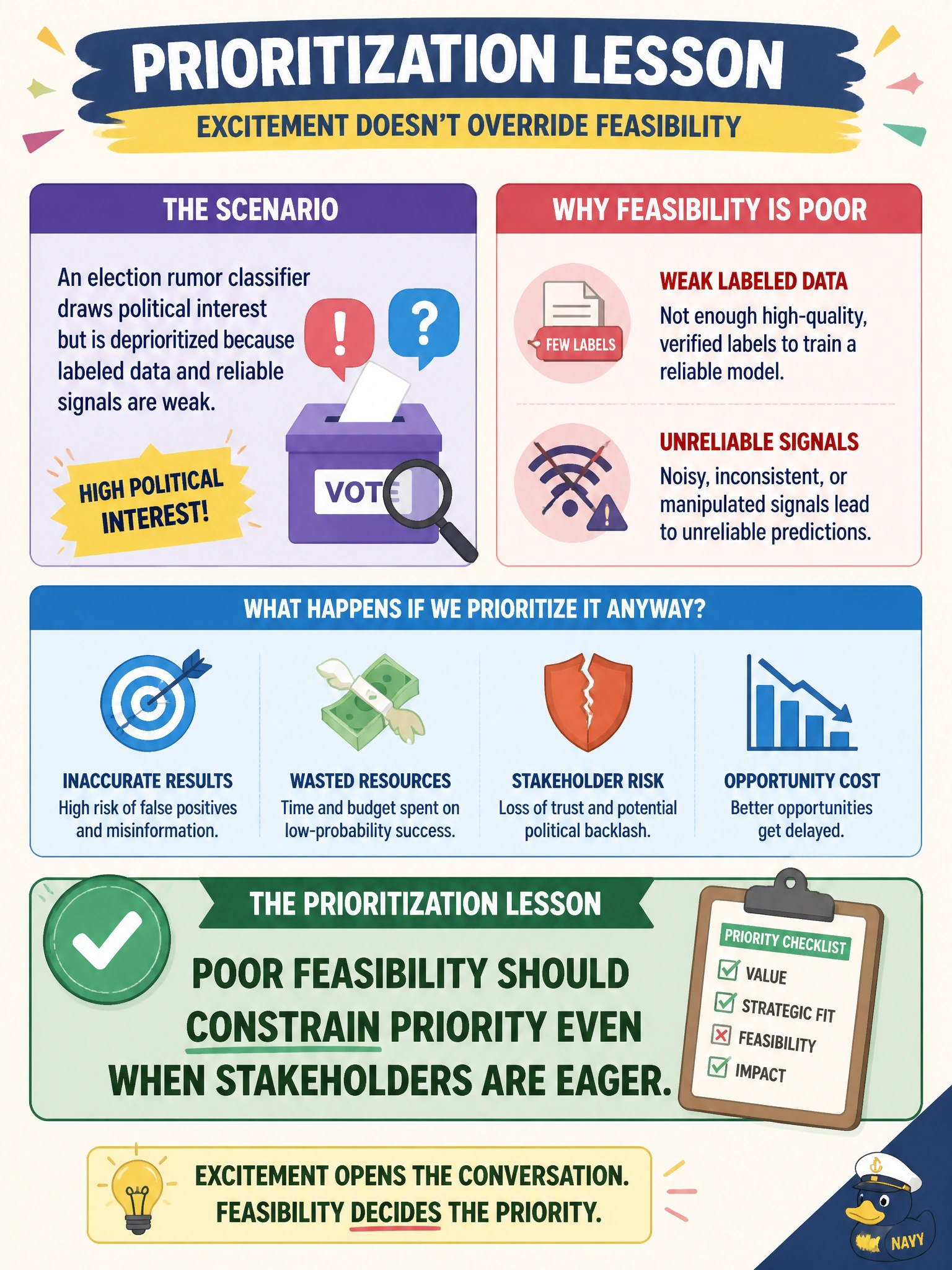
An election rumor classifier draws political interest but is deprioritized because labeled data and reliable signals are weak. What prioritization lesson applies?
Select an answer to reveal the explanation.
Short Explanation
Excitement without labeled data is a parade float with no chassis. Feasibility—especially thin signals—can and should park a hot idea until the foundation exists.
Full Explanation
When an election rumor classifier draws political interest but is deprioritized because labeled data and reliable signals are weak, the prioritization lesson is that poor feasibility should constrain priority even when stakeholders are eager. Political heat does not create training labels, stable definitions of ‘rumor,’ or trustworthy input channels. The correct lesson works because civic AI portfolios must resist urgency bias: launching a weak classifier in an elections context can cause more harm than delay.
Claiming political interest alone must always outrank feasibility fails because enthusiasm without foundations produces brittle, contested systems. Asserting election-related ideas should never be evaluated for data readiness fails conceptually—the opposite of sound practice; elections uses demand extra readiness scrutiny. Treating deprioritization as a permanent ban on all analytics in elections offices fails because a single infeasible classifier does not invalidate every future data use; it only defers this one until feasibility improves.
Exam caveat: deprioritization should include a revisit trigger (for example, labeled corpus size, signal quality threshold, governance clearance), not silent abandonment without criteria. Operational check: document the feasibility blockers (labels, signal quality, legal constraints), communicate them to eager stakeholders with a remediation path, and keep the item in a monitored backlog rather than forcing a premature build.