
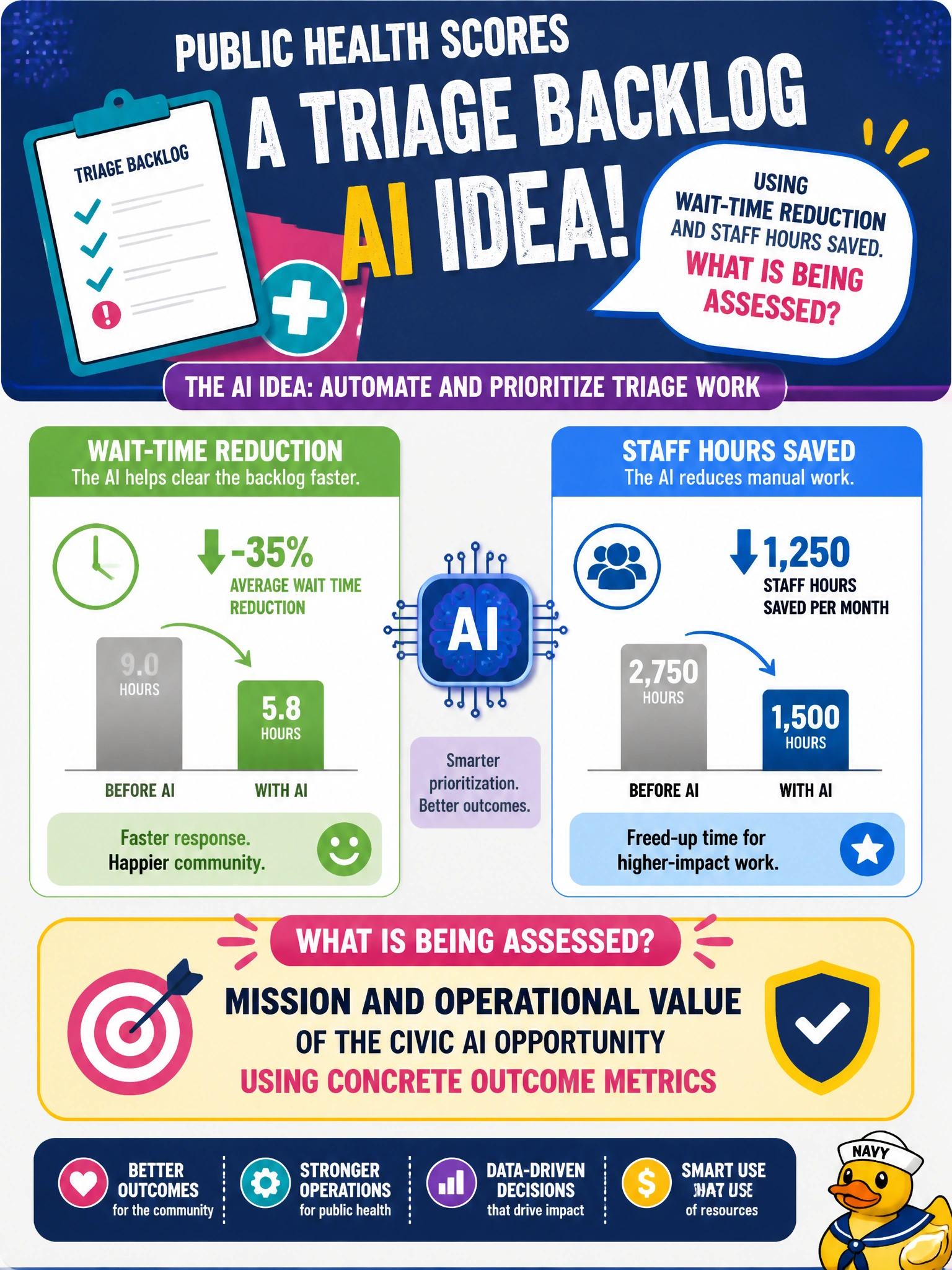
Public health scores a triage backlog AI idea using wait-time reduction and staff hours saved. What is being assessed?
Select an answer to reveal the explanation.
Short Explanation
You’re assessing value through wait-time reduction and staff hours saved—not poster art or logo matching. Those concrete outcomes help you judge whether AI supports the public health mission.
Full Explanation
When public health scores a triage backlog AI idea using wait-time reduction and staff hours saved, it is assessing the mission and operational value of the civic AI opportunity through concrete outcome metrics. Value framing connects the proposed system to outcomes the department already manages—faster triage and reclaiming clinician or intake time—rather than abstract “innovation” language. Prioritization and later benefits tracking both depend on measurable mission outcomes. The aesthetic of the waiting-room poster fails as a measure because décor quality is unrelated to triage backlog value. Whether the AI logo matches the department seal also fails conceptually: brand alignment is not mission value. Treating the backlog of unread general-inbox emails as the only measure fails because inbox volume is a weak, easily gamed proxy that may not reflect patient wait times or staff capacity outcomes tied to triage. Exam caveat: operational metrics must be paired with safety and equity checks in public health; faster triage that systematically disadvantages certain populations is not mission success. Practical check: define baseline wait-time and staff-hour measures, set target changes for the pilot, instrument the workflow to capture them, and include clinical oversight criteria so speed gains do not silently degrade care quality.