
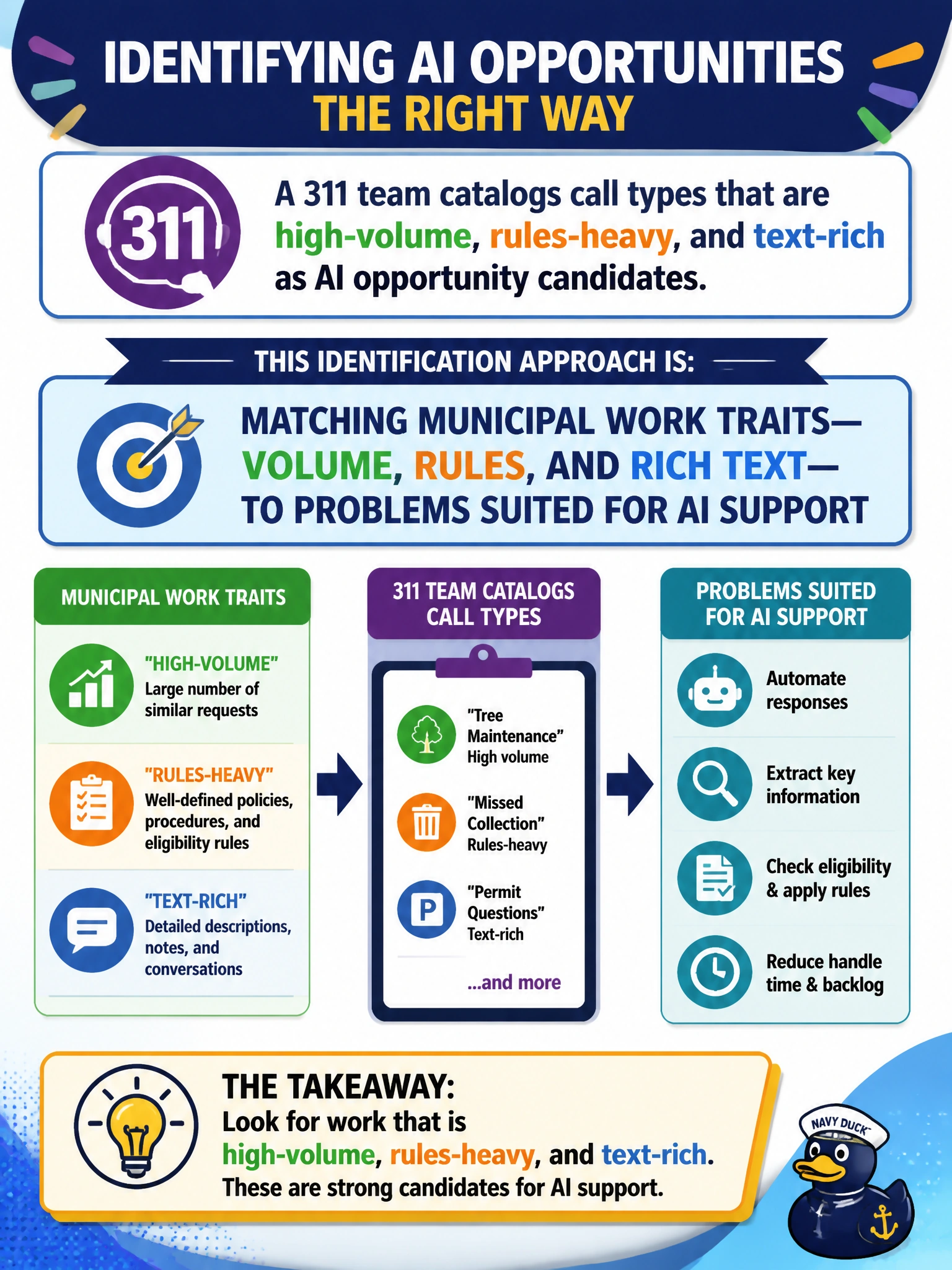
A 311 team catalogs call types that are high-volume, rules-heavy, and text-rich as AI opportunity candidates. What identification approach is this?
Select an answer to reveal the explanation.
Short Explanation
AI loves busy, ruley, wordy work the way a plow loves a predictable snow route. Cataloging those call traits is how 311 finds real opportunity, not vendor-inbox roulette.
Full Explanation
When a 311 team catalogs call types that are high-volume, rules-heavy, and text-rich as AI opportunity candidates, the identification approach is matching municipal work traits—volume, rules, and rich text—to problems suited for AI support. Those traits often indicate repeatable patterns where classification, retrieval, drafting, or triage assistance can reduce backlog without inventing novel policy. The correct answer works because opportunity discovery starts from the nature of the work, not from whichever tool is fashionable that quarter.
Selecting only the rarest, one-of-a-kind calls with no patterns fails because unique edge cases rarely yield scalable AI value and are often better handled by skilled humans. Choosing opportunities solely by which vendor emailed first fails conceptually—vendor outreach order is not a work-trait analysis and invites solution-first bias. Avoiding any high-volume queues because AI cannot help with repetition fails because repetition is precisely where many assistive AI patterns excel when rules and text signals exist.
Exam caveat: high volume plus text is necessary but not sufficient; fairness, privacy, and escalation sensitivity can disqualify or tightly constrain a queue even when it scores well on volume traits. Operational check: score candidate call types on volume, rule stability, text richness, and sensitivity; shortlist only those with clear human-in-the-loop designs; and validate with frontline staff before promising automation levels to leadership.