
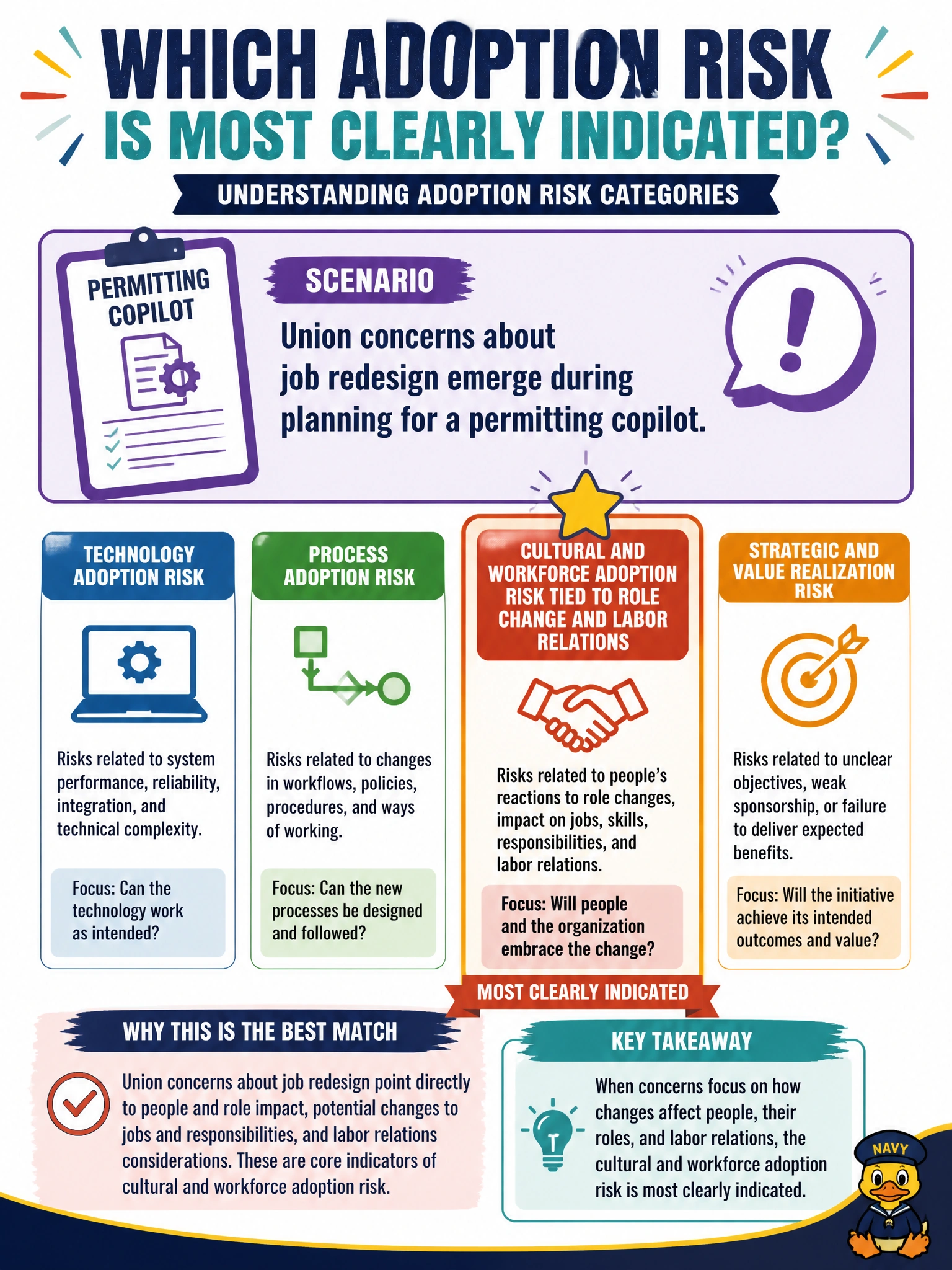
Union concerns about job redesign emerge during planning for a permitting copilot. Which adoption risk category is most clearly indicated?
Select an answer to reveal the explanation.
Short Explanation
When the union leans in about job redesign, that is culture and workforce risk waving a flag. Ignore it and the permitting copilot becomes a labor fight instead of a helper.
Full Explanation
Union concerns about job redesign during planning for a permitting copilot most clearly indicate cultural and workforce adoption risk tied to role change and labor relations. Civic AI often changes task mix, performance expectations, and skill requirements; labor agreements and trust dynamics can block adoption even when the model is accurate. The correct category works because it names the people-and-process risk: without engagement, training, and role clarity, staff may refuse, underuse, or work around the copilot.
Framing the issue as a pure network-cabling shortage with no people implications fails because the stem’s signal is labor concern, not physical plant. Limiting risk to the font size on the permit PDF fails conceptually—typography is not an adoption risk category and does not address role redesign. Assuming union concerns will fade because copilots win immediate support from all staff fails because adoption is never automatic; public-sector labor contexts frequently require negotiation, consultation, and redesign of procedures.
Exam caveat: workforce risk is distinct from pure skills-gap risk; training alone may not resolve issues that are really about classification, workload, surveillance fears, or bargaining status. Operational check: engage labor relations early, document which tasks the copilot assists versus decides, define human review expectations, and include change-management milestones in the permitting pilot plan before scaling.