
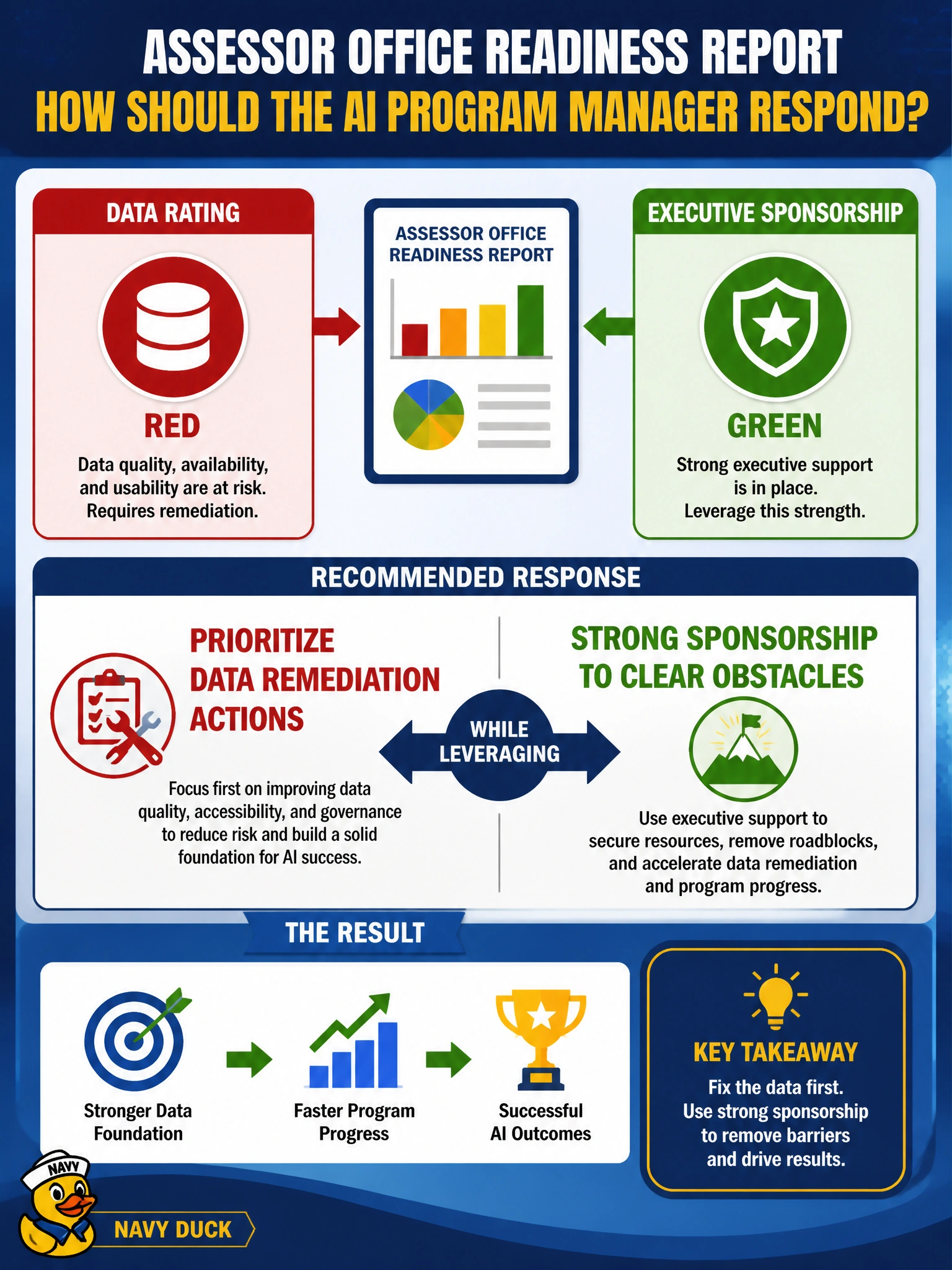
An assessor office readiness report rates data as red and executive sponsorship as green. How should the AI program manager respond?
Select an answer to reveal the explanation.
Short Explanation
Green sponsorship with red data is a powerful engine pointed at a muddy road. Use the sponsors to pave the data path—do not pretend mud is optional.
Full Explanation
When an assessor office readiness report rates data as red and executive sponsorship as green, the AI program manager should prioritize data remediation while leveraging strong sponsorship to clear obstacles. Dimensional scoring exists so leaders can use strengths to fix weaknesses: sponsors can unlock funding, data stewardship mandates, and cross-system access that technical staff alone cannot obtain. The correct response works because green sponsorship does not magically create clean parcels, linkages, or quality controls—those remain blockers until remediated.
Treating green sponsorship as permission to ignore data gaps forever fails because sponsorship without usable data yields unreliable AI and political exposure when assessor outputs are wrong. Flipping colors randomly to avoid hard conversations fails conceptually—it destroys the diagnostic value of the report and undermines trust with leadership. Canceling sponsorship meetings because data scores look worse fails because that abandons the very leverage needed to fix data; the right move is to put data remediation on the sponsor agenda.
Exam caveat: ‘red data’ should be decomposed (quality, access, lineage, documentation, legal use constraints); not every red is the same fix, and some may be temporary no-go for sensitive AI uses. Operational check: produce a data remediation backlog with owners and dates, brief sponsors on dependencies for any proposed AI, and refuse model-build milestones that still require unresolved critical data defects.