
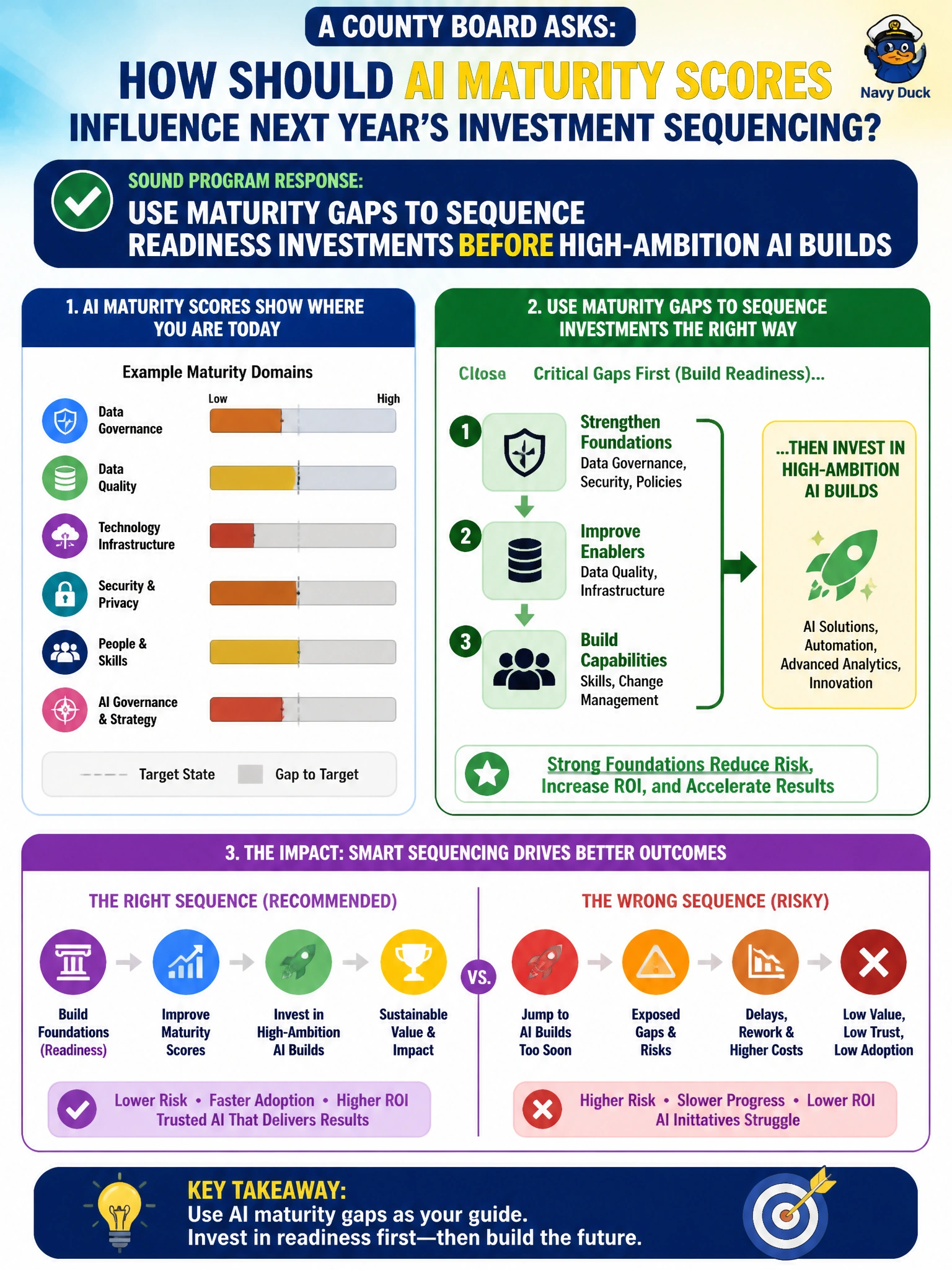
A county board asks how AI maturity scores should influence next year’s investment sequencing. What is the sound program response?
Select an answer to reveal the explanation.
Short Explanation
Maturity scores are a construction schedule, not a popularity contest. Fix the weak floors—data, skills, governance—before stacking a fancy penthouse model on top.
Full Explanation
When a county board asks how AI maturity scores should influence next year’s investment sequencing, the sound program response is to use maturity gaps to sequence readiness investments before high-ambition AI builds. Scores are most valuable as a prioritization input: weak data, skills, or governance dimensions should be funded early so later models and copilots have a viable operating environment. The correct answer works because it connects diagnostic evidence to capital and operating planning instead of treating maturity as decorative reporting.
Ignoring scores and funding the loudest department first fails because political volume is not readiness; it produces brittle deployments and wasted spend. Treating every low score as a reason to cancel all digital services fails conceptually—low maturity argues for targeted remediation and restrained ambition, not wholesale shutdown of digital government. Converting maturity scores into parking-ticket quotas fails because enforcement metrics have no causal relationship to AI capability sequencing and confuses unrelated civic functions.
Exam caveat: sequencing readiness first does not mean freezing all AI indefinitely; small, well-scoped pilots can still proceed where local readiness is adequate, provided portfolio rules prevent leapfrogging critical gaps. Operational check: publish a gap-to-investment map for the board (dimension, gap, funded action, dependency for which AI builds), and withhold approval for high-ambition projects that still depend on unresolved red dimensions.