
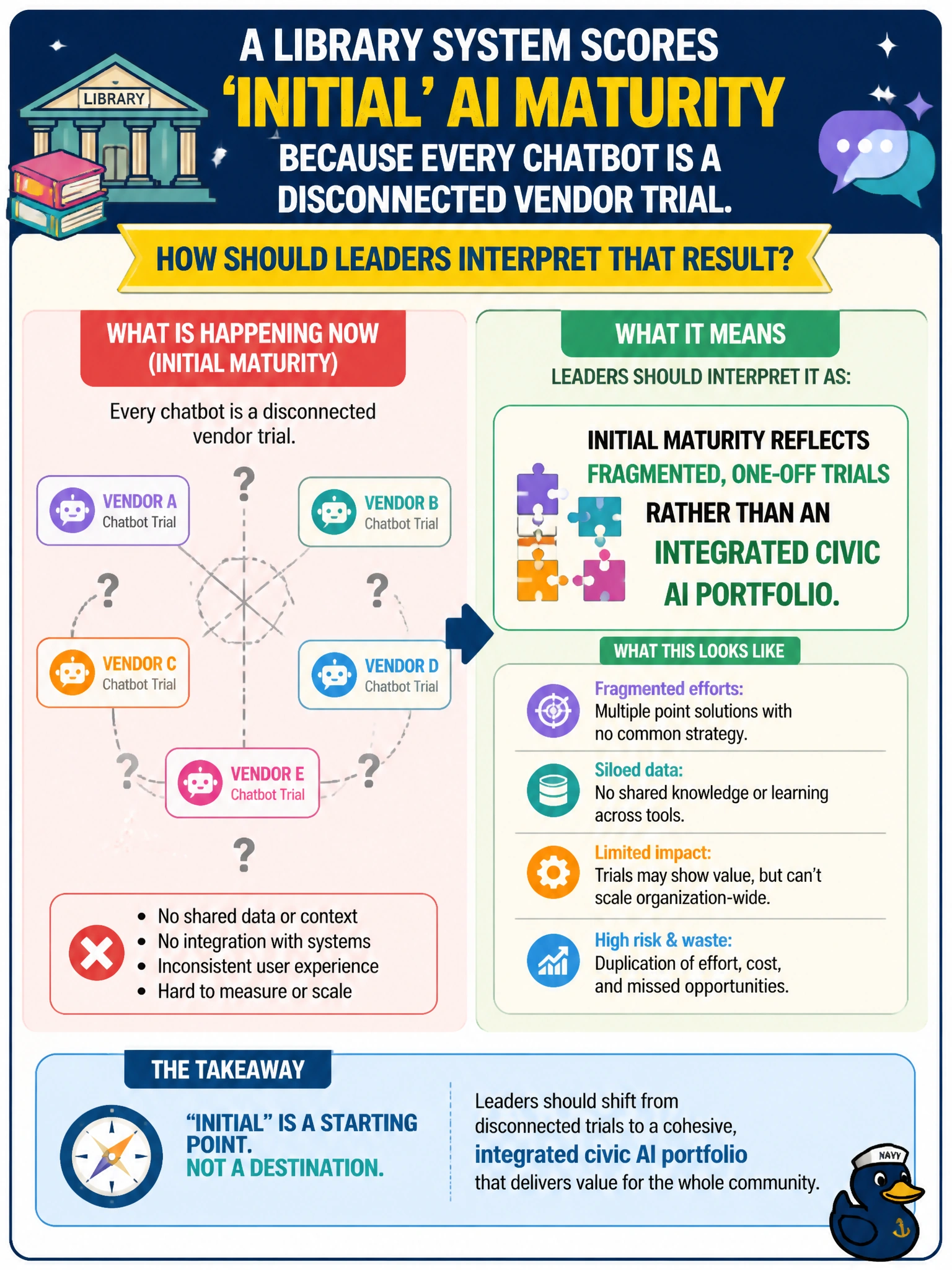
A library system scores ‘initial’ AI maturity because every chatbot is a disconnected vendor trial. How should leaders interpret that result?
Select an answer to reveal the explanation.
Short Explanation
You can read ‘initial’ as a baseline: the chatbots are fragmented trials, not an integrated civic AI portfolio. Treat the score as a map pin—not a blank check for hardware or a ban on digital help.
Full Explanation
A library system scoring ‘initial’ AI maturity because every chatbot is a disconnected vendor trial should interpret the result as evidence of fragmented, one-off trials rather than an integrated civic AI portfolio. Initial or early maturity labels typically mean experiments exist without shared standards, integration patterns, shared knowledge bases, portfolio oversight, or a consistent resident experience across branches. The score is actionable: the problem is not ‘no AI,’ but unmanaged AI that cannot scale safely or coherently across the system. Saying the score proves libraries never need shared standards fails because initial maturity calls for standards and integration, not a permanent exemption. Saying residents must never use digital services fails because maturity scoring diagnoses organizational capability; it does not ban public digital access. Treating the score as enough reason to fund a citywide GPU cluster before assessing needs fails because hardware does not remedy fragmented vendor trials; governance, content quality, privacy, and portfolio management do. Exam caveat: ‘initial’ is not a permanent judgment; it is a baseline. Jumping to advanced generative features before closing integration and policy gaps can increase resident harm and staff confusion. Practical check: inventory every chatbot and vendor trial, define shared content and escalation standards, assign a system product owner, and require portfolio intake before new branch-level AI purchases.