
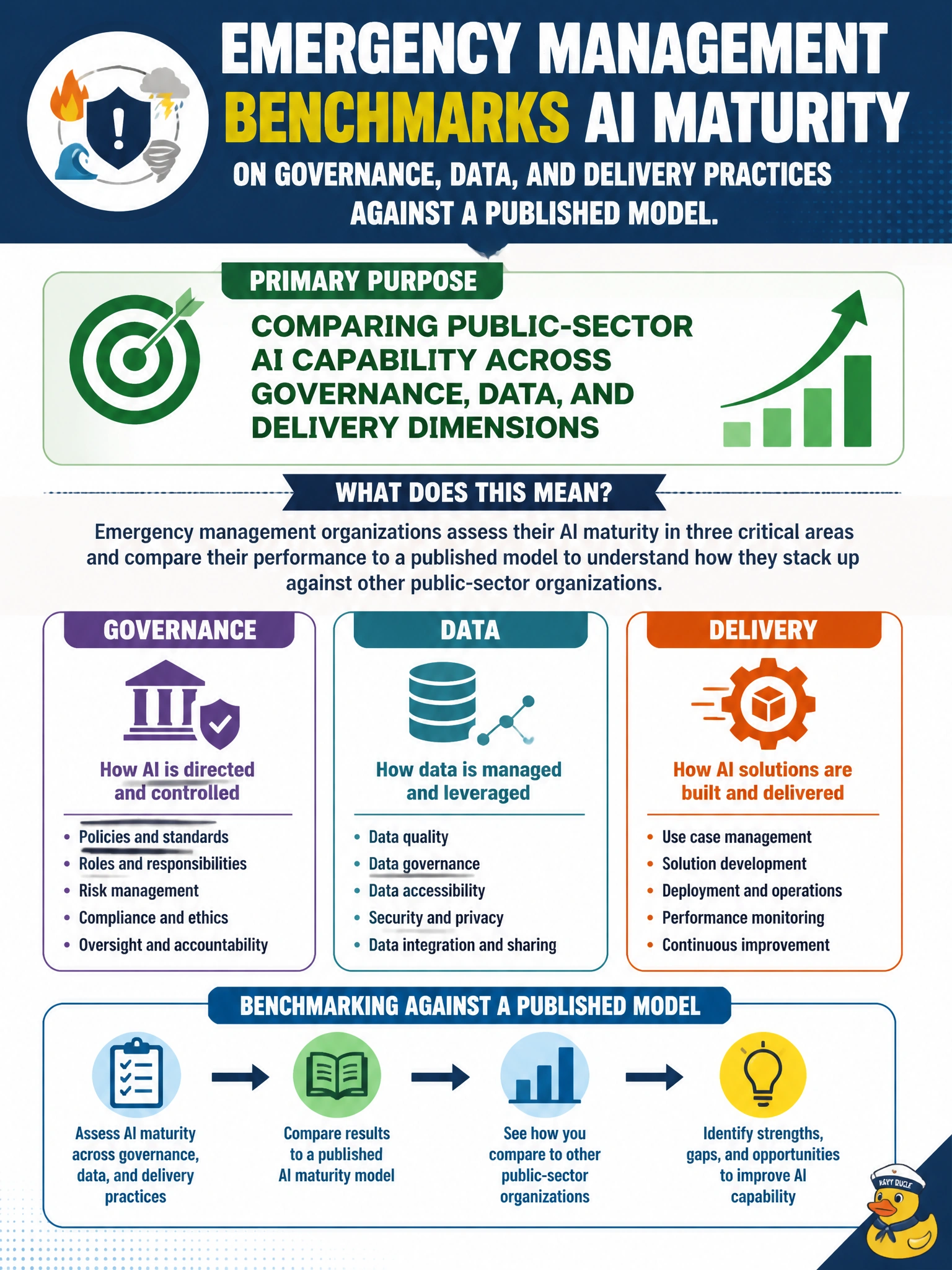
Emergency management benchmarks AI maturity on governance, data, and delivery practices against a published model. What is the primary purpose?
Select an answer to reveal the explanation.
Short Explanation
A maturity model is a report card with columns for governance, data, and delivery—not a paint chip deck. Benchmarking those columns shows where emergency AI is sturdy and where it still wobbles.
Full Explanation
Emergency management’s primary purpose in benchmarking AI maturity against a published model on governance, data, and delivery practices is to compare public-sector AI capability across those dimensions in a structured way. Published models give emergency managers a consistent lens for judging whether command-adjacent AI uses are supported by policy, usable data, and disciplined delivery—not merely by enthusiasm after an exercise. The correct answer works because multi-dimensional comparison reveals where an emergency AI program is strong (for example, sponsorship) and where it is fragile (for example, data lineage or after-action quality controls) before life-safety workflows depend on it.
Choosing emergency vehicle paint colors for brand consistency fails because branding aesthetics are unrelated to AI capability assessment; maturity benchmarking is about operating practices, not fleet cosmetics. Eliminating the need for any operational procedures after AI arrives fails conceptually because AI does not remove the requirement for SOPs, roles, and after-action discipline—it often increases the need to update them. Replacing after-action reviews with unverified chat transcripts fails because maturity in delivery and governance requires validated learning loops, not untrusted generative text standing in for formal review.
Exam caveat: a high maturity score in non-emergency domains does not automatically transfer to emergency management; continuity, failover, and human override expectations remain distinct. Operational check: score governance, data, and delivery separately; attach each gap to a remediation owner; and verify that any AI used near incident response has tested escalation paths and documented human accountability.