
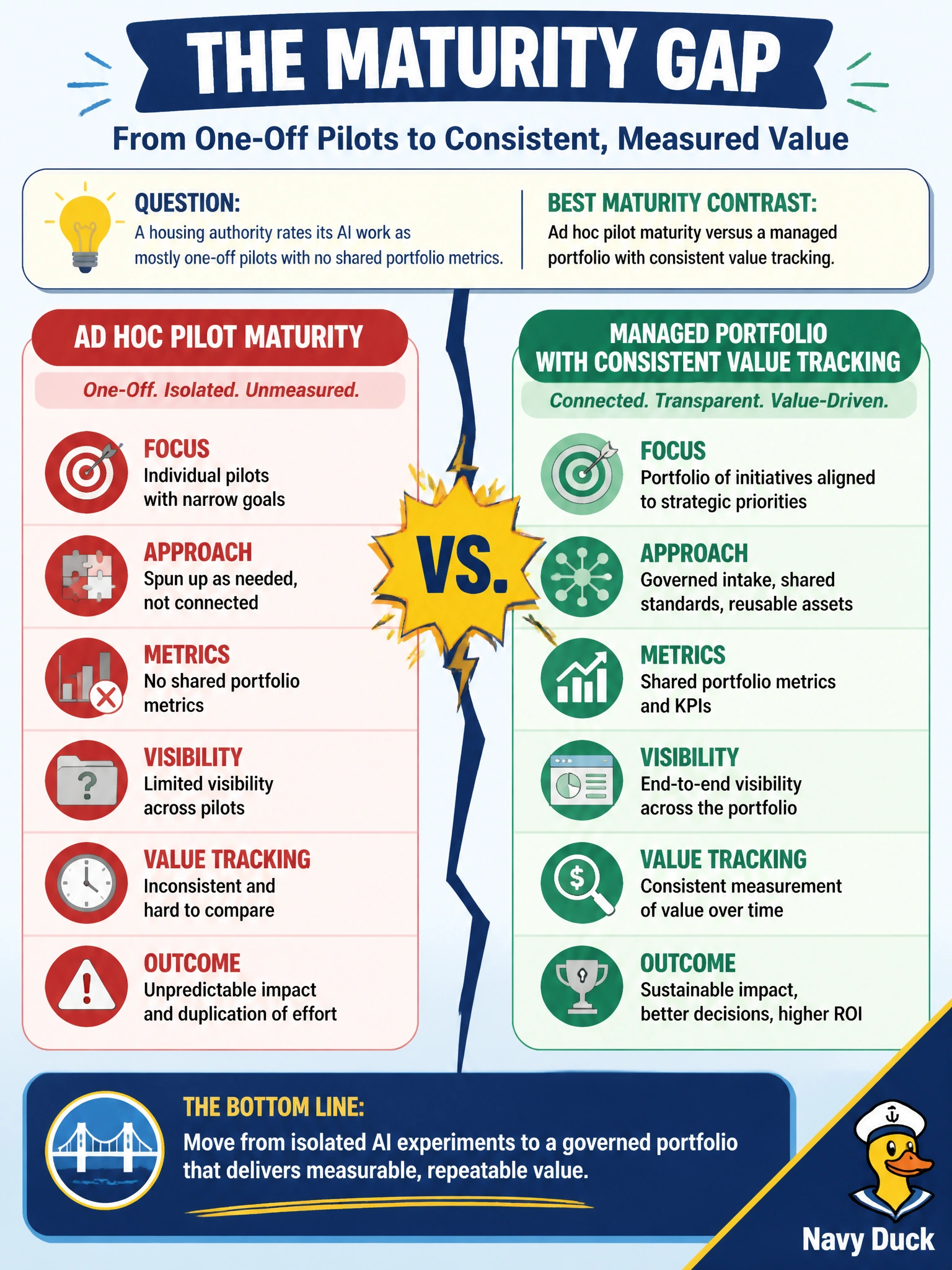
A housing authority rates its AI work as mostly one-off pilots with no shared portfolio metrics. Which maturity contrast best describes the gap?
Select an answer to reveal the explanation.
Short Explanation
One-off pilots are like garage experiments with no shared toolbox. A managed portfolio looks more like a fleet board—same measures, owners, and value tracking—so maturity climbs when chaos becomes a program.
Full Explanation
When a housing authority’s AI work is mostly one-off pilots without shared portfolio metrics, the maturity contrast is ad hoc experimentation versus a managed portfolio with consistent value tracking. Maturity rubrics in civic AI programs typically progress from isolated trials to coordinated intake, common KPIs, named owners, and benefits realization. The correct answer works because it names that gap precisely: pilots may prove technical feasibility, but without portfolio metrics the authority cannot compare outcomes, retire dead ends, or defend continued investment to boards and residents.
Claiming optimized value tracking is already fully implemented fails because the stem describes the opposite condition—fragmented pilots without shared measures—so that option invents a higher maturity state that is not present. Asserting that zero pilots exist fails because the problem is not absence of activity; it is unmanaged activity that never graduates into a governed program. Measuring maturity only by unused software licenses fails conceptually because license inventory is a cost artifact, not evidence of delivery capability, governance, or resident value.
Exam caveat: moving from ad hoc to managed maturity still requires domain-specific safeguards in housing (fair housing, privacy of case data, human decision authority); portfolio metrics do not erase those duties. Operational check: establish a simple portfolio board with intake criteria, shared outcome metrics (cycle time, backlog, equity indicators), and sunset rules for pilots that never produce measurable civic value.