
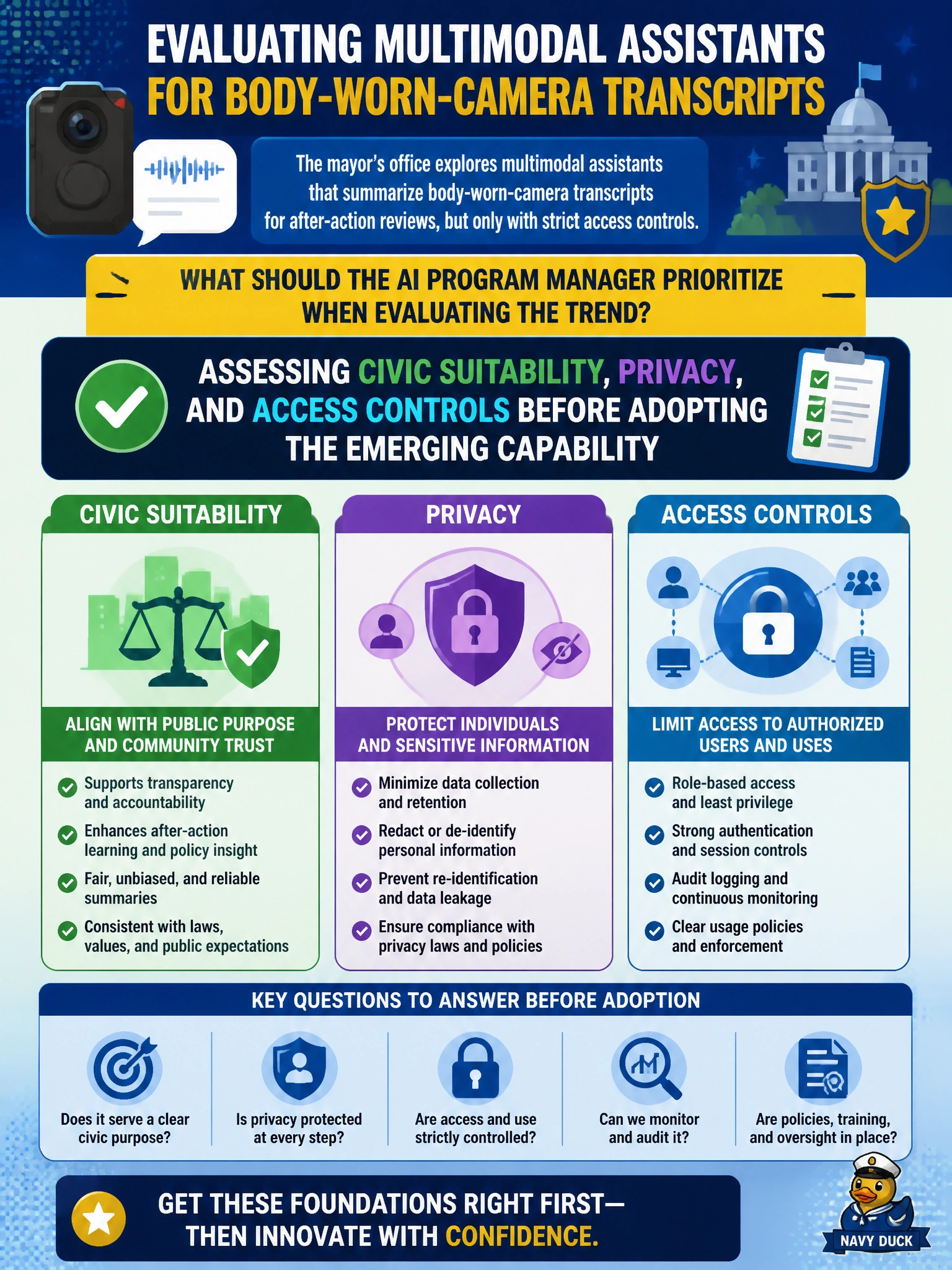
The mayor’s office explores multimodal assistants that summarize body-worn-camera transcripts for after-action reviews, but only with strict access controls. What should the AI program manager prioritize when evaluating the trend?
Select an answer to reveal the explanation.
Short Explanation
New multimodal toys can summarize messy audio, but body-cam material is not a podcast for the whole city. Suitability means asking who may see it, how it is logged, and whether the juice is worth the privacy squeeze.
Full Explanation
Multimodal assistants that summarize body-worn-camera transcripts for after-action reviews can be powerful, but the AI program manager must prioritize assessing civic suitability, privacy, and access controls before adopting the emerging capability. Public-safety recordings intersect criminal procedure, personnel rules, retention schedules, and public-records law. Trend scanning is responsible when paired with assurance—not when skipped for novelty. Immediate citywide open publishing of all raw camera audio without review ignores privacy, victim rights, and investigative integrity. Rejecting all emerging AI because multimodal models cannot summarize text is factually wrong and needlessly anti-innovation; many multimodal stacks handle speech-to-text and summarization. Assuming marketing demos prove readiness without security or records review substitutes theater for due diligence. Exam caveat: emerging capability ≠ deployable civic fitness; privacy and access gate first. Operational check: classify data sensitivity, define role-based access and audit logging, involve legal/records early, redact or segment per policy, and pilot with narrow after-action cohorts before any broader rollout of multimodal review tools.