
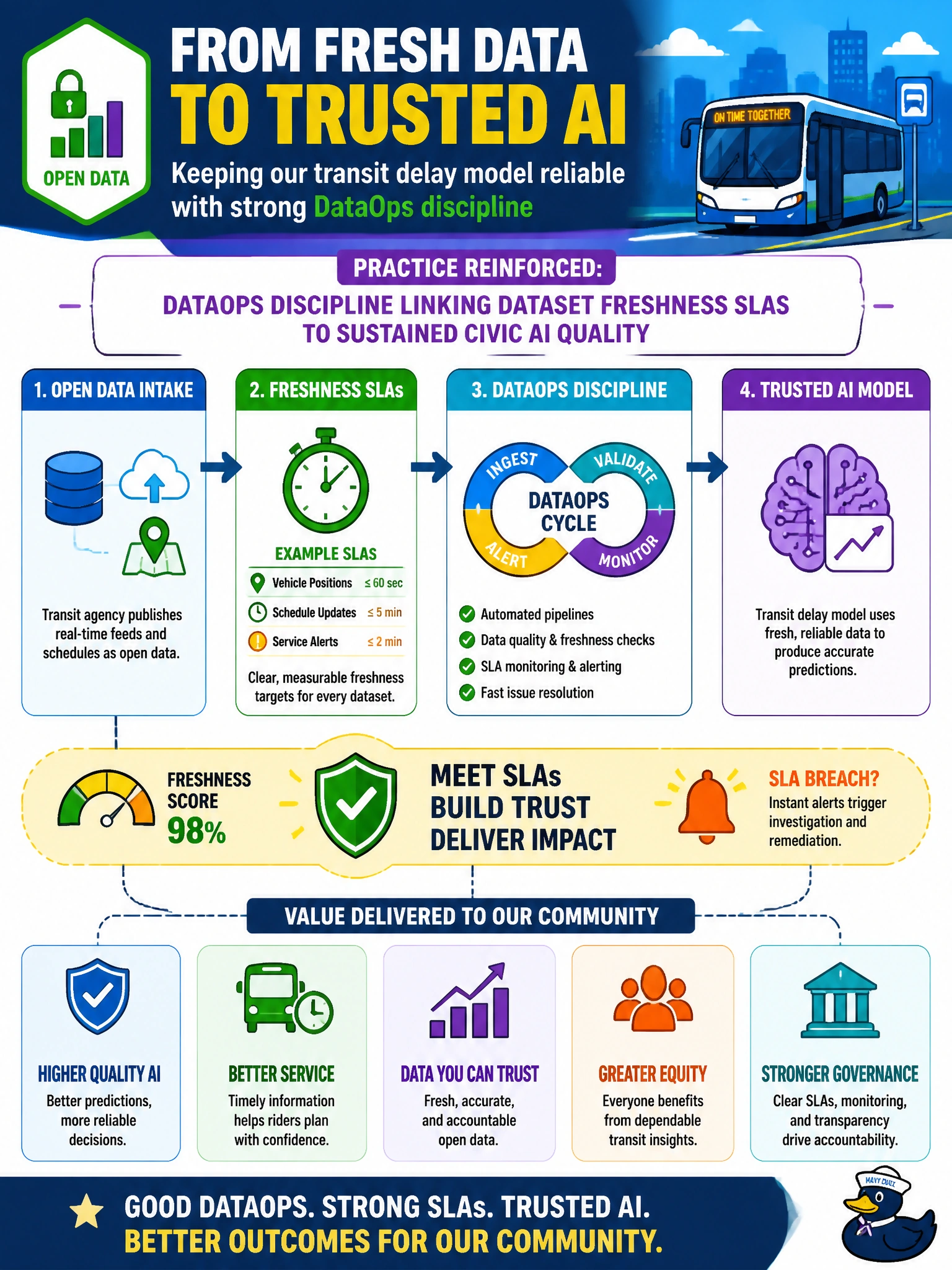
An open-data team sets freshness SLAs so a transit delay model stays trustworthy. Which practice is the program manager reinforcing?
Select an answer to reveal the explanation.
Short Explanation
A delay model on yesterday’s bus pings is like traffic radio stuck on last week’s jam. DataOps is the promise that feeds stay fresh on a clock—so the AI’s advice still matches the street.
Full Explanation
Transit delay prediction quality tracks the freshness and completeness of AVL, GTFS, and related operational feeds. DataOps discipline links dataset freshness SLAs to sustained civic AI quality: measurable agreements on latency, completeness, schema stability, and repair times so the model’s advice still matches conditions on the street. Ignoring feed health while celebrating static model weights is a common municipal failure pattern that strands predictive products. Ignoring feed latency because model weights never change misunderstands serving-time dependence on live features; unchanged weights on stale pings still yield wrong delay estimates. Replacing all GTFS feeds with handwritten whiteboard schedules abandons scalable, machine-readable transit data and breaks automation. Treating DataOps as optional once generative marketing copy is approved confuses communications assets with operational data contracts that predictive services require. Exam caveat: static weights do not imply healthy online features; DataOps remains mandatory for predictive civic products. Operational check: publish freshness SLAs with named feed owners, page on heartbeat and schema failures, degrade or suppress rider-facing delay claims when data is stale, dual-track model accuracy with DataOps metrics in transit AI steering meetings, and test failover messaging so riders are not confidently misled during outages.