
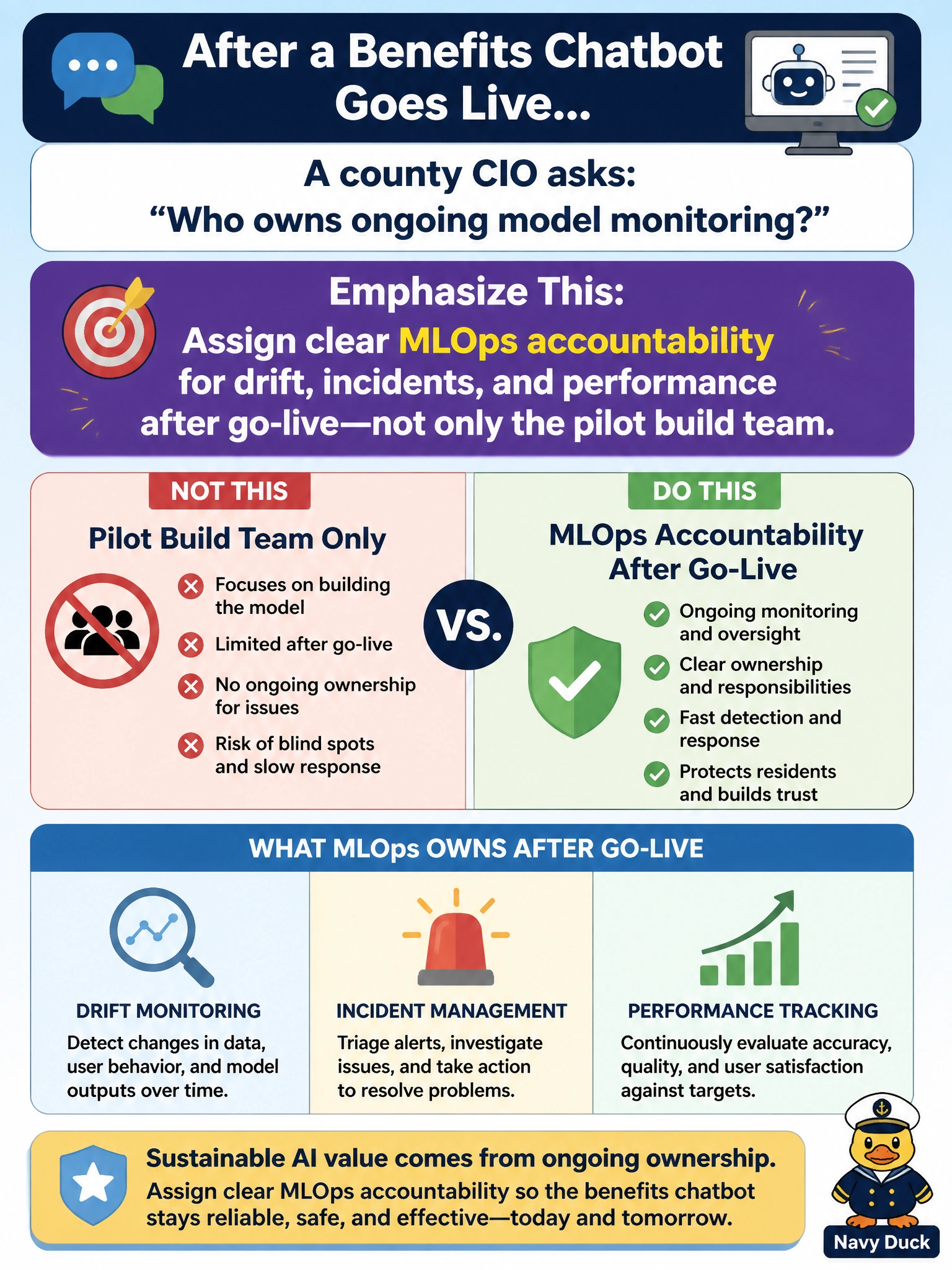
After a benefits chatbot goes live, a county CIO asks who owns ongoing model monitoring. What should the AI program manager emphasize?
Select an answer to reveal the explanation.
Short Explanation
Launch day is not the finish line—someone has to watch the chatbot the way facilities watches elevators after ribbon-cutting. That ongoing model babysitting is MLOps ownership, and it needs a name on the org chart.
Full Explanation
After a resident-facing chatbot goes live, the city needs clear MLOps accountability for drift, incidents, and answer performance—not only the pilot build team’s temporary ownership. Production language models and retrieval stacks degrade when knowledge bases change, prompts are tweaked ad hoc, abuse patterns emerge, or upstream APIs shift. Assigning ongoing owners on the org chart is a fundamentals-of-adoption practice for municipal AI and protects residents from silent quality collapse after ribbon-cutting. Declaring monitoring unnecessary once the chatbot passes a single UAT script ignores distribution shift and real-world resident traffic that scripts never covered. Giving ownership solely to the print shop that produced launch posters confuses communications production with model operations. Using resident-submitted wrong answers as the sole signal, reviewed only occasionally, is an unacceptable feedback loop for service quality, equity, and risk management. Exam caveat: go-live is not the end of AI accountability; MLOps is continuous ownership after launch. Operational check: publish severity-based incident playbooks, track grounded-answer rates and escalation volume, monitor knowledge-base freshness against source systems, schedule model and prompt reviews, separate production on-call from the original pilot squad’s project closeout, and retain a rollback path to scripted FAQs when the chatbot breaches quality thresholds.