
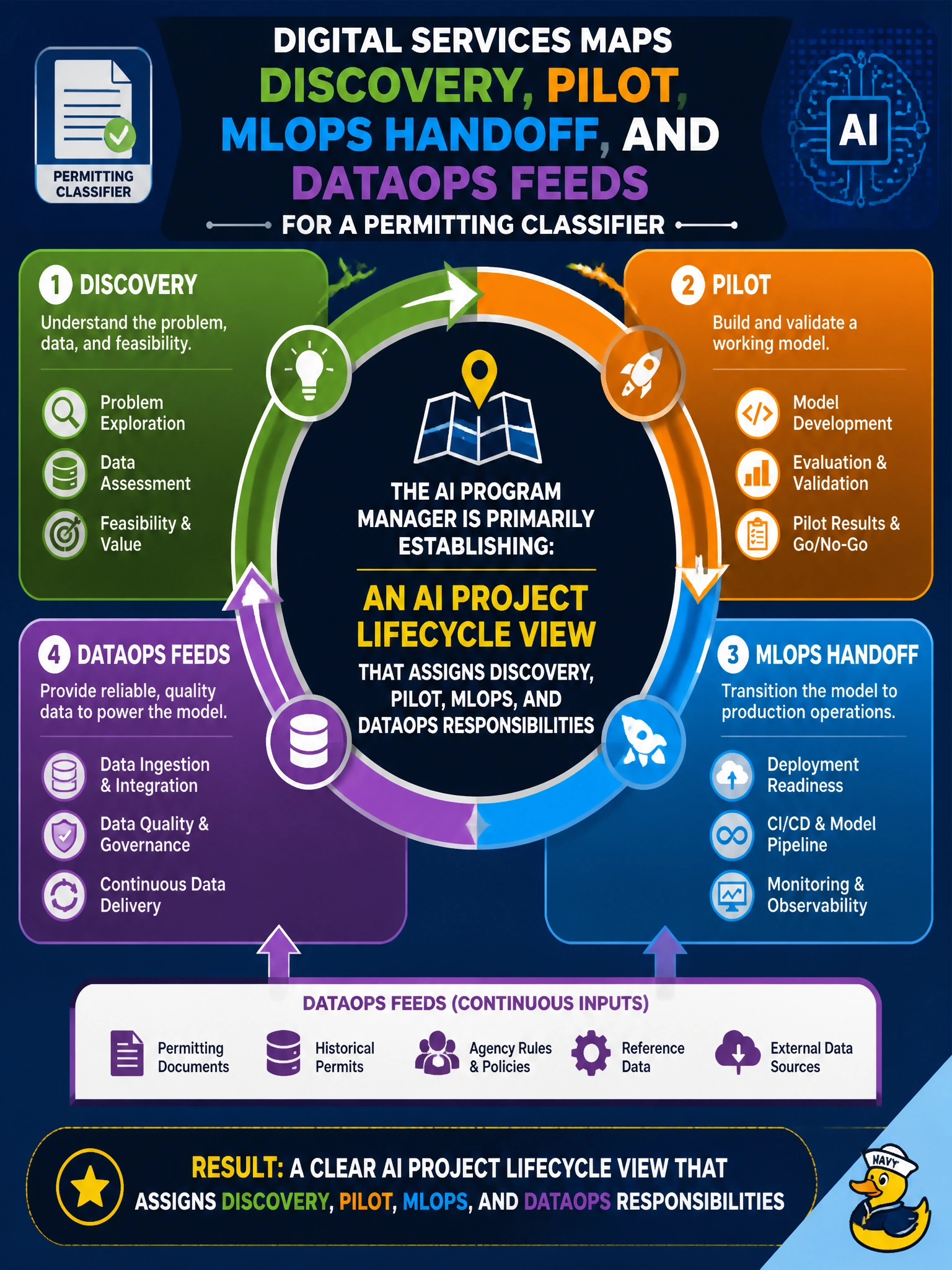
Digital services maps discovery, pilot, MLOps handoff, and DataOps feeds for a permitting classifier. What is the AI program manager primarily establishing?
Select an answer to reveal the explanation.
Short Explanation
Shipping a permitting classifier is a relay race: discover, pilot, then hand the baton to folks who monitor models and keep data fresh. Naming those legs—lifecycle, MLOps, DataOps—keeps the baton from hitting the floor.
Full Explanation
Delivering a permitting classifier that survives beyond a demo requires an AI project lifecycle view that assigns discovery, pilot, MLOps, and DataOps responsibilities. Discovery frames the civic problem, data, and success metrics; the pilot proves value and surfaces risks with limited blast radius; MLOps owns production model health, drift, and incidents; DataOps keeps features, labels, and pipelines fresh. Explicit stage ownership prevents orphaned models after the innovation spotlight moves on and keeps permitting decisions supportable under audit. A one-day council resolution that supposedly replaces all lifecycle stages confuses authorization theater with an operating model—votes do not monitor drift or repair feeds. A vendor logo wall with no operating model signals procurement theater without named run accountability. A public art program unrelated to model delivery may enrich civic culture but does not assign AI delivery, monitoring, or data-steward roles for the classifier. Exam caveat: lifecycle and operating roles beat ceremony, branding walls, or unrelated programs when the stem asks how work is organized. Operational check: name accountable owners for discovery artifacts, pilot exit criteria, production MLOps (performance, drift, incidents), and DataOps SLAs; gate go-live on runbooks and on-call coverage; and revisit permitting-model metrics in regular municipal AI governance reviews so the classifier remains a managed service, not a stranded experiment.