
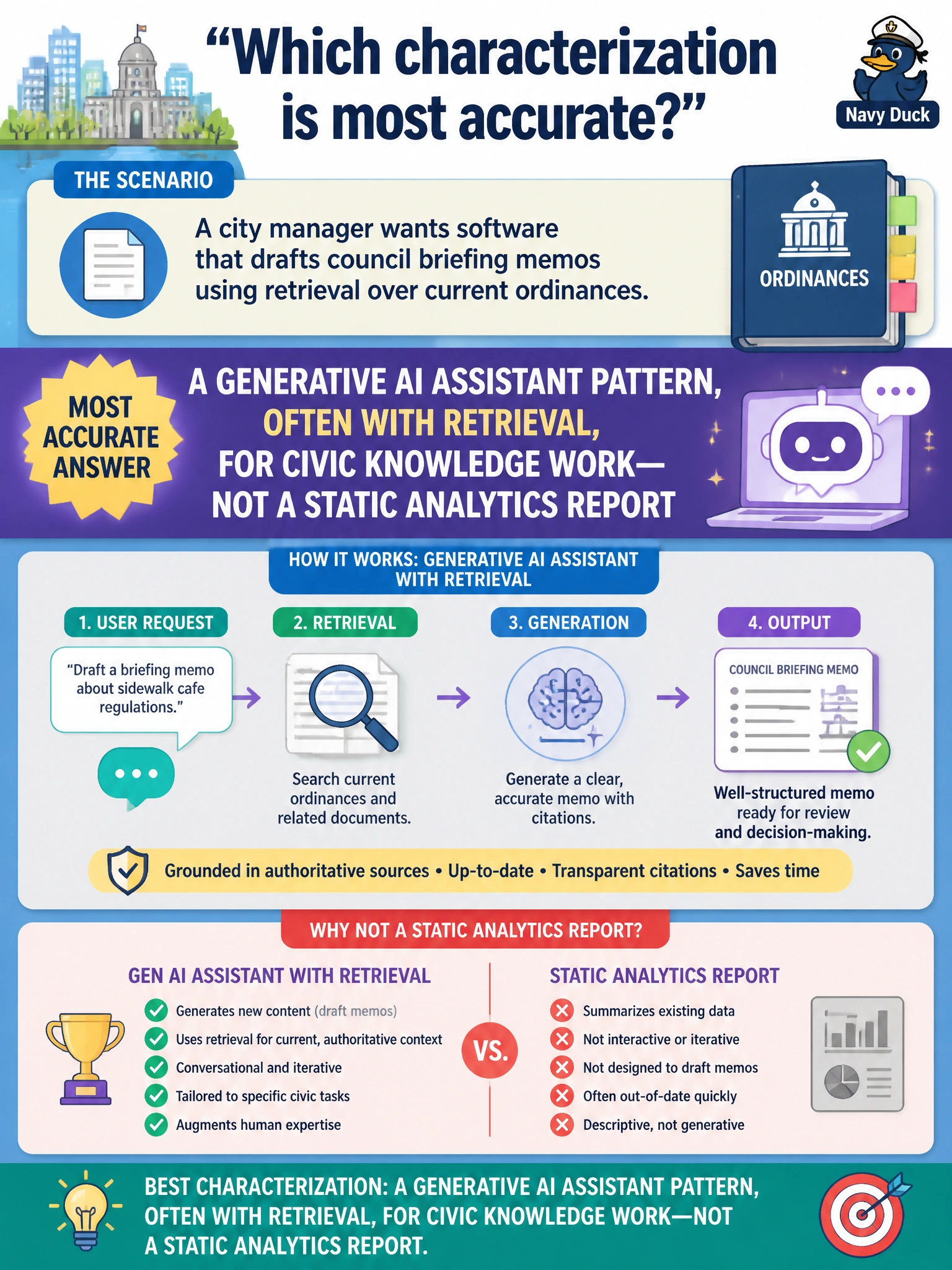
A city manager wants software that drafts council briefing memos using retrieval over current ordinances. Which characterization is most accurate?
Select an answer to reveal the explanation.
Short Explanation
Pull today’s ordinance text, then draft the memo—that is a generative assistant with a library card into City Hall’s binder. It is not a cluster map or a thermostat alarm. Retrieval keeps the draft honest to current code.
Full Explanation
Drafting a council memo from today’s ordinance text via retrieval plus composition is a generative AI assistant pattern for civic knowledge work. Retrieval grounds the draft in current municipal code; generation produces memo structure and prose for human edit. That combination supports legislative staff without treating the output as a static analytics report or as an unsupervised clustering artifact. Program managers should emphasize citations to retrieved ordinance sections, version pins on the corpus, and attorney or clerk review before anything enters the official record. A pure unsupervised clustering job with no text generation may group similar ordinances or topics for discovery, but it does not draft the memo the stem requires. A SCADA threshold monitor for council chamber temperature is facilities automation and has no bearing on legislative drafting quality or legal fidelity. An assessor spreadsheet macro that only totals millage rates is deterministic calculation—useful for finance, irrelevant to generative knowledge assistance grounded in ordinance text. Exam caveat: look for draft-plus-source patterns; retrieval-augmented generation is not clustering, SCADA, or macros. Operational check: restrict corpora to authoritative ordinance repositories, display source excerpts beside drafts, block or escalate when retrieval returns nothing on-point, retain human ownership of the official memo, and log which code versions informed each draft so audits can reconstruct how civic advice was produced.